“It was my first real time in Poland. I was immensely impressed by what the Polish people have done” – Our interview with Lord Randall of Uxbridge, who recently visited Poland to analyse the refugee situation and combat potential human trafficking.
George Byczynski, British Poles: John, you’ve recently returned from Poland. Please, tell me what the reason for your travel to Warsaw was. What were your goals?
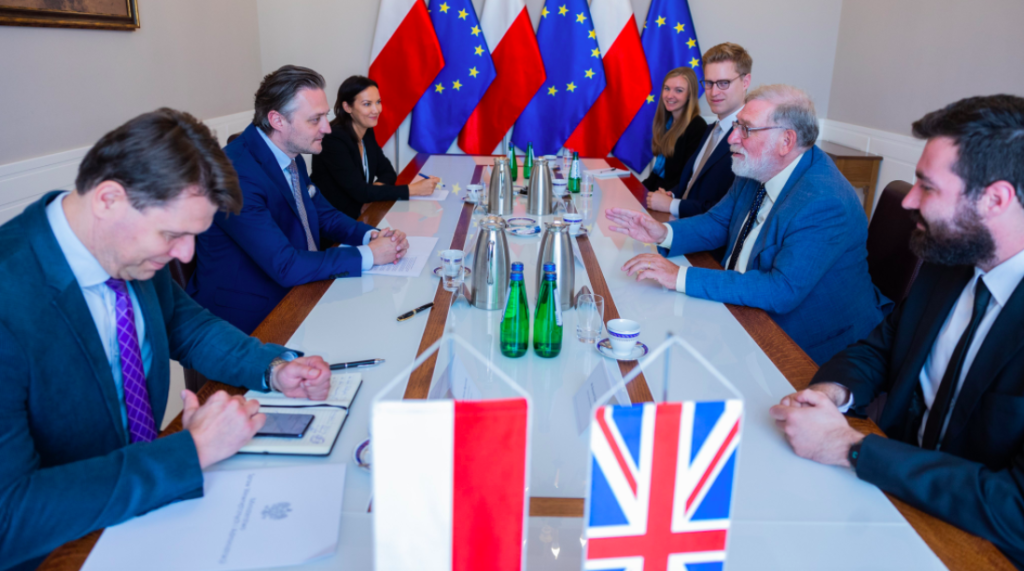
John Randall: We had two principal reasons for wanting to go with the Human Trafficking Foundation. One was to try to revive and find Members of Parliament interested in human trafficking and modern slavery. We would like to cooperate between parliaments and parliamentarians in European countries. And the other thing was, at the moment, with the invasion of Ukraine by Russia, we know how much Poland has been having a huge influx of refugees. We wanted to understand how they dealt with it, particularly how they were trying to stop any potential trafficking of vulnerable people. So those were the two main aims that we had. And I have to say, on both counts, I was pleasantly surprised that we were pretty successful.
GB: Over 4 million Ukrainian refugees went through Poland since the beginning of the conflict, and millions have stayed. Do you think Poland is managing to deal with all the issues related to accepting such a huge number of people but also to counter any potential issues of human trafficking?
JR: I was immensely impressed by what the Polish government, and really the Polish people, have done. They’ve taken these Ukrainian refugees literally to their hearts and their homes. They’ve done as much as you can to avoid trafficking. Actually, the first stages are okay. It’s gone really well. The danger will be that after some months, people might move to other countries. I really was impressed. We went to a reception centre, which is one of the most efficient things I’ve ever seen. I have to say it was extremely sad, but considering everything, I don’t think any government could have done more, to be honest.
https://twitter.com/arekmularczyk/status/1544749517924454400?s=20&t=RK-g3mnhzo9-35suCxuIog
GB: What did you see at that reception centre?
JR: People were coming in from the border, and they were being given social security numbers. They were also able to get some cash. There was food and, importantly, medical resources on site. For the very vulnerable, there was an ambulance on standby. Something that moved me was the people with their pets. Some people are being uprooted from their family homes, and they may well have been destroyed by the Russian bombings by now. They’ve fled with very few possessions, but these pets are part of the family. It was so nice to see how well they were being treated. It brought a tear to my eye.
https://twitter.com/uxbridgewalrus/status/1545448829272657920?s=20&t=cKprEZZid6f0d3oJTgwaPA
GB: Was that your first time in Poland? What was your general experience?
JR: It was my first real time in Poland. I’d been transiting through years ago. I thought it was a really interesting place. I know we went on business as it were, but it’s given me a great desire to come back and visit properly, not just Warsaw, but other areas. I couldn’t have been made more welcome by not only the wonderful people we met who took us around but also generally Polish people we met out in the streets or in the restaurants.
https://twitter.com/uxbridgewalrus/status/1545283036446687232?s=21&t=z1AhEnYn7OA8Gu4U6JvGsg
GB: The UK is the leader in supporting Ukraine and Poland during these turbulent and difficult times because of the Russian invasion. Do you think there is anything more that the UK government or the British population could do to help Poland, that’s at the front, but also Ukraine, that’s currently suffering?
JR: Governments can always do more. I was pleased to see that the Minister for Refugees, Lord Harrington, an old friend of mine from the House of Commons, had been to the reception centre previously. He would’ve seen it first-hand and probably got an idea of what needs to be done. As I said, I think the Polish government is doing a fantastic job. They probably will need more assistance depending on how long the conflict lasts. We’ve got a very good relationship between the Polish and UK governments, so both of them should be talking. It’s a little bit above my pay grade, but I’m sure there are many things that could be, should be, and probably will be done. Many Polish people in the UK, whether they’ve been here recently or been here for generations, are also, I’m sure, expressing that same hospitality that we saw in Poland.
GB: Excellent. Thank you for the interview.
JR: Thank you as well.
Interviewed by George Byczynski
Cover photo: Twitter @PolandMOI