In the mid 19th century, the European continent was relatively quiet as regards to international conflicts. Russia had been weakened by its Crimean war and had introduced a more liberal attitude in its internal politics. This encouraged Poland’s patriotic movements to organise strikes against their Russian occupiers from the spring of 1863.
The uprising was far from being an improvised move. It had been planned for many years already, among others by its leaders Stefan Bobrowski, Romuald Traugutt, Marian Langiewicz and Ludwik Mierosławski. However, the announcement of conscriptions of young Poles to the Imperial Russian army triggered the resistance and the clashes soon began.
The rebellion by young Polish conscripts was soon joined by high-ranking Polish-Lithuanian officers and members of the political class. The insurrectionists were quickly outnumbered and lacked sufficient foreign support in order to overthrow the rule of Tsar Alexander II.
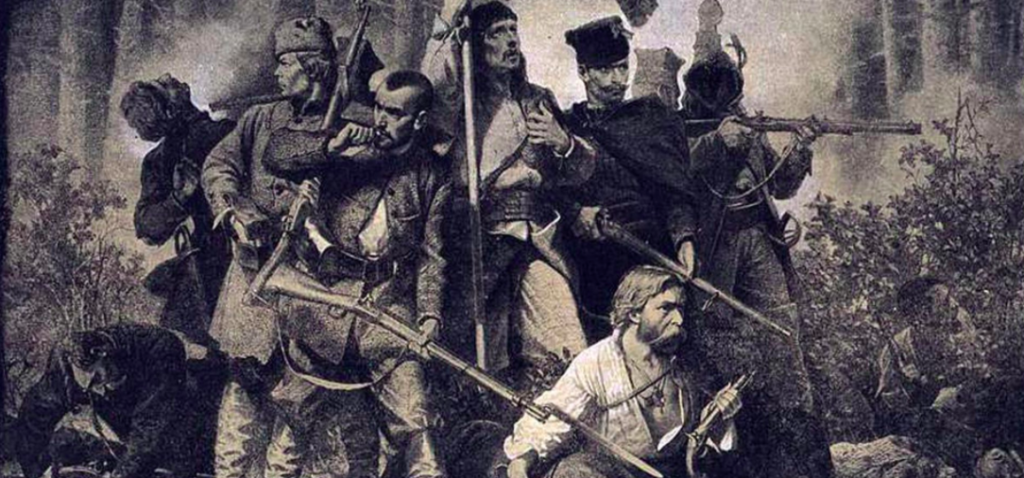
The aim of the January Uprising was the restoration of the Polish–Lithuanian Commonwealth. It began on the 22nd of January 1863 and continued until the last insurgents were captured by Russian authorities in 1864.
Reprisals from the authorities were brutal. The numerous public executions and deportations to Siberia eventually persuaded many Poles to give up the hopeless fight.
The January Uprising remains an important symbol up until this day in Polish memory. It symbolises the will of tens of thousands of Poles who simply refused to let their nation be destroyed.
In 1863-1864, many insurgents either remembered or at least had heard a lot about the first big attempt of 1830-1831. In turn, freedom Polish fighters in both world wars of the 20th century got inspiration from their ancestors for having had the courage to stand against tyranny.
Patriots of the January Uprising did not fear death and showed their readiness to die for the freedom of their nation. They had the choice between complying or standing tall and fight for independence. They chose the latter, and this is why they deserve to be remembered as heroes.
Author: Sebastien Meuwissen
Cover photo: Instytut Pamięci Narodowej