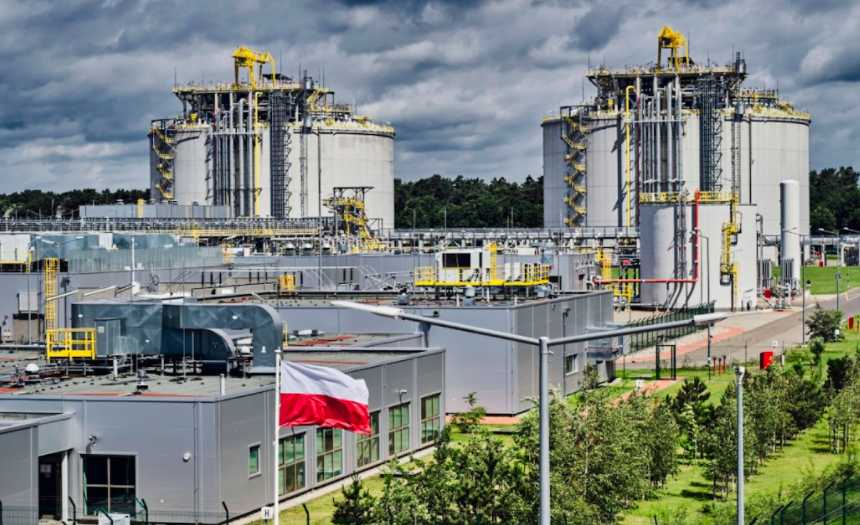
With its 95% of gas storage facilities full, Poland is far above the EU average (roughly 46%) in this regard. All the 27 EU member states, as well as the UK, Ukraine, and Serbia, show stocks in storage rising by around 0.5 billion cubic meters per day, which represents half the capacity of the daily intake possible in the EU.
There is currently 12% of the yearly EU consumption of gas for 2020 which is in storage across the UE. In Poland, this figure amounts to 14%, while only 11.5% in Germany.
Other than Poland, the 60% storage threshold is met only by Spain, Portugal, and the Czech Republic, in which actual reserves account for close to a quarter of yearly gas consumption.
In the meantime, France is in possession of reserves of over 50%, which represents 14% of its domestic annual consumption.
Being aware of the risk of energetic blackmail from the Russian Federation, Warsaw has been exploring several ways to diversify its sources of energy and by doing so diminish its dependence vis-à-vis its aggressive neighbour.
Due to the unfavourable gas contract involving Poland and Russia’s Gazprom signed by Donald Tusk’s government in 2010, Poland had until now no other choice than to import a fixed quantity of Russian gas regardless of its real needs and had to pay more for it than most other European countries.
By diversifying its supplies before the expiry of the Russian contract in 2022, Warsaw has put itself in a better position in the midst of (potential) future purchasing conditions.
Image: gaz-system.pl
Author: Sébastien Meuwissen