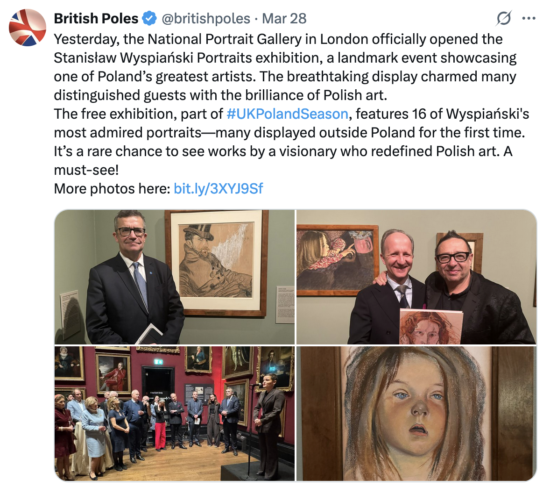
On 27 March, the National Portrait Gallery in London celebrated the opening of the largest Polish art exhibition ever held in a British museum, called Portraits of Stanisław Wyspiański. It includes as many as 16 of the artist’s most outstanding portraits, most of which have never been displayed outside Poland.

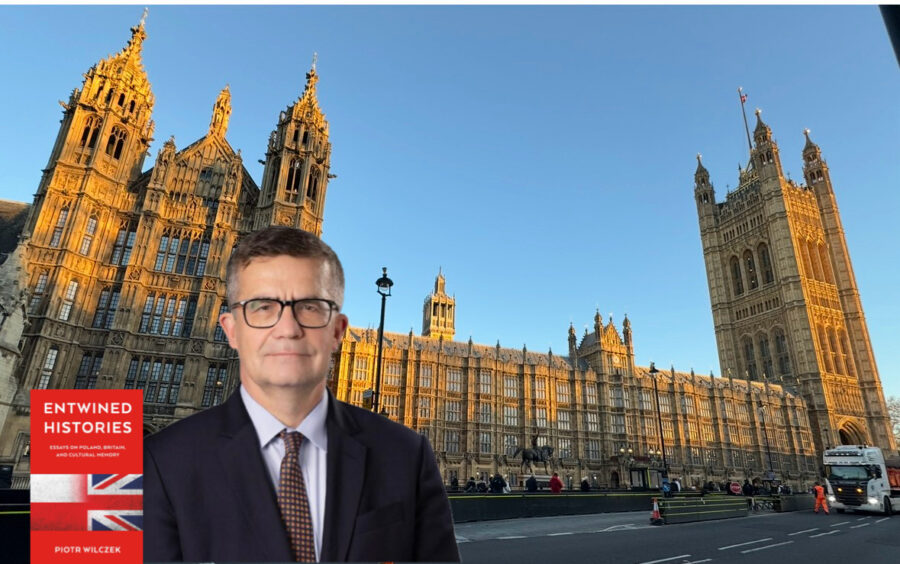
Guests were welcomed by the Director of the National Portrait Gallery Victoria Siddall, the Polish Ambassador Professor Piotr Wilczek, the Deputy Minister of Culture Marta Cienkowska, the Director of the British Council Scott McDonald, the curator of the exhibition Dr Alison Smith and the Head of the National Museum in Kraków (from which most of the exhibited artworks come) Professor Andrzej Szczerski (our interview in Polish with the Professor).

„We are so proud to report this wonderful group of portraits by Wyspiański. Drawn rapidly in bold lines in pastel. The charismatics works in this display and his mastery of compositional balance and colour. I am seeing it for the first time and it really is extraordinary,” – said Victoria Siddall, the Director of the National Portrait Gallery, marvelling at the artist’s works.

“The exhibition is the result of 4 years of close cooperation between institutions in both of our countries. I would like to express my warmest thanks to the National Museums in Kraków and Poznań, the Ministry of Culture and National Heritage, the Polish Cultural Institute in London, the National Portrait Gallery and the private collectors who have generously granted us works from their collections. Thanks to all of them, we can share the legacy of one of the most famous Polish artists with the British public (…) This is not the first exhibition of his works in the UK in recent years. The William Morris Gallery presented some of Wyspiański’s works as part of the Young Poland exhibition in 2021. Such events also help us to build understanding and meaningful relationships in the present. This exhibition is also a tribute to the Polish community in the UK and its vibrant contribution to the cultural life of the country,” said the Polish Ambassador to the UK, Piotr Wilczek.

“As part of the common cultural season, events are held in many British cities to bring the richness of Polish culture to a wider audience. At the same time, Polish institutions have the opportunity to present the most interesting phenomena of British culture to a Polish audience. Today, we are opening an exhibition of portraits by Stanisław Wyspiański. His creative path fits perfectly with the theme of the Polish-British season. Wyspiański was an extremely versatile artist – a drama writer, painter, and designer. Each of these spheres is represented in the programme of our joint events. I would like to express my deepest gratitude to all those who contributed to the creation of this impressive exhibition. It took an enormous amount of effort, but the result is stunning,” said the Polish deputy Minister of Culture Marta Cienkowska.

The next speaker at the exhibition opening was Scott McDonald, director of the British Council, who emphasised the importance of cultural exchange between Poland and the UK, noting that such cooperation fosters mutual understanding and respect between the two nations. McDonald referred to the historical context of the British Council, which was founded in 1934 to build lasting relationships through culture rather than short-term political cycles. McDonald emphasised the role of the arts in overcoming cultural differences and promoting dialogue, stating that through exhibitions such as this, audiences can appreciate not only individual works of art but also the shared values and experiences that connect people across borders.
“We have been operating in Poland for 87 years, and the bonds between our nations are defined by mutual respect, cooperation and friendship. Our mission in Poland remains focused on building bonds, understanding and trust between the people of the UK and Poland,” McDonald said.

The curator of the exhibition, Dr Alison Smith, explained that it has been divided into three sections.
“In the first section, we will see intellectuals, artists and writers with whom Wyspiański was associated in Kraków. I would like to mention one portrait of Dagna Juel Przybyszewska in particular, as it provides an important link to our exhibition Portraits by Edvard Munch. The central section contains portraits of actors who appeared in plays written and directed by the artist. There is an amazing group of portraits, including the magnificent Irena Solska with flaming hair. The final section is dedicated to Wyspiański’s family. Here, we see some of the great icons of Polish art. The whole exhibition is rounded off with two self-portraits. One of them you will see upon the entrance. It shows a young Wyspiański who is just beginning his career as an artist. And the last is a shocking self-portrait that shows his face disfigured by the effects of the syphilis that was to kill him just a few weeks later,” Dr Alison Smith explained.

“We have organised this exhibition because we have received a unique offer from the National Portrait Gallery – the opportunity to present Stanisław Wyspiański here in London. It is not only an opportunity to celebrate his work on this extraordinary evening but also a chance to look at him in a new context. In Poland, we see Wyspiański as the quintessential national artist, but this exhibition allows us to rediscover him – to see his works through the eyes of an international audience and to set them in the wider context of European art. His work, full of emotion and universal references, appeals not only to Poles but also to the British and all visitors to this prestigious gallery. I think we have managed to serve justice to Wyspiański by showing both his Polish identity and the timeless, universal dimension of his art. The artist himself believed that he could only match the greatest artists of his era in Europe – and this exhibition confirms that,” said the head of the National Museum in Kraków, Prof Andrzej Szczerski.

Among the guests invited to the opening of the exhibition were the Polish Ambassador to the UK, Professor Piotr Wilczek, the Consul General Renata Kowalska and Consul Anna Tarnowska-Waszak. Among the guests were also Waldemar Januszczak, the director of the National Gallery Gabriele Finaldi (who is also of Polish origin), Justin Maciejewski, the director of the National Army Museum, an Oscar winning movie director Piotr Fudakowski, Lady Halina Munster, Lady Lucy French, the wonderful team of the Polish Cultural Institute headed by director Magdalena Grabianowska and many, many friends and art lovers.

Quoting Professor Andrzej Szczerski, we agree that Stanisław Wyspiański’s exhibition at the National Portrait Gallery is a true “museum Oscar” – a triumph of art and spirit. We hope that the British will fall in love with the works of our brilliant artist and that his portraits, imbued with universal power, will appeal to the hearts of the public here.

This is a unique opportunity for Polish art to shine in Britain, to be appreciated and to find its place among the esteemed works of world culture that it deserves.

The exhibition is the result of collaboration between the National Museum in Kraków, the British Council, the National Portrait Gallery and the Polish Cultural Institute in London. The exhibition was funded by the Ministry of Culture and National Heritage from the “Inspiring Culture” programme and is presented as part of the Poland-UK 2025 Cultural Season.
Maria Byczynski. The author is an art historian
Photos: British Poles, Ministry of Culture and National Heritage, Patrick Baldwin
Editor’s note: The exhibition features an English-language publication, „Stanisław Wyspiański Portraits”, edited by Alison Smith and Julia Griffin, available here.
Stanisław Wyspiański’s portraits can be admired until 13 July 2025, from 10:30 AM to 6:00 PM at the National Portrait Gallery, Room 14, 3rd Floor, St. Martin’s Pl, London WC2H 0HE. Free entry.