During a ceremony near the Chancellery and the Bundestag in Berlin, a memorial site dedicated to Poland’s wartime suffering between 1939 and 1945 was officially unveiled. The temporary monument commemorates the millions of citizens of the Second Polish Republic who perished as victims of Nazi Germany’s invasion and brutal occupation during the Second World War. For some commentators, the fact that unveiling a “symbolic rock” took German authorities more than 80 years symbolises the fiasco of real reconciliation between the nations.
Located on the symbolic grounds of the former Kroll Opera House—where Adolf Hitler declared war on Poland on 1 September 1939—the site now features a 30-ton glacial boulder bearing a bilingual plaque. Inscribed in both Polish and German, it reads: „To the Polish victims of Nazism and of German occupation and terror in Poland, 1939–1945.”
This provisional memorial is set to encourage establishing a permanent site of remembrance for Polish victims of the 2 World War in the Federal Republic of Germany. Plans are underway to create the German-Polish House, which will combine a commemorative monument with an educational and cultural centre designed to foster dialogue and mutual understanding.
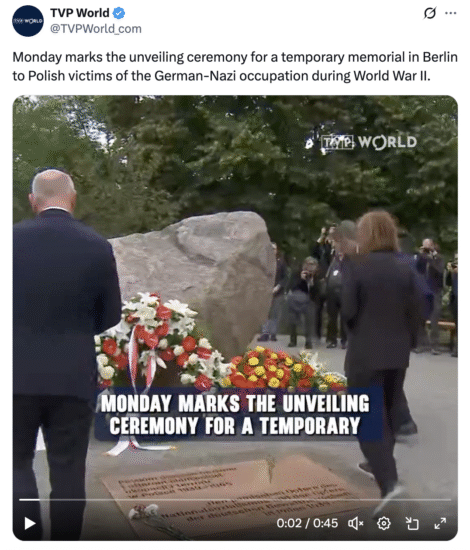
“This is a day we have long awaited,” said Heiko Maas, former German Foreign Minister and current head of the German-Polish Institute, as he welcomed guests to the unveiling. Maas expressed hope that a permanent monument and meeting place for Germans and Poles would soon stand on the site.
He emphasised that the project grew out of a 2017 civic initiative and highlighted the contributions of German advocates, including former Bundestag presidents Rita Süssmuth and Wolfgang Thierse, who were present at the ceremony.
Maas also acknowledged a lingering gap in German public consciousness regarding Poland’s wartime suffering. “We Germans are still not fully aware of the misery, the pain, and the devastation that our country inflicted on Poland during the Second World War,” he stated. “This place should be a signal to everyone in Poland that Poland matters to us.”
Wolfram Weimer, Minister of State and the German government’s Commissioner for Culture and the Media, described the newly unveiled memorial stone as a powerful symbol of the historical burden. “Never again must hatred, violence, and injustice be allowed to triumph,” he declared.
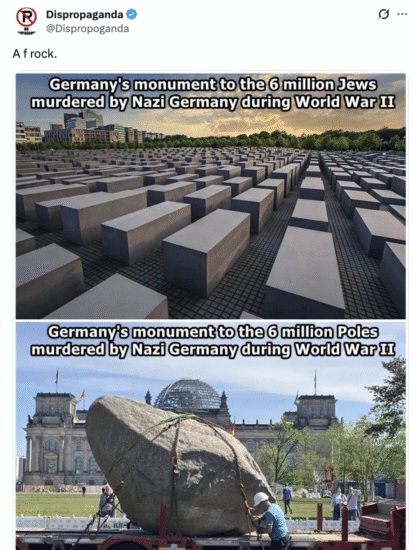
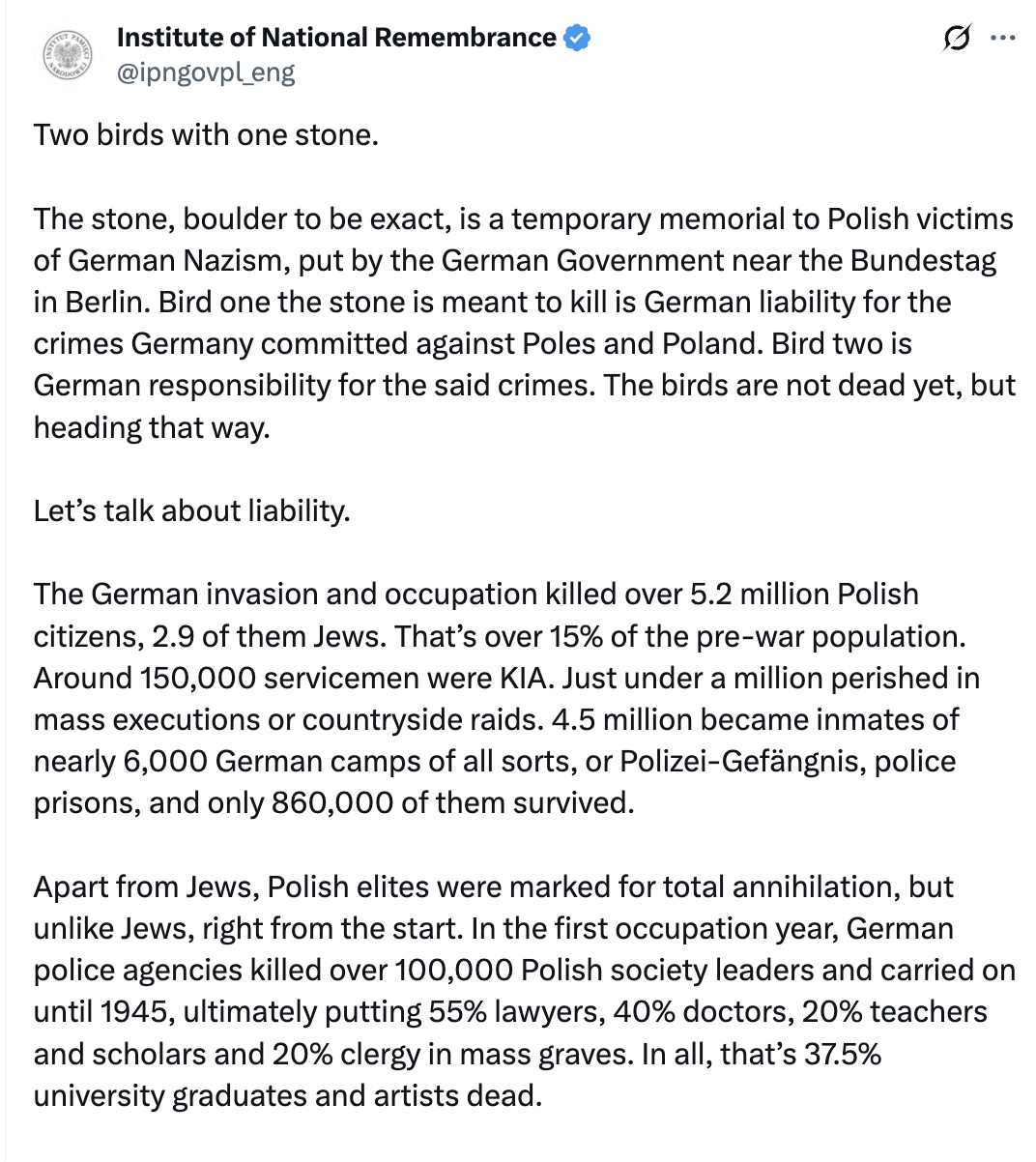
The commemoration was criticised by the Polish Institute of National Remembrance, which described it as “two birds with one stone.”
“The stone, boulder to be exact, is a temporary memorial to Polish victims of German Nazism, put by the German Government near the Bundestag in Berlin. Bird one the stone is meant to kill is German liability for the crimes Germany committed against Poles and Poland. Bird two is German responsibility for the said crimes. The birds are not dead yet, but heading that way,” the IPN wrote in an X post.
The unveiling of a temporary memorial to Polish victims of the Second World War has drawn sharp criticism from the Polish opposition.
“Germany wants to settle the matter of its crimes with a STONE rolled in front of the Reichstag,” PiS MP Paweł Jabłoński wrote on the platform X on Monday, calling the gesture a disgraceful attempt to evade true responsibility.
“It is in Poland’s national interest to completely reject this shameful effort—no Polish politician should have attended today’s so-called ceremony,” the Polish parliamentarian added.
Earlier in May, PiS MEP Arkadiusz Mularczyk told the Polish Press Agency (PAP) that the stone was a “symbol of the failure of German policy” in addressing historical memory. In his view, the memorial comes “far too late” and falls short of what is needed to meaningfully honour Polish victims.
Source: PAP
Photo: X @SzSz_velSek
Tomasz Modrzejewski