On 14 May 1983, 18-year-old Grzegorz Przemyk died in a Warsaw hospital from severe internal injuries, just three days before his 19th birthday. The son of Barbara Sadowska, a poet and prominent opposition activist, Przemyk had been brutally beaten by three policemen two days earlier at the police station. His crime? Celebrating his secondary school graduation with friends at Warsaw’s Castle Square.
The young man’s death sparked widespread outrage in Poland. Tens of thousands attended his funeral at Warsaw’s Powązki Cemetery, a mass act of defiance against the authoritarian regime of General Wojciech Jaruzelski.
But what followed Przemyk’s death would prove even more shocking. Instead of launching a transparent investigation, the communist authorities began a coordinated campaign to protect the perpetrators and suppress the truth.
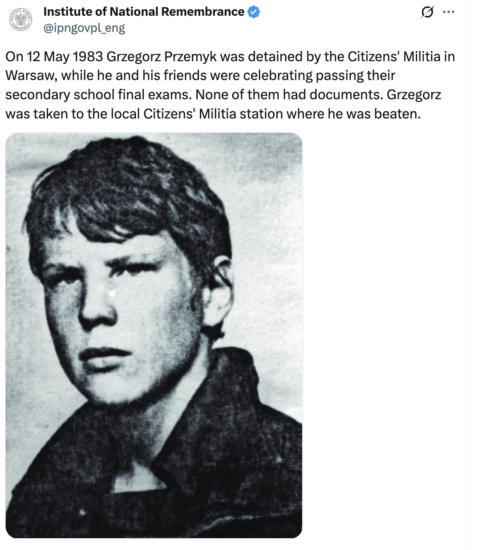
The tragedy was set against a backdrop of systemic repression. Just days before Grzegorz’s arrest, on 3 May 1983, his mother had been assaulted by unidentified assailants. Sadowska was active in the Primate’s Committee for Aid to People Deprived of Freedom and Their Families – a Catholic human rights group often targeted by the regime.
Deputy Prime Minister Mieczysław Rakowski’s political diaries later revealed chilling insights into official attitudes.
He noted, „Mrs Sadowska belongs to the opposition; before 1 May, she and her son were detained for 48 hours, and one may assume that the boy had been marked and they decided to teach him a lesson.”
On the afternoon of Thursday, 12 May 1983, three students from the Andrzej Frycz-Modrzewski Secondary School – Grzegorz Przemyk, Cezary Filozof, and Jakub Kotański – arrived at Castle Square in Warsaw. They intended to celebrate having passed their final school exams.
The group of friends drew the attention of a police van parked nearby and members of the ZOMO riot police. Two officers approached and asked to see their identification. Grzegorz did not have his ID card with him, so the ZOMO officers ordered him to accompany them to the nearby police station.
The events of the following minutes are known primarily from the account of Cezary Filozof. Shortly after entering the police station, one officer asked Cezary for his ID, while another struck Przemyk in the face, saying he would „teach him to carry his papers.” Przemyk replied that martial law was no longer in force and there was no obligation to carry identification. Moments later, two ZOMO officers entered the room. The identity of one remains unknown to this day; the other was Ireneusz Kościuk. Przemyk lunged at him as he was preparing to deliver the first blow.
As Jakub Kotański arrived at the police station with Grzegorz Przemyk’s ID card, he could hear screams coming from inside. Concerned, he decided to go in. He immediately noticed the officers appeared unusually agitated. Around that time, one of them – Inspector Roman Gembarowski – decided to call an ambulance. Speaking to the dispatcher, he claimed that the detainee was likely “mentally unstable”.
At around 6 p.m., an ambulance arrived at the police station with two paramedics, Michał Wysocki and Jacek Szyzdek. The militia officers told the paramedics that the detainee was a drug addict, though no injection marks on his body were visible.
The next day, Przemyk’s health rapidly deteriorated. His mother called for an ambulance and a trusted doctor, who recognised signs of internal bleeding. At Solec Hospital, doctors diagnosed severe internal injuries. One of them quietly told Sadowska that her son would not survive. Grzegorz Przemyk died at 1:15 p.m. on 14 May.
The state’s response was not to prosecute the killers but to protect them. Senior officials, including General Czesław Kiszczak and Interior Minister Zenon Milewski, orchestrated a strategy to deflect blame. Prosecutors were replaced or intimidated, witnesses coerced, and scapegoats identified.
The case files contain a note from the then Minister of the Interior, General Czesław Kiszczak, stating: „There is to be only one version of the investigation – the paramedics.” This narrative was promoted by the official propaganda, which conducted a smear campaign against Przemyk’s mother and his circle.
„I try to stay strong despite the brutality and the crude campaign of which I am the target. God took my child, and yet I continue to shield him from a pack of rats acting under the guise of the law,” wrote the mother of the murdered Grzegorz Przemyk, poet Barbara Sadowska, in a letter to her aunt, Maria Mrożkiewicz, who lived in Paris.
After the orchestrated investigation in July 1984, two police officers from Jezuicka Street were acquitted, including station duty officer Arkadiusz Denkiewicz – the man who had reportedly ordered, “Beat him so there are no marks.”
Instead, two paramedics who transported Przemyk from the police station to the hospital were convicted of „failing to render assistance,” based on statements obtained under duress.
Government spokesman Jerzy Urban, aided by security service propagandists, publicly advanced the false narrative. Years later, in the 21st century, Urban described Przemyk’s death as a “brutal accident at the police station,” but continued to deny any deliberate targeting of the teenager due to his mother’s activism.
Rakowski’s notes offer more damning evidence of systemic collusion. On 5 April 1984, he recorded that the general prosecutor had been discreetly removed under pressure from the Interior Ministry, which was determined to cover up for the police.
Even Jaruzelski himself, in a meeting on 22 May 1983, attempted to disinform, reportedly claiming that Przemyk was a drug addict and that this might have contributed to his condition. Even Rakowski found this justification disturbing. But the regime’s highest ranks, especially its military and militia, would go to any length to justify state violence and avoid accountability.
Despite the fall of communism in 1989, Poland’s judicial system failed to provide justice in the case. Denkiewicz, the only officer ever sentenced, never served time due to „health reasons.” The architects of the cover-up – those who obstructed justice, pressured witnesses, and slandered the dead – were never held to account.
One indirect consequence came in 1990. According to information cited by Professor Antoni Dudek, the first opposition Prime Minister, Tadeusz Mazowieck, read secret files on the case and was shaken despite his previous trust in General Kiszczak’s work.
Mazowiecki’s aide, Waldemar Kuczyński, recalled that after a sleepless night with the documents, the Prime Minister did not doubt that Kiszczak had to be dismissed.
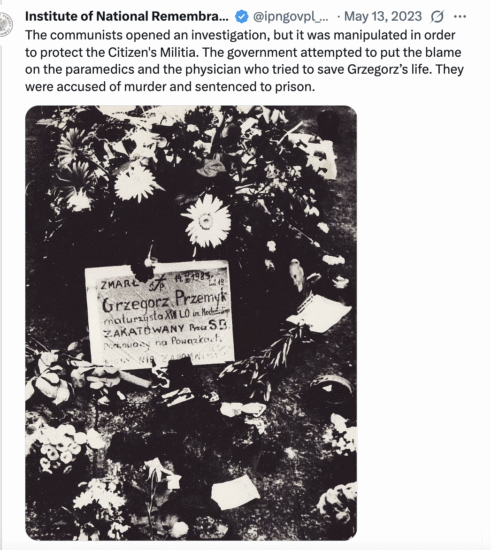
Grzegorz Przemyk’s death remains one of the most powerful symbols of communist brutality in Poland. A teenager beaten to death not for a crime, but to intimidate his mother, and all who dared oppose a regime that demanded obedience and silence. His story endures as a tragedy and a reminder of the price of freedom and the cost of truth in an age of lies.
In August 2007, President Lech Kaczyński posthumously awarded Przemyk the Knight’s Cross of the Order of Polonia Restituta.
Source: IPN, Dzieje.pl
Photo: @o_zawadzki
Tomasz Modrzejewski