Lebanon has been facing a historical socio-economical crisis for over a decade. World Bank economists estimate that the country has been struggling with one of „probably the three biggest economic crises” in the world for almost 200 years.
The country’s nominal GDP fell from USD 52 billion in 2019 to USD 18 billion in 2021, and GDP per capita in the same period decreased from USD 7,500 to USD 2,700. Only in 2020 prices increased by 85%, and then by another 155% in 2021. The real value of the Lebanese lira against the dollar has fallen by 90% since 2019.
In this rather pessimistic context, the Polish Center for International Aid (PCPM) came to the rescue.
The central axis of the PCPM Foundation’s activity in Lebanon is to help the poorest inhabitants through two flagship programs: „Cash for Rent” and „Cash for Work„.
The first one – providing rent subsidies for the country’s poorest inhabitants – is conducted by PCPM in Beirut, Tripoli, and in the northern province of Akkar. That is where close to 2 million Syrians have found refuge since 2011.
George Krikorian is a representative of the Bourj Hammoud district in Beirut. In his opinion, the “Cash for Rent” program has proven essential.
“In recent months, 103 families have been evicted from our neighbourhood because they were unable to pay their rent. Thanks to the funds provided by the PCPM, many other families are saved from eviction,” – he explained.
He also stressed PCPM’s flexibility in approaching local needs. “Other organisations come with ready-made solutions and ideas, on the principle of 'take what we give or nothing’. PCPM first listens to our needs and then prepares a project of action and help. Thanks to this, the effectiveness of this help […] is much greater than the help provided to us by people who have never been here,” he added.
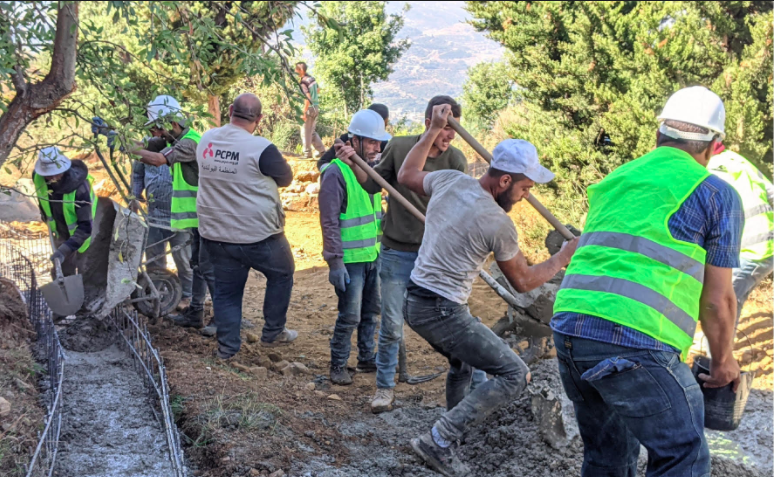
The second flagship project of the PCPM Foundation in Lebanon, „Cash for Work„, is a public works program that cooperates with local governments and provides short-term employment to local residents.
The program supports the construction and maintenance of infrastructure in municipalities, improving the living conditions of local communities. In addition, the program is often the only source of income for many families, especially in rural areas.
In the villages of Kubajat, Katlabe and Fnaideq in the north of the country, PCPM currently supports the construction of a water supply system, a sewage system, and a sewage treatment plant.
The Polish Center for International Aid (PCPM) describes itself as the largest Polish secular non-governmental organisation in terms of its annual cash flow and number of field-based missions, providing foreign humanitarian and development assistance. The latter is aimed at putting a given country in a position to become financially independent and further developing on its own.
Image: PCPM
Authors: Nikodem Chinowski / Sébastien Meuwissen