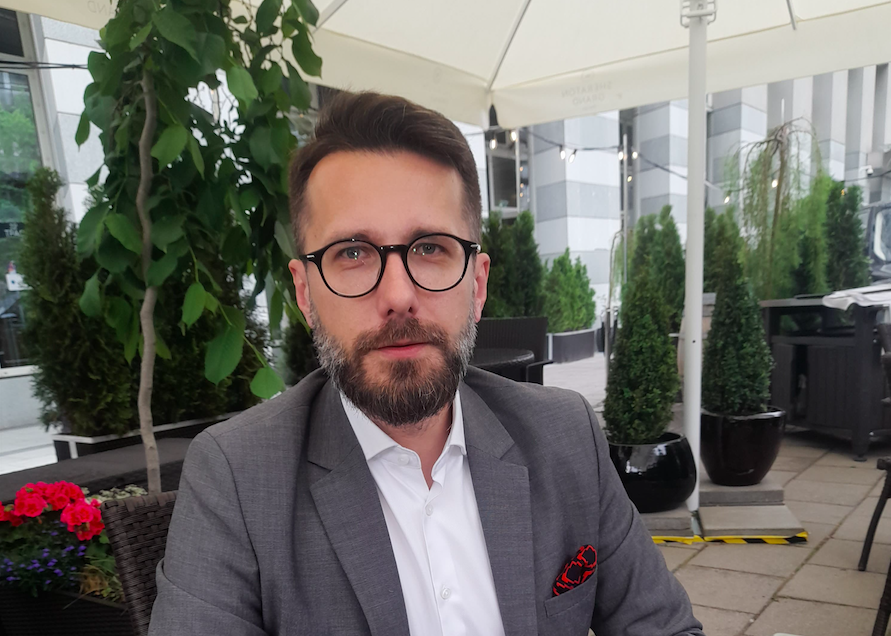
British Poles offer its readers an exclusive interview with the Chairman of the Polish-British parliamentary group in the Sejm and the press spokesman of the Law and Justice party, Radosław Fogiel. The conversation covered the war in Ukraine, the refugee crisis, cooperation with the Polish community and Polish-British relations.
British Poles: The Ukraine war has been going on since 2014. However, the date of February 24, 2022, and the large-scale attack by Russia on its neighbour is considered a turning point. Did a new chapter in Polish history begin on that day?
Radosław Fogiel: Yes, definitely! You rightly pointed out that this whole conflict did not start overnight. The Ukrainians themselves emphasise that they have been dealing de facto with the Russian occupation of their territory for a while. All soft phrases or mink terms used since 2014, such as „separatists” or „unknown forces”, were in accordance with the Russian narrative claiming Ukraine itself is divided. They explained that they were defending the inhabitants of these so-called separatist republics.
Russia has now launched a full-scale traditional – or kinetic – conflict. It was believed that the war would be limited to hybrid activities. It turns out that we are dealing with a very „old school” armed conflict. This placed the whole of Europe, particularly Poland, in an extraordinary situation.
On the one hand, we and the countries in the region knew that Putin could do anything. On the other hand, those in the West petted Putin. The United Kingdom does not belong to these countries because of its security policy and respect for specific moral criteria. It is consistent in this matter. Besides, how could its stance be different after the stories involving, Skripal, Litvinenko, and what unfolded?
For a large part of the West, February 24 must have been a serious shock given its citizens’ overall soft attitude or self-deception that Russia can be a civilised partner. The West has been lulled into believing that making deals and trading with Putin is possible. Suddenly their short-sightedness has been struck and brightly lit by a spotlight. All the shadows in which they hid so far have disappeared.
At the same time, this spotlight also brought to light such things as the violations of the arms embargo by Germany and France, as well as repeated conversations with Putin on the phone, not to mention the constant German reluctance to act decisively. It is worth recalling the words of President Macron, saying that one has to be “very careful” with the vocabulary used towards Putin. This was after Biden called Putin, a butcher during his visit to Warsaw.
BP: Since Putin took power in Russia, there have been many warning signs that could have been taken into consideration by European states when it comes to dealing with Putin. We had a war in Chechnya in 2002, an attack on Georgia in 2008, the Smolensk catastrophe in 2010 and everything that happened after it, and then an attack on Ukraine in 2014. In Poland, it seems that the threats related to such an aggressive neighbour have been known for two decades already.
RF: The current situation is also difficult to understand for a part of the public opinion in Poland, not to mention how the situation looks abroad. Despite the revolution of 1989 and the withdrawal of the Soviet troops from Poland, the threat always remained close from the Polish perspective. Let me give you a few examples. Formally, after the collapse of the Soviet Union, we had events in Lithuania, including the storming of the television tower where people died, we had the Yanayew coup, etc. So we were very well aware of our neighbours and who we were dealing with.
In fact, when a young, talented member of the KGB took power, it did not have a calming effect on the countries of the region. Anyway, it was very quickly visible, for example, in Chechnya, with the accusations of provocations that were to justify the attack and the genocide that de facto took place there. After all, many Chechen refugees found a home in Poland, so we knew perfectly well what was going on there.
In Poland, historical knowledge is common, and I think that here, regardless of political views, there is practically no one in Poland – apart from marginal far-left groups – who would deny the crimes of communism. I think, however, that the perception of the degree of reality of the threat was different. Following the West’s example, this part that was in opposition to the Law and Justice party, let’s call it more left-liberal, was practising self-deception. Only while the West can be explained either by long-term interests and entanglements or by naivety, such an argument should not reach anyone in Poland.
Unfortunately, this is the part of the political dispute that is very strong, also mentally, dependent on the countries of the West, on the countries of the so-called old union. Some were inclined to imitate, for example, the German policy of taming Putin, which was unacceptable from the Polish perspective.
The broadly understood centre-right community has long tried to become energetically independent of Russia. Attempts to build the Baltic gas pipeline were first made under Jerzy Buzek’s government, who is today in the Civic Platform and found himself in an environment that has impaired efforts in this direction.
Only with the third attempt was it possible to initiate the whole process. The construction of the Baltic Pipe began in 2017 and is coming to an end this year. To this must be added the construction of a gas terminal in Świnoujście, whose patron was the late President Lech Kaczyński, who in his Georgian speech predicted step by step all of Russia’s moves we are witnessing today. These were two key investments in terms of ensuring energy security, which means that today when Russia turns off our tap, we don’t suffer from it so badly. We do not have a situation like Germany, Hungary, or many other countries, where they are brought to their knees and open accounts in rubles in Gazprombank.
Our efforts and sacrifices up until now are fortunately turning the gun Russia is applying to our head into a water pistol.
BP: The UK has been showing strong commitment along with Poland in recent months in helping Ukraine. Can we say that the UK has now become Poland’s main ally in Europe?
RF: When it comes to the Ukrainian issue, it is 100% sure, but also in many other aspects. Obviously, these relations have changed somewhat after Brexit. Our presence in the EU also determines our policy in some way. But cooperation with Great Britain has always been close and good.
I think now it has a chance to reach completely new levels. Look, for example, at the last declaration of cooperation signed by Prime Minister Morawiecki and Prime Minister Cameron. Work is now underway to give it a specific dimension. Intergovernmental consultations are planned this summer, i.e. a joint meeting of the Polish and British governments. I think this alliance is heading towards an even higher and even better level.
BP: The results of the 2019 parliamentary elections show that the Civic Coalition enjoyed the support of almost 37% of voters in the UK, while Law and Justice received only over 20% of votes. How to explain the fact that what prompted voters living in Poland did not convince the Polish diaspora in Great Britain? And how is your party planning to deal with it?
RF: The voice of Poles abroad varies indeed. It can be observed that the opposition enjoys solid support there. This changed several years ago with the opening of the British labour market to Poles. Over the years, this old Polish community, still post-war or from communist times, has mostly conservative views and supported rather right-wing parties.
This changed with the departure of these people after the opening of the British labour market, which is a paradox, by the way. Many of them left in search of a better life, forced to do so by the poor governance and inefficient way of conducting politics by people related to the ones they are now voting for. Of course, everyone has the right to vote as they wish.
Our role as Law and Justice and as the ruling party in Poland is to present our proposals and achievements. I think that hard data also says a lot when it comes to economic growth in Poland, but also an increase in wealth, an increase in wages as well as productivity, and economic production. These are all indicators that are going up, so you can see that Poland is changing for the better.
Our goal is to make Poland a country in which the level of wealth can be comparable with that of perhaps not the richest EU countries but to countries such as Spain, Portugal, and Italy. It is possible with good management of Polish affairs.
Of course, when it comes to the government’s relations with the Polish diaspora, this is not influenced by political choices. It is our duty to take care of Poles abroad. A special Secretary of State in the Chancellery of the Prime Minister is appointed to deal with this. We also have various initiatives for the Polish diaspora; wherever we can, we provide support and serve as best we can. We are available even for someone who has been living abroad for many years.
Image: British Poles
Interview conducted by Sébastien Meuwissen