When Andy Burnham enters Downing Street on 20 July, his appointment will carry a significance extending well beyond the ordinary transfer of political power. Raised in the Roman Catholic tradition and shaped by the Catholic communities of north-west England, Burnham will become the first lifelong Catholic to assume the office of British prime minister in the modern constitutional era.
Boris Johnson was baptised as a Catholic but was confirmed in the Church of England and was generally regarded as an Anglican when he became prime minister. Tony Blair, meanwhile, did not formally enter the Catholic Church until after leaving office. Burnham’s case is therefore different: Catholicism formed part of his upbringing, education and political outlook long before he arrived at Number 10.
His premiership represents an important symbolic breakthrough. It also raises an uncomfortable question: why has Britain had to wait so long?
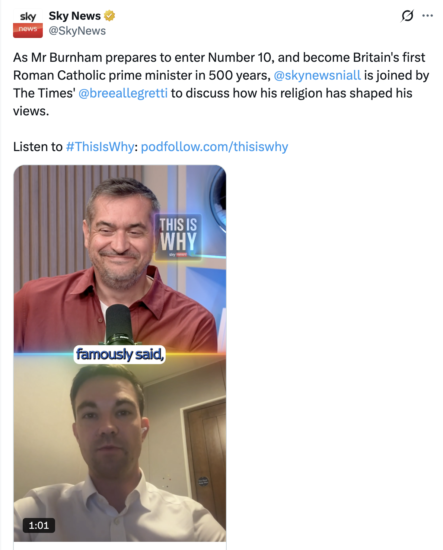
The remarkable aspect of Burnham’s appointment is not simply that a Catholic has reached the highest political office, but that the absence of Catholics from such positions has been treated as normal for centuries.
The scarcity of Catholics in the upper reaches of British public life cannot be understood solely as a product of modern electoral preferences. It is rooted in a political and constitutional system that deliberately excluded Catholics from power.
After the Reformation, allegiance to Rome came to be regarded by the English state not merely as a religious choice but as a potential political threat. During the seventeenth century, penal legislation restricted the civil rights of Catholics and Protestant Nonconformists.
The Corporation and Test Acts made participation in the established Church a condition of holding many public and municipal offices. Parliament itself describes the period as one in which penal laws produced persecution, religious hostility and violent disturbance.
The Catholic Relief Act of 1829 removed many of the most important barriers and allowed Catholics to sit in Parliament. Yet emancipation did not immediately dismantle the habits, assumptions and networks created by centuries of exclusion.

Catholics were not merely underrepresented in British institutions; for generations, they were legally classified as unsuitable for public authority.
The consequences outlived the legislation. Senior offices in government, the judiciary, diplomacy, the universities, the armed forces and the civil service developed within a predominantly Protestant and frequently explicitly Anglican establishment. Informal patronage and social networks continued to favour those who attended the right schools, belonged to the right institutions and conformed to the cultural expectations of the governing class.
Catholics could legally participate, but they did not necessarily belong.
Modern Britain presents itself as a religiously neutral and pluralistic democracy. Catholics serve as MPs, ministers, judges, senior civil servants and military officers. Open anti-Catholic discrimination would be widely condemned.
Nevertheless, fragments of the old constitutional settlement remain visible. Under the Roman Catholic Relief Act 1829, a Catholic prime minister is still restricted from advising the monarch on certain appointments within the Church of England. In practice, that responsibility can be delegated, and the prime minister’s role in episcopal appointments has become largely formal. Yet the survival of the restriction is revealing.
Nearly two centuries after Catholic emancipation, British law still assumes that a Catholic holding the country’s highest elected office requires a special constitutional workaround.
This is more than an antiquarian curiosity. It demonstrates how deeply the Church of England remains embedded in the machinery of the British state. The monarch must be in communion with the established Church, bishops sit by right in the House of Lords, and ecclesiastical appointments continue to intersect with government procedure.
The issue is not that Catholic politicians should replace Anglican ones, nor that public office should be distributed according to religious quotas. A democratic state should neither privilege nor penalise citizens because of their faith. The concern is that Britain has seldom examined why members of one of its largest Christian communities have been so conspicuously absent from its most senior positions.
The historic shortage of Catholics in high office does not always take the form of direct discrimination. It is also connected with geography, class and ethnicity.
For much of modern British history, Catholic communities were concentrated among Irish immigrants and their descendants, as well as in working-class areas of Liverpool, Manchester, Glasgow and parts of London. They often stood outside the social institutions from which the governing elite was recruited.
Burnham’s own background reflects this history. His Catholic formation belongs to the culture of Merseyside and Greater Manchester, where parish life, Catholic schools, trade unionism and Labour politics were often closely connected. His political language of solidarity, public service and social justice has been associated with that environment, even though his positions do not always correspond with official Catholic teaching.
His rise consequently carries a double significance. It represents not only the arrival of a Catholic at Number 10, but the advancement of a political tradition formed beyond the traditional centres of British establishment power.
The lack of Catholics in public office has therefore reflected more than religious prejudice: it has also exposed the narrow social and cultural routes through which Britain has historically selected its leaders.
Burnham’s premiership may help to make Catholic participation in national leadership appear unexceptional. That would be a genuine achievement. The ultimate measure of equality is not the celebration surrounding the first person to cross a barrier, but the point at which subsequent appointments cease to require historical explanation.
Britain has travelled a long way from the Test Acts and the penal laws. It has become more diverse, more secular and, in many respects, more tolerant. Nevertheless, the ascent of its first lifelong Catholic prime minister demonstrates how slowly some exclusions disappear.
Catholics have nevertheless made important contributions to British politics and public culture, even when access to the highest offices remained limited. Sir Jacob Rees-Mogg, a former Cabinet minister, has been unusually open about the influence of Catholic teaching on his political and moral views, while figures such as Ruth Kelly, Ann Widdecombe and Lord Alton have also brought a recognisably Catholic identity into national political debate.
Beyond Parliament, the writer and public intellectual G. K. Chesterton, who entered the Catholic Church in 1922, became one of the most prominent defenders of Catholic thought in twentieth-century Britain. Their visibility demonstrates that Catholics were never absent from British public life; rather, they frequently appeared as distinctive or exceptional voices within institutions whose culture and leadership remained predominantly Anglican or secular.
Burnham’s arrival at Number 10 will not, by itself, erase that history. It may, however, force Britain to acknowledge it.
Source: eKAI, America Magazine
Photo: X/@PolitlcsUK
Tomasz Modrzejewski