On 4 February 1945, a conference of the Big Three began in Yalta, Crimea, attended by the leaders of the Soviet Union – Joseph Stalin, USA – Franklin Delano Roosevelt and Great Britain – Winston Churchill. During the meeting, the fate of Poland was decided without the participation of any Polish representatives, including the legal government in exile operating in London.
In addition to Stalin, Roosevelt and Churchill, the talks were attended by foreign ministers, chiefs of staff and numerous advisors and experts representing the three largest states of the anti-Hitler coalition.
“Stalin had the strongest position. The Red Army had captured the Balkans, besieged Budapest, occupied Poland and fought the Germans already on their territory. The capture of Berlin was only a matter of time,” wrote Polish historian Prof Andrzej Garlicki, describing the balance of power between the Allies.
During the Yalta talks, which lasted more than a week, several arrangements were made for strategic cooperation in the final phase of World War 2 and for the principles of a post-war world political order.
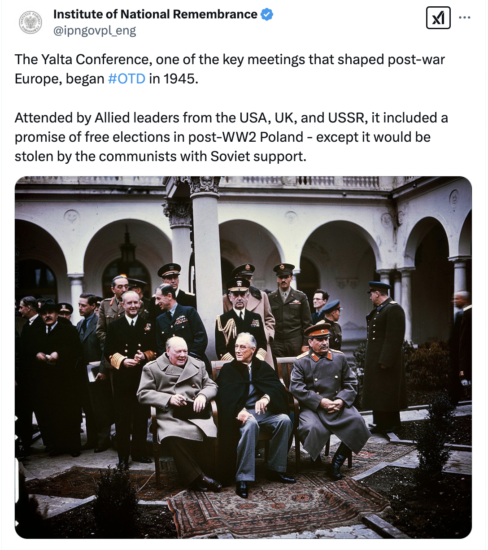
Roosevelt received assurances from Stalin that the Soviet Union would cooperate in the formation of the United Nations (UN) and that it would enter the war against Japan within two to three months after defeating the III German Reich.
The official statement after the Conference mentioned nothing about the legal Polish Government in London, which was still recognised by the USA and the UK.
“We reiterate our common desire to see Poland as a strong, free, independent and democratic state.”
During the discussion on the problem of the Polish eastern border, the three leaders of the superpowers finally decided that it should run along the Curzon line, with variations in certain areas of 5 to 8 km in Poland’s favour.
Despite the demands of Roosevelt and Churchill, Stalin rejected the idea that Lwów (today’s Ukrainian Lviv) should remain within the borders of Poland. The city was one of the most vivid academic and cultural centres in Poland before the war.
Because of those decisions, Poland was about to lose more than half of its territory. The leaders agreed that the compensation for the loss shall be made on the expense of German Eastern territories in Silesia, Pomerania and Masuria.
The precise location of the Polish western border based on the line of Szczecin and along the course of the Oder and Lusatian Neisse rivers, was not yet agreed in the Conference statement – this time Stalin was opposed by the Western leaders.
“Poland should obtain significant territorial gains in the North and West’. Given the existing divergence of opinion, it was announced that the Polish Provisional Government of National Unity would in due course pronounce on this territorial increase and that final decisions would be taken at a peace conference.”
The course of Poland’s western border was determined by Stalin’s demands at the Potsdam Conference at the turn of July and August 1945.
Information concerning the provisions of the Yalta Conference, which, in contrast to the arrangements at Tehran, were made public, caused a wave of protest among Polish communities across the West.
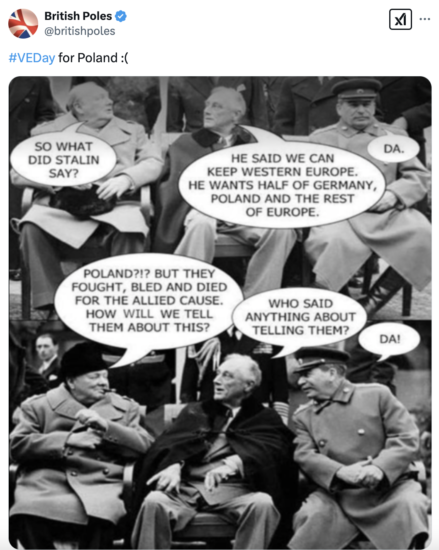
On 13 February 1945, the Polish Government in Exile issued a statement in which it said:
“The decisions of the Conference of Big Three concerning Poland cannot be recognised by the Polish Government and cannot be binding on the Polish Nation. The detachment from eastern Poland of half of its territory by the imposition of the so-called Curzon line as the Polish-Soviet border will be considered by the Polish Nation as a new partition of Poland, this time carried out by Poland’s allies.”
It is important to remember that Poland was the first country that opposed the Nazi German aggression and the destruction of the international law system with its army. Its fight since 1 September 1939 shielded the West and bought time to prepare for a German attack in 1940.
Tragically, the enormous war effort and the death of 6 million Polish civilians were met without any regard for a better future for Poland by the Western Allies. As a result, Poland fell into Soviet domination between 1945 and 1989 and still struggles to rebuild from the dark period of communism.
The Yalta Conference was also an important element in legitimising communist governments in Central and Eastern Europe and at the same time posed a universal justification for the violations of fundamental human rights committed in its name.
Source: Dzieje.pl
Photo: @ipngovpl_eng
Tomasz Modrzejewski