Poland and Lithuania have always had close relations throughout their history. This was particularly the case in the Middle Ages during which conflicts between them were not rare. However, despite their differences, Poles and Lithuanians created a powerful state in the 16th century: the Polish-Lithuanian Commonwealth.
In order to better understand the origin of this common destiny, let’s have a look at the historical context. The dynasty which united the Kingdom of Poland with the Grand Duchy of Lithuania was that of the Jagiellons. They reigned in the late 15th and early 16th centuries in Poland, Lithuania, Hungary and Bohemia. The Jagiellons then controlled an area of over 2 million square kilometres, making it one of the most powerful dynasties in Europe.

Close collaboration between Poland and Lithuania began at the end of the 14th century. On the one hand, Poland was then a stronghold of Catholicism while Lithuanians were known for their pagan traditions. On the other hand, the disagreement between the two nations was exacerbated by their aspiration to control the disputed regions of Podlasie, Mazovia and Red Ruthenia.
On the 14th of August 1385, Lithuanians and Poles reached an agreement and signed the Krewo Union. This event marked a first step which will prove to be crucial for the decades to come. The Grand Duke of Lithuania, Ladislaus II Jagiello was then baptised and crowned King of Poland.
The union of Poland and Lithuania strengthened the two nations both threatened by their powerful neighbour: the Teutonic Order. Most historians in the region agree that it was precisely the threat of this common enemy that pushed the two nations to form this strategic alliance.
In 1410, King Ladislaus crushed the troops of the Teutonic Order in one of the greatest medieval battles known as the Battle of Grunwald. Following this triumph of the Polish-Lithuanian troops, the Union of Horodło was signed on the 2nd of August 1413, reaffirming Polish-Lithuanian ties.
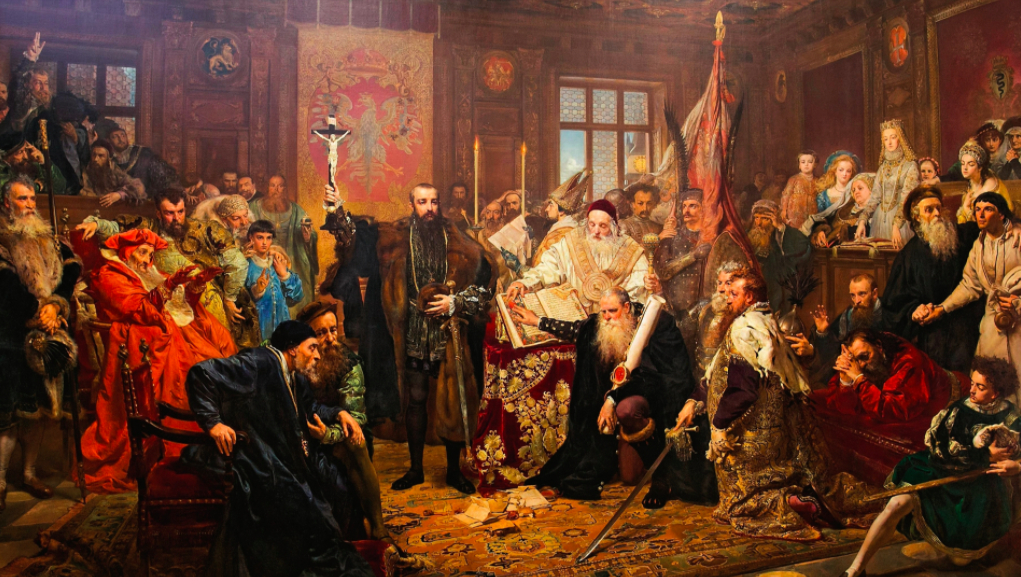
A century and a half later, Poland and Lithuania united in order to form one and the same entity on the occasion of the signing of the Union of Lublin on the 1st of July 1569. This event formalised the unification of the two States.
From that moment, the Kingdom of Poland (the Crown) and the Grand Duchy of Lithuania officially became one. This meant the establishment of a common parliament in Warsaw. From then on, the king would be elected by the Polish and Lithuanian nobility and simultaneously carry the title of Grand Duke of Lithuania as well as King of Poland.
The Polish Lithuanian Commonwealth had common institutions, including the bicameral parliament (in which the Polish and Lithuanian senators and deputies sat), a common coat of arms, a single currency, and the same foreign and defense policy. However, the two now unified states retained separate administrative structures. This distinction concerned among others the treasury, the army and the legal system. The territory of the Grand Duchy of Lithuania encompassed almost all of present-day Belarus and more than two-thirds of present-day Ukraine was then an integral part of the Kingdom of Poland.
By the mid-15th century, the Teutonic Knights no longer posed such a threat. It was then the Duchy of Moscow of Tsar Ivan which became the main threat in Eastern Europe. Lithuanian troops were unable to repel the Moscow advance without Polish military support.
Yet despite this, a considerable part of the Lithuanian nobility refused to form a formal union with Poland until the last moment, fearing a dilution of its national identity. The Polish king Sigismund II Augustus had to insist at length with his partners that the union between the two states be ratified. By uniting their forces, the two nations succeeded in expanding their territory to such an extent that the Polish-Lithuanian troops occupied Moscow between August 1610 and November 1612.
The 17th century turned out to be the bloodiest in the history of the Polish-Lithuanian Commonwealth. The latter had to wage numerous wars against its powerful Swedish, Russian and Turkish neighbours. Devastating civil wars also could not be avoided. As a result, the large country suffered significant territorial losses and was largely destroyed.
This crisis situation initiated the process which led to the pure and simple disappearance of the Polish-Lithuanian Commonwealth from the map of Europe as a result of the Partitions of Poland.
Today, the debate around the appreciation of the Republic of Two Nations remains animated. Poles and Lithuanians have a quite various appreciation of this long chapter of common history. One thing is certain, the Lublin Union represents a major event in the context of geopolitical rivalries in Central and Eastern Europe from the 15th century onwards.
Main image: Jan Matejko, 1868, oil on canvas. Lublin Museum
Author: Sébastien Meuwissen