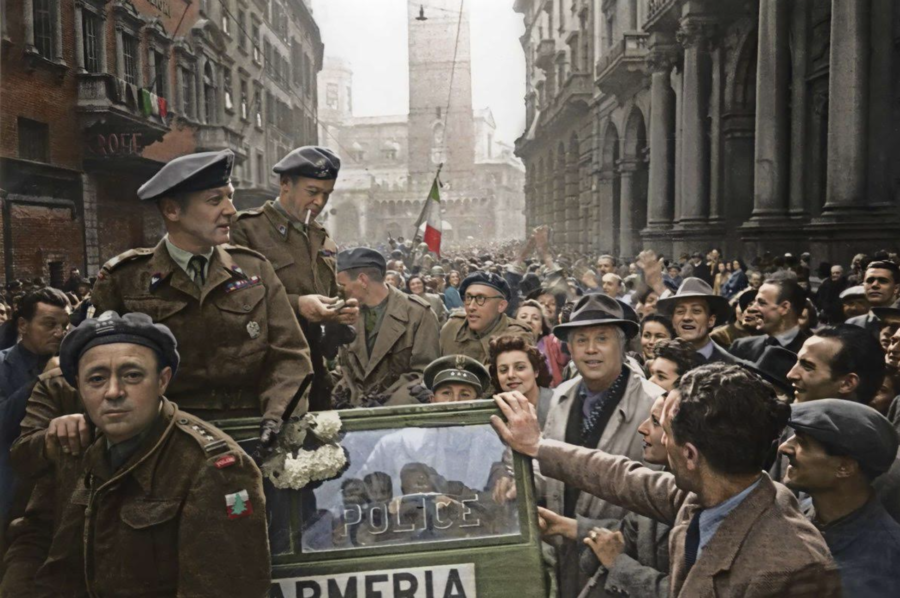
On 21 April 1945, troops of the Polish II Corps entered the Italian city of Bologna, marking one of the final Allied victories on the Italian front and the last battle fought by the formation commanded by Władysław Anders. Although often overshadowed by earlier engagements such as Monte Cassino, the capture of Bologna represented a crucial strategic and symbolic achievement both for the Allied war effort and for the Polish soldiers fighting far from their occupied homeland.
The battle formed part of the Allied spring offensive in northern Italy, known as Operation Buckland. Its objective was to break through German defensive lines south of the River Po and encircle enemy forces in the Lombardy plain. The British Eighth Army, including the Polish II Corps, played a central role in this manoeuvre, advancing alongside American and other Allied units.
Bologna itself was a key communications hub. Its capture would accelerate the collapse of German resistance in Italy and prevent the establishment of a new defensive line in the Alps.
In early April 1945, the Polish II Corps was tasked with breaking through heavily fortified German positions along rivers such as the Senio and Santerno. These defences were held by experienced units, including elite German paratrooper divisions that had previously fought at Monte Cassino.
Despite difficult terrain and determined resistance, Polish forces steadily advanced. By 20 April, German troops were in retreat, and the path to Bologna lay open.
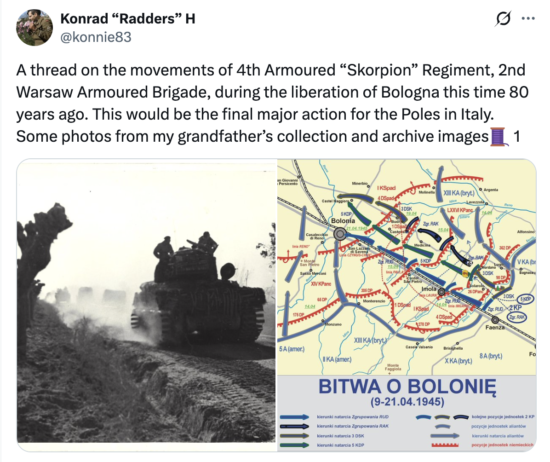
At dawn on 21 April, units of the 9th Carpathian Rifle Battalion were among the first to enter the city centre. Rather than fierce urban combat, they encountered mainly retreating rearguards.
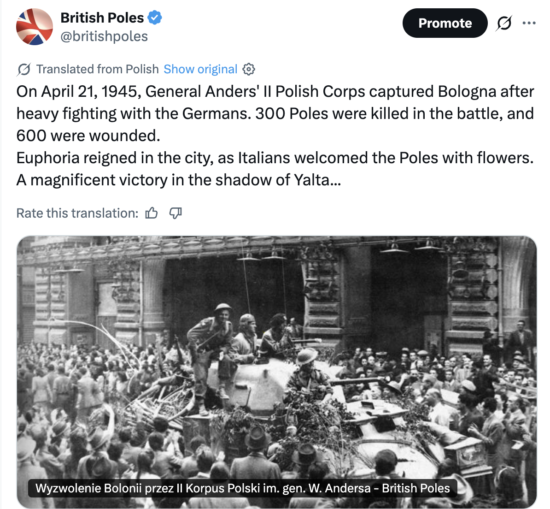
The entry of Polish troops into Bologna was met with enthusiasm by the local population. Civilians greeted the soldiers as liberators, and the city later honoured their contribution with commemorative medals and honorary citizenships for several officers.
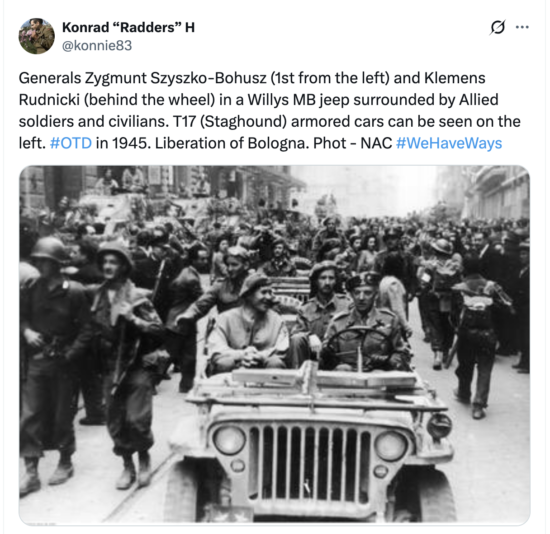
Although the fighting in the immediate vicinity of the city was limited, the broader campaign had been costly. Approximately 300 Polish soldiers were killed and around 600 wounded during the battle.
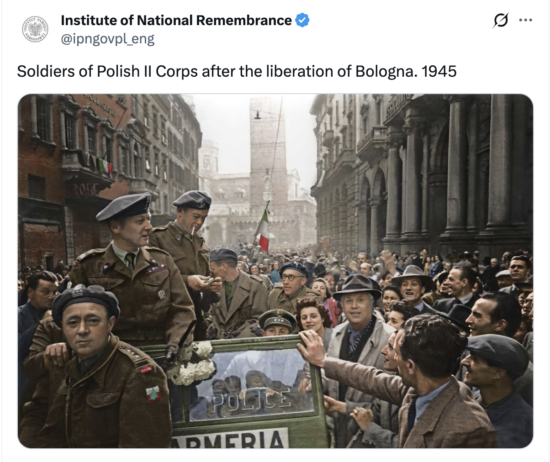
The liberation of Bologna effectively marked the end of major operations for the Polish II Corps in Italy. Despite their success and readiness to continue advancing northwards, political considerations intervened. Allied command feared potential contact between Polish forces and advancing Soviet troops, and the corps was withdrawn from further offensive action.
This decision underscored a bitter reality: while Polish soldiers contributed significantly to the defeat of Nazi Germany, the future of Poland itself had already been shaped by the geopolitical agreements of the great powers.
The Battle of Bologna stands as a testament to the determination and effectiveness of the Polish II Corps. Over the course of the Italian campaign, the formation gained a reputation as one of the most resolute Allied units, distinguished by its willingness to engage the enemy at close quarters.
Yet the victory carried a poignant irony. For many of the soldiers who fought under Anders, the liberation of foreign cities contrasted sharply with the continued lack of freedom in their own country.
Source: British Poles, Dzieje
Photo: X/@ipngovpl_eng
Tomasz Modrzejewski