Stanisław Żółkiewski is undoubtedly one of the greatest military leaders Poland has ever had. This nobleman of the Lubicz coat of arms was a magnate and a chancellor, representing the Polish crown in the Polish–Lithuanian Commonwealth. He participated in decisive campaigns against Sweden, Muscovy, the Ottoman Empire, and the Tatars from the 1580s until the 1620s.
Żółkiewski occupied several key positions in the administration of the Commonwealth. In 1588, he acquired the prestigious title of Field Crown Hetman. His courage and strategic abilities quickly made him noticed among the Polish-Lithuanian power circles. Shortly after his nomination, Żółkiewski was sent to Ukraine to push back a Tatar invasion threatening the state. In 1590, he became the castellan of the strategic city of Lwów.
In the last years of the 16th century, Hetman Żółkiewski led several successful campaigns in Eastern Europe, from Moldova in the South (against the Ottomans) to Livonia in the North (against the Swedes). In 1606, he was sent to Ukraine, where he defeated the Tatars at the battle of Udycz.
His most famous triumph took place in 1610 when the Commonwealth army defeated combined Russian and Swedish forces at the Battle of Klushino. The outnumbered Polish-Lithuanian men managed to trap the enemy forces thanks to the outstanding strategical competence of their leader and the military prowess of Polish hussars. It was this great victory that allowed Poles to seize the powerful city of Moscow and occupy it.
On 29 October 1611, Żółkiewski held a victory procession to the Royal Palace through the Polish capital, Warsaw. He had the tsar Vasily IV Shuysky as a prisoner. The latter gave the oath of allegiance to the Polish King Sigismund III Vasa on the occasion of what is today known as the Shuysky Tribute.
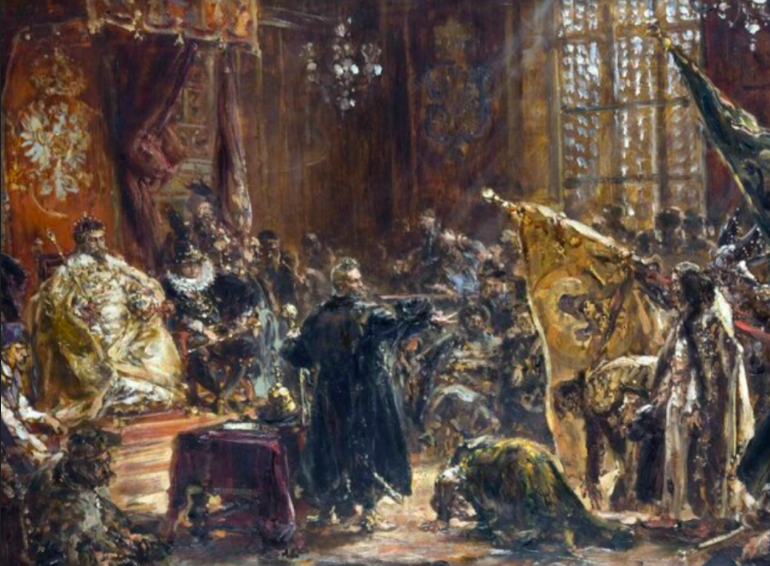
Poland was at the apogee of its power. Until the mid-17th century, The Polish-Lithuanian Commonwealth extended to nearly 1 million sq km. Despite his advanced age, Żółkiewski was eventually promoted to Grand Crown Hetman, and shortly after, Grand Crown Chancellor, became the de facto most powerful man in the Commonwealth, with the sole exception of the king.
The veteran military genius kept his excellent reputation until the end. He remained an active and respected military commander until his death 402 years ago, on 7 October 1620. He was killed by the Turks during the Commonwealth’s retreat following the battle of Cecora, in Moldova. He was buried in the St Lawrence Church in Żółkiew (now Zhovkva, Ukraine).
Image: Fine Art Images
Author: Sébastien Meuwissen