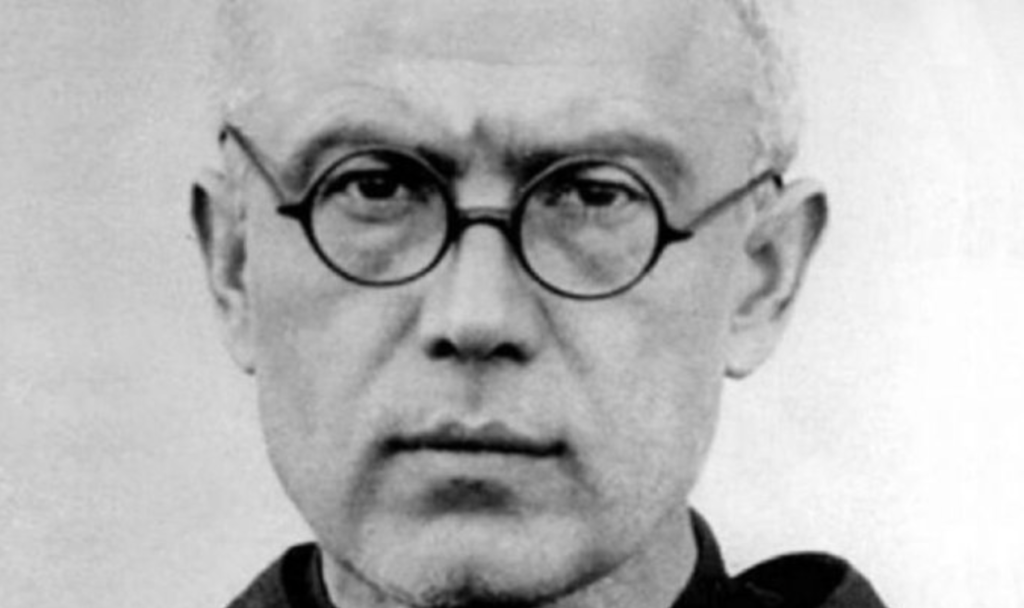
On 29 July 1941, during a roll call at the German Auschwitz Death Camp, the Franciscan monk, Maksymilian Kolbe voluntarily gave his life to save another prisoner, Franciszek Gajowniczek, one of other ten prisoners sentenced to death by starvation.
Father Maximilian Maria Kolbe was arrested by the Gestapo for hiding Jews during WWII. He was sent to Pawiak prison in Warsaw and then to the German Death Camp of Auschwitz as prisoner #16670. He started to work to build a fence around the crematorium.
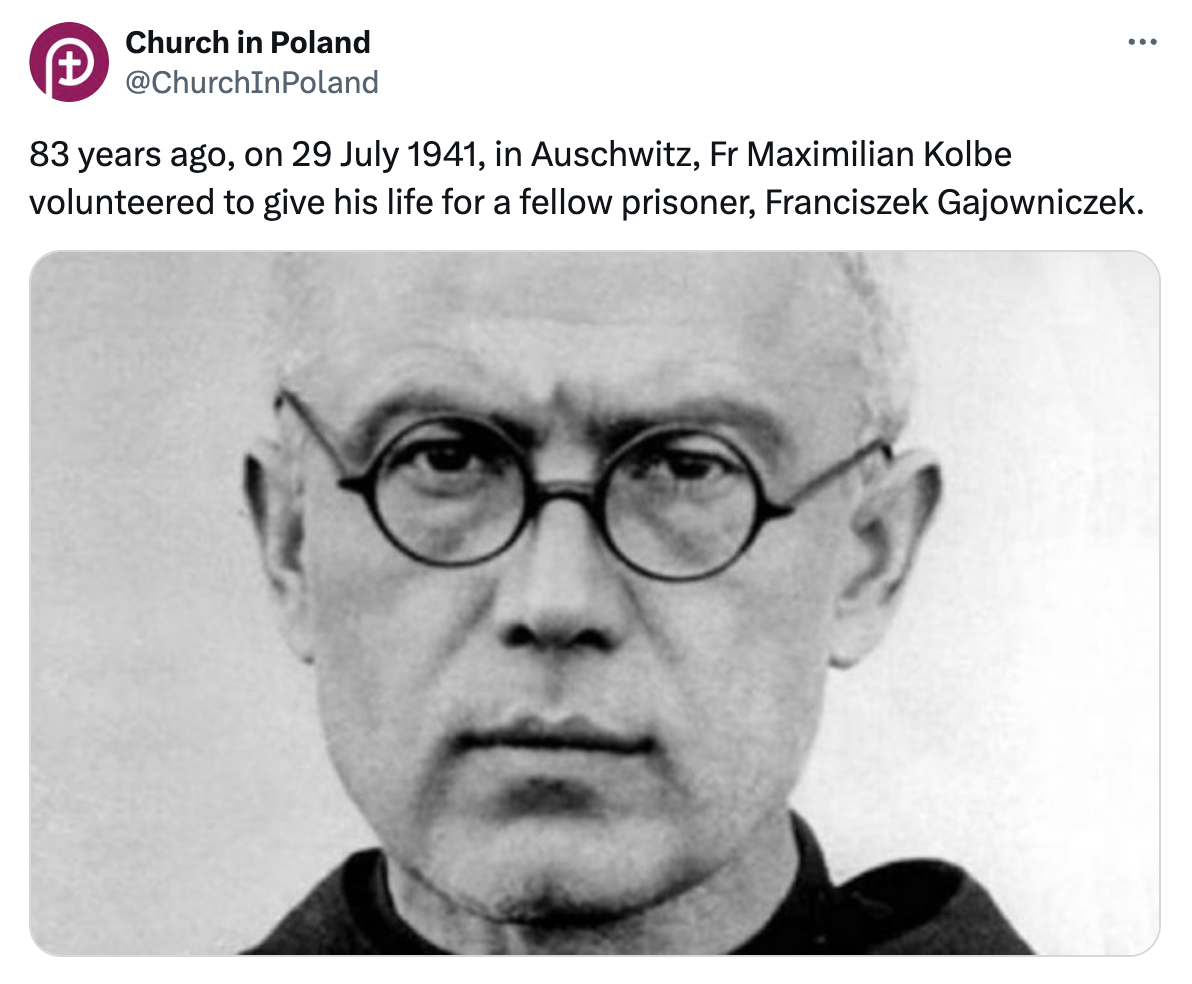
Franciszek Gajowniczek recalled Father Kolbe’s sacrifice in his memoirs written in 1946:
“An unfortunate fate fell upon me. With the words +Ah, how I feel sorry for my wife and children who I am orphaning+ I went to the end of the block. I was about to go to death row. Father Maximilian heard those words. He stepped out of line, approached Fritzsch and attempted to kiss his hand. He expressed his willingness to go to death for me.”
Kolbe was still alive after two weeks of agony. On 14 August 1941, he was put to death by the German prisoner-criminal Hans Bock, who injected him with the deadly phenol.
The people who were working in the cell and removing bodies later recalled that the German SS soldiers were unable to look in the eyes of the Polish saint, and screamed whenever he looked at them.
A few weeks before his death, Maximilian said to another prisoner: “Hatred is not a creative force. The creative force is love”.
Franciszek Gajowniczek survived the war. He died in 1995 in Brzeg in the Opole region at the age of 94. He was buried in the cemetery of the Franciscan monastery in Niepokalanów.

Father Kolbe was the first Polish saint martyr of the 2 World War period. A statue of St. Maksymilian Kolbe was unveiled in July 1998 and stands above the west entrance to Westminster Abbey. The sculptor was Andrew Tanser.
Tomasz Modrzejewski