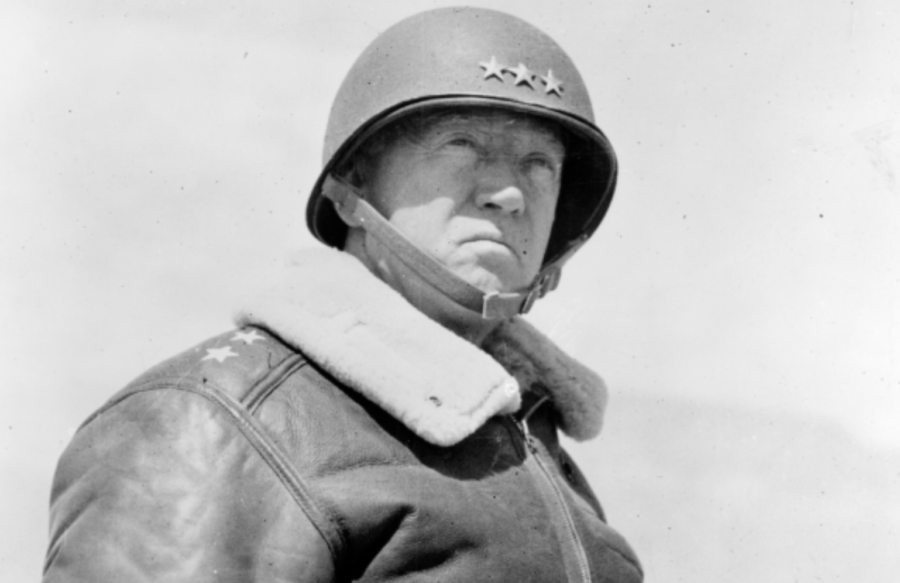
General George Patton died on 21 December 1945 in the hospital bed he was placed in after a truck crashed into his Cadillac. The doctors fought for his life for 12 days but were unable to save the legendary commander of the 2 World War. Until today the circumstances of that death spark controversies as Patton could be targetted by the Soviets as a man who believed in the upcoming 3rd World War.
During the Second World War, Patton was shrouded in the nimbus of the best Allied commander. Under his command, the brilliant successes of the 7th and 3rd Armies overshadowed the achievements of other great Allied units.
However, it is important to note that Patton’s brewery was many times at the cost of huge casualties. The dynamics of Patton’s relationship with his subordinates were complex – he was able to prove he understood them and “spoke their language” but also required extraordinary bravery, which could be considered contempt for death.
Patton’s attitude was proved during the Allied fight for the Sicilian port of Messina in 1943. He ignored the orders from the Allied command and attacked the port with the full might of the American forces, although the British were supposed to attack the city.
Because of this incident and its repercussions in the media, Patton was able to return to the fight only a year later during the Allied operations in German-occupied Normandy.
Patton became famous again as an excellent strategist in December 1944, when his troops succeeded in stopping the German offensive in the Ardennes.
In 1945 General Patton was once again stripped of his command of the 3rd Army and his position as military governor of Bavaria. The reason was Patton did not remove the Nazi German officials from their posts.
The general was reassigned as commander of the 15th Army, which was a facade unit formed of several hundred officers mainly involved in cataloguing cultural goods stolen by Nazis Germany throughout the war.
During a hunting trip, Patton’s car suffered an accident. A two-and-a-half-ton truck suddenly hit his car. The driver of the truck, Robert L. Thompson, was under the influence of alcohol while driving.
At that time and in the initial post-war period, the official version of those mysterious events was not questioned.
In the mid-1970s, a former agent of the OSS (Office of Strategic Services, the mother service to the CIA), Douglas Bazata admitted that he was involved in Patton’s death. The task was commissioned by the head of the Bureau himself, William ‘Wild Bill’ Donovan.
Bazata claimed that he had agreed on the course of the assassination attempt with Thompson, the driver of the accidental truck and that he hid at the side of the road to fire a shot at the general from a short distance with a special weapon that threw metal shrapnel.
A different version of those events was presented in 1993 by former US Army counterintelligence officer Stephen J. Skubik. The US officer of Ukrainian descent claimed that the NKVD planned the assassination of Patton.
The source of that information was the head of the Ukrainian nationalist movement Stepan Bandera – a man who bore responsibility for the Volhynia Massacre who stayed in the US occupation zone after leaving German detention.
According to his version of events, the American commander was killed by a Soviet agent who killed him with poison during his stay in the hospital.
Regardless of the eventualities indicated, General Patton remained a legend among soldiers as an outstanding commander.
Before his death General Patton was openly criticising the Soviet Union, even calling its citizens “savages”.
“Let’s keep our boots polished, bayonets sharpened and present a picture of force and strength to these people [the Soviets]. This is the only language they understand and respect. If you fail to do this, then I would like to say to you that we have had a victory over the Germans and have disarmed them, but have lost the war,” Patton famously said after the end of the war.
He was also a hope for many representatives from Central and Eastern European countries who believed in the possibility of an imminent World War 3 that would liberate them from the oppression of the Soviets and the then-powerful Red Army occupying most of these countries.
Source: Polskie Radio
Photo: @CapitolHistory
Tomasz Modrzejewski