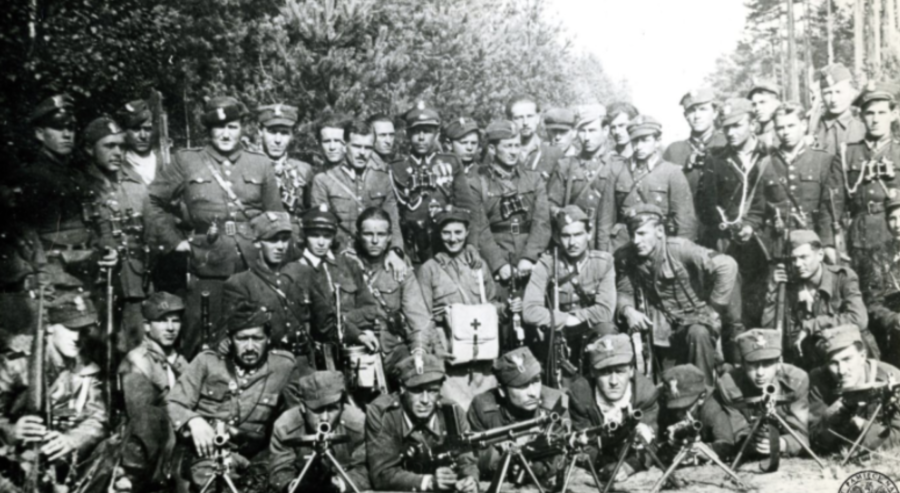
The Cursed Soldiers, a wide group of Polish partisans from all wartime organisations who remained on their posts after the fall of the Third Reich, symbolise resistance to the new Soviet occupation brought to Poland by the Yalta and Potsdam agreements between the Allies. They continued their desperate battle for Poland’s freedom into the 1960s and, in most cases, paid the ultimate price for their love of the country.
When the war ended on 9 May 1945, the Stalin troops dominated Poland, which was set to receive its new borders and lose almost half of its original territory in the Eastern Borderlands.
The so-called new Poland was to be a democratic state, but its future was to be decided under the occupation of Soviet troops. For most members of Polish society, it was obvious that creating a free, sovereign state was impossible under such conditions, and Soviet actions followed incredibly quickly.
After the Polish Home Army was disbanded, and given the post-war international situation, the ‘Freedom and Independence’ Association (Zrzeszenie ‘Wolność i Niezawisłość’) was established in September 1945 as a continuation of the work of the Home Army.
For the next few years, it was the WiN Association that was the most important and the most numerous of the new underground organisations.
The most famous armed units included soldiers commanded by Major Marian Bernaciak ‘Orlik’, Major Hieronim Dekutowski “Zapora” from the Lublin region, or Lieutenant Franciszek Jaskulski “Zagończyk”, operating in the Kieleckie region.
The south of the country, especially the region of the Polish Tatra mountains, was famous for the huge unit commanded by Józef “Ogień” Kuraś.
The researchers recalled that the supremacy of WiN was also recognised by the Conspiratorial Polish Army commanded by Capt. Stanisław Sojczyński “Warszyc”.
The second largest organisation was the National Military Union (NZW), which was connected to more nationalist circles, such as the wartime NSZ (Narodowe Siły Zbrojne).
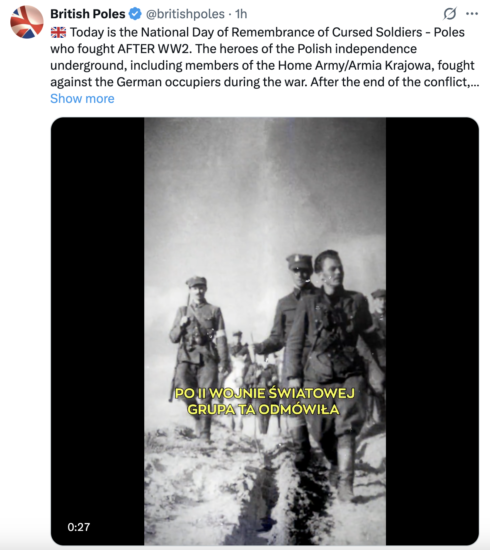
The history of the post-war anti-communist underground has been popularised by the search for victims of communist crimes conducted by the IPN throughout Poland, especially at the Łączka in the Powązki Military Cemetery, and more recently also in Lithuania and Belarus.
Thanks to IPN historians and archaeologists, Dr Krzysztof Szwagrzyk, the remains of Major Zygmunt Szendzielarz ‘Łupaszka’ and Major Hieronim Dekutowski ‘Zapora’, as well as the last commander of the National Armed Forces (NSZ), Lieutenant Stanisław Kasznica, have been discovered.
In Gdańsk, the researchers were able to locate the remains of Danuta Siedzikówna “Inka” and Feliks Selmanowicz “Zagończyk”.
The search for the remains of the famous General August Emil Fieldorf “Nil” is still ongoing.
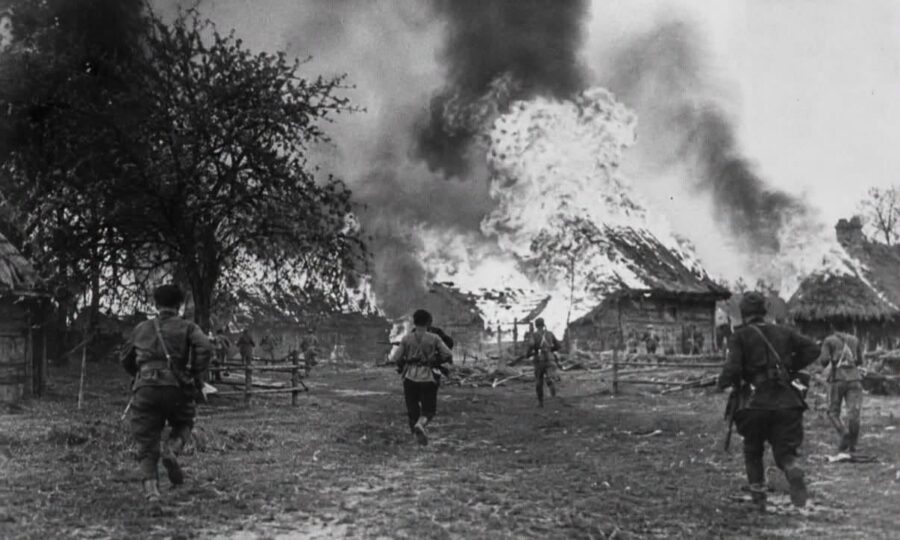
Between 1944 and 1956, the communist terror in Poland resulted in the deaths of – according to the IPN’s estimates – around 50,000 people. Some were executed under court rulings, others were murdered or died at the headquarters of the Security and Military Information Offices, prisons and forced labour camps, and other groups died in combat or during pacification operations.
The defence of independence in the face of the Sovietisation of Poland after 1944 was the most important goal of the Cursed Soldiers. The last of the Cursed Soldiers, Józef Franczak “Lalek”, was captured and killed in 1963. Until that time, some 300,000 Poles were active members of the anti-communist underground forces.
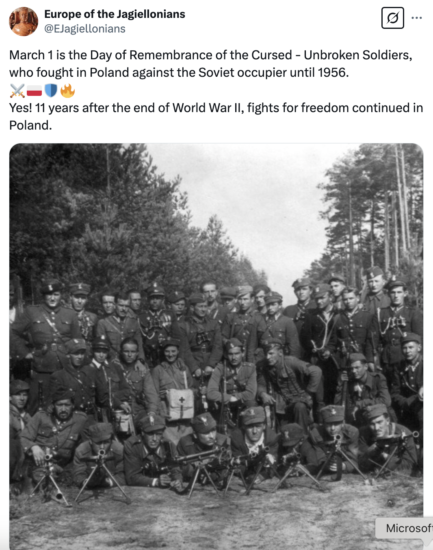
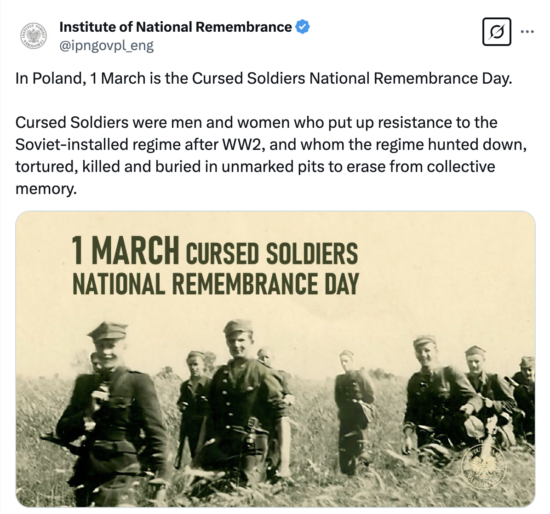
The Day of Remembrance of the “Cursed Soldiers” (1 March) was chosen to commemorate the anniversary of the execution of the leadership of the 4th Headquarters of the “WiN” Association.
On 1 March 1951, the commanders Lt. Łukasz Ciepliński, Maj. Adam Lazarowicz, Lt. Józef Rzepka, Capt. Franciszek Błażej, Lt. Józef Batory, Karol Chmiel and Maj. Mieczysław Kawalec were killed at the Warsaw prison on Rakowiecka Street.
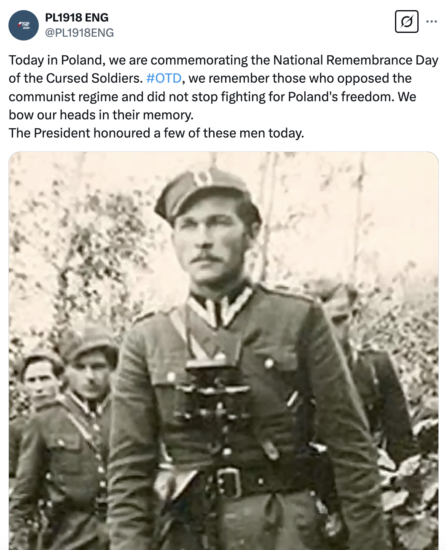
The initiator of the Day of Remembrance dedicated to the Wyklęty Soldiers was President Lech Kaczyński, who issued a bill on the matter to the Sejm, in cooperation with the late IPN Head Janusz Kurtyka.
The national holiday was finally established by Sejmy in 2011 after President Bronisław Komorowski signed the act.
Source: Dzieje.pl
Photo: @ipn_gov
Tomasz Modrzejewski