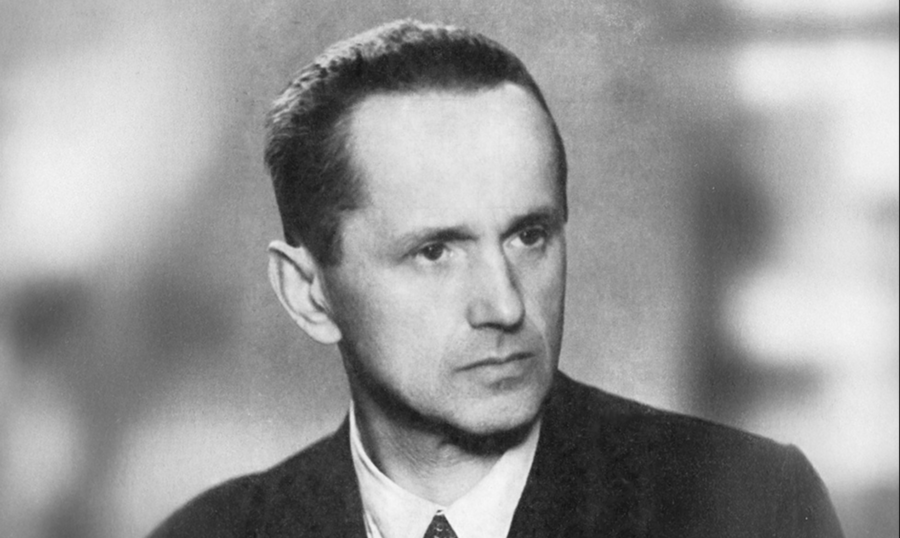
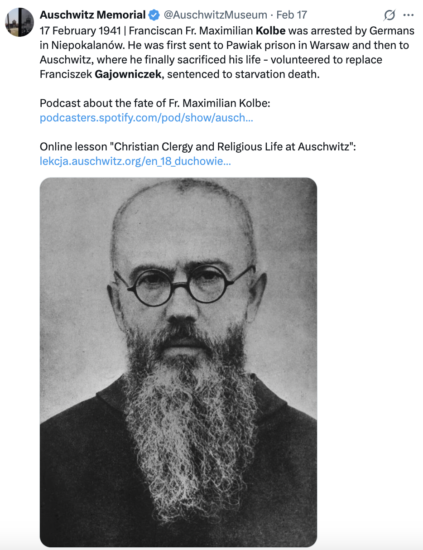
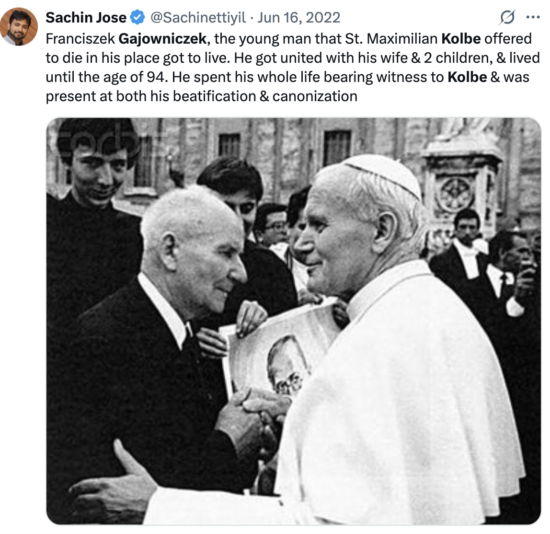
A man saved by Father Kolbe, Franciszek Gajowniczek, lived for 94 years and preserved the memory of the ultimate sacrifice made to save his life in the hell of the German concentration camp. Every year of his life, Gajowniczek would come to Auschwitz and honour the memory of his saviour. He died on 13 March 1995.
Franciszek Gajowniczek was born in 1901 in the village of Strachomin near Minsk Mazowiecki and later moved to Warsaw. He had a wife and two sons.
He was a professional soldier serving as an N.C.O. in the Polish army. He fought with the Germans in the September Campaign/ He was one of the defenders of the Modlin Fortress, after the fall of which, on 28 September 1939, he was taken prisoner.
In October 1939, Gajowniczek escaped. He wanted to leave Poland and move west through Hungary but was arrested by the the Gestapo after a report of a Slovak woman. He was imprisoned in Zakopane and Tarnów, from where the Germans deported him to the Auschwitz concentration camp on 8 September 1940.
Gajowniczek served in the same unit as Father Maksymilian Kolbe. They worked together, and he was a witness of frequent torture that Kolbe suffered from the capos as a catholic priest.
On 29 July 1941, a Pole, Zygmunt Pilawski, escaped from Auschwitz.
During roll call, as a form of collective punishment, the camp head, Karl Fritzsch, selected 10 prisoners and sentenced them to death by starvation.
Gajowniczek, who was among the selected group, started crying because he was deeply worried about his family’s fate.
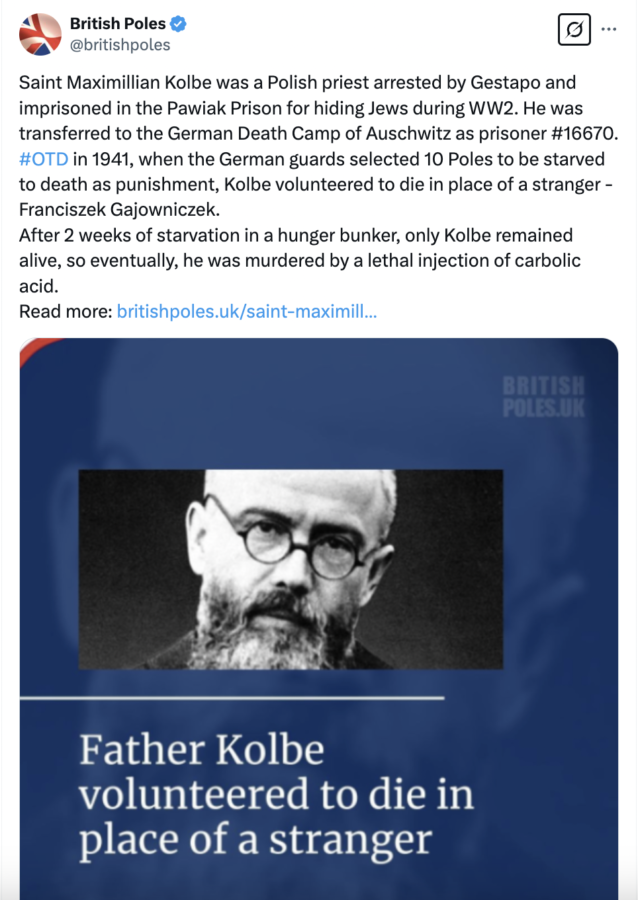
After that, Father Kolbe approached Fritzsch, said that he was a Catholic priest, and asked if he could take the place of a fellow prisoner who had a family. The SS man was surprised. After a while, he agreed.
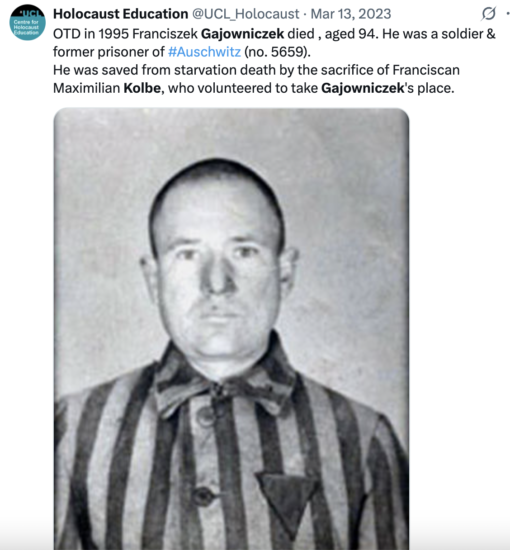
“In that moment, I found it difficult to realise the impression that had come over me. I, a condemned man, have to go on living, and someone willingly and voluntarily offers his life for me? Is this a dream or reality?” Gajowniczek recalled years later.
The Germans placed Father Kolbe in a special starvation bunker in the basement of block 11.
On 14 August, after the death of his fellow prisoners, Maximilian Kolbe was killed by an injection of phenol to his heart by a prisoner, a German criminal transferred from the Sachsenhausen camp, Hans Bock, who was the block elder serving in the camp hospital.
Gajowniczek survived in Auschwitz until 25 October 1944. The Germans then deported him to Sachsenhausen concentration camp. He was liberated by the US military during the evacuation of the camp in May 1945.
In autumn of 1945, he returned to Rawa Mazowiecka, where he found his wife. Their sons were killed on 17 January 1945, during the bombardment of the town by the Soviet army.
After the war, Gajowniczek and his wife settled in Brzeg nad Odrą in Lower Silesia. Every year during his 94-year life, he visited Auschwitz to commemorate Father Kolbe’s sacrifice that saved him from death.
Franciszek Gajowniczek died on 13 March 1995. He was buried in a cemetery established by Father Kolbe at the Niepokalanów monastery.
Father Maximilian Kolbe was canonised as a saint by Pope John Paul II on October 10, 1982.
Source: Dzieje.pl
Photo: @Cogito1918
Tomasz Modrzejewski