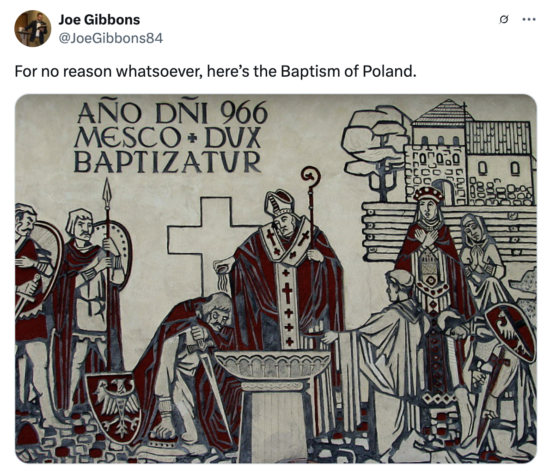
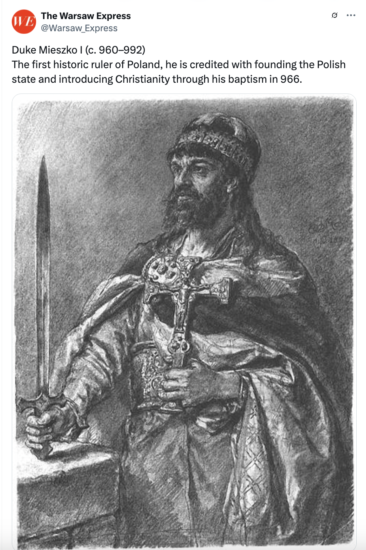
According to a historical tradition, Mieszko I, the duke of Poland, accepted baptism on 14 April 966. His decision was a part of an agreement with Bohemia, from which came the first Christian wife of Mieszko – Dobrawa. His decision helped secure the country from German armed raids, explained by fighting the pagans and helped his son to create a church organisation independent from the Holy Roman Empire.
While much of early Polish history is shrouded in legend, historians generally agree that Mieszko’s decision was spiritual and strategic. Surrounded by powerful Christian neighbours, particularly the Holy Roman Empire, Mieszko saw conversion as a way to strengthen his political position and legitimise his rule.
The marriage with Czech Princess Dobrawa, a devout Christian, played a key role in influencing his choice.
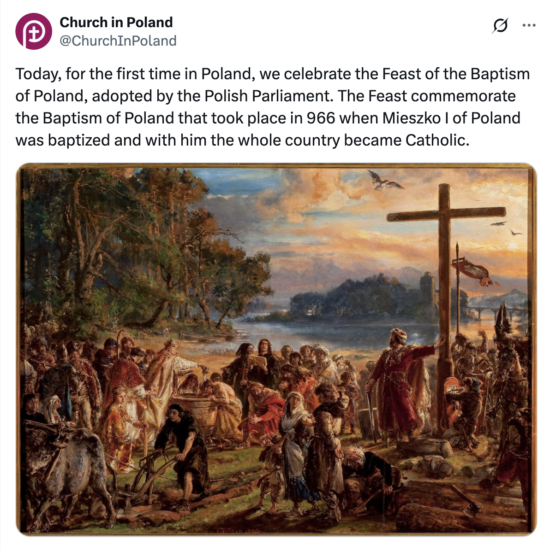
The baptism likely took place in Gniezno or Poznań, though some sources suggest Ostrów Lednicki as a possible site. It was not merely a personal conversion but the first step in a broader process of Christianisation across his domain.
Missionaries, churches, and the first bishopric were soon established, laying the foundations of Poland’s religious and cultural identity.
“Because of his decision, today we use the Latin alphabet, we feel part of the West. On the other hand, if he had decided on an eastern version of Christianity, we would probably be writing in the Cyrillic alphabet and feel more connected to Russia than to France, Germany, Italy and other Western countries,” a Polish medievalist, Prof Przemysław Urbańczyk, said in an interview.
Two years after the baptism took place by the decree of Pope John XIII and Emperor Otto I, the first Bishop, Jordan, was sent to Mieszko in 968. From then on, the process of the Christianisation of Poland began.
The fact that the first Polish bishopric was not subjected to the German church hierarchy gave Mieszko and his heirs a perspective to further extend the borders of Poland and avoid the strong political influence of Germany.
This situated Poland in a much better position compared with the Czechs, whose church organisation and the process of nominating bishops was frequently interfered by the Germans.
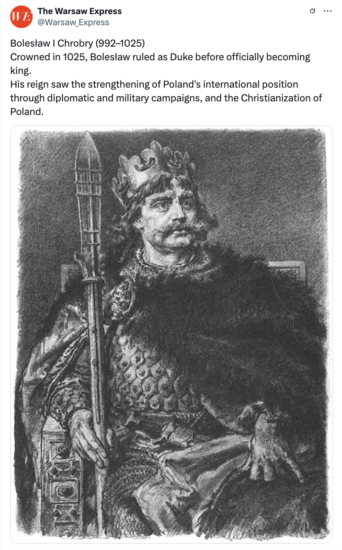
Mieszko’s son, Bolesław the Brave (Chrobry), went on to establish four bishoprics in Gniezno, Kraków, Wrocław, and Kołobrzeg.
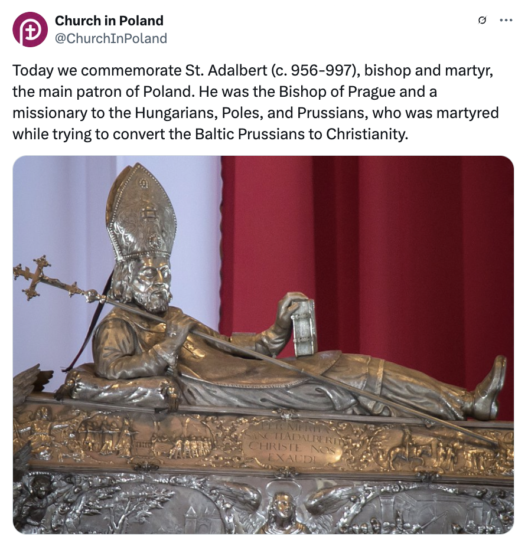
Bolesław would later host St Adalbert (Wojciech), a prominent church figure and intellectual of the time and former Archbishop of Prague. Adalbert was martyred while undertaking a missionary journey to the pagan Prussians. His martyrdom and subsequent canonisation brought great prestige to the Polish Church and led to the visit of Emperor Otto III.
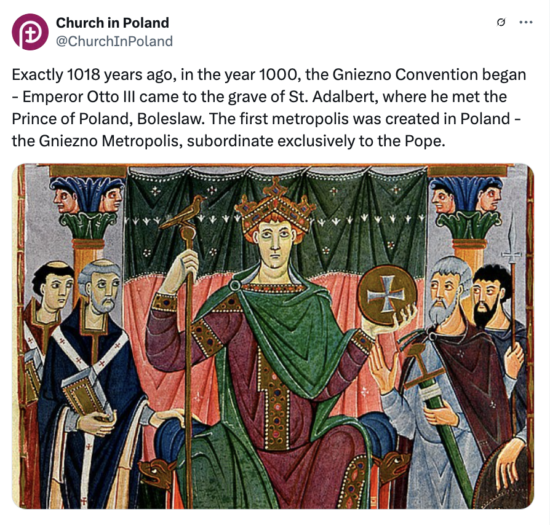
During this historic encounter, the Emperor acknowledged Poland’s sovereignty by agreeing to the coronation of Bolesław as the first king of Poland.
The significance of the Baptism of Poland reaches far beyond its immediate religious consequences. It marked the beginning of Polish statehood, introduced Latin literacy and European legal traditions, and firmly positioned Poland within the cultural and political sphere of Western Christendom.
Today, the Baptism is commemorated as one of the most pivotal milestones in Polish history—celebrated not only for its spiritual importance but also for symbolising the birth of the Polish nation.
The adoption of Christianity also offered a powerful unifying ideology, which helped to consolidate power under the Piast dynasty and bring cohesion to a once-fragmented land.
Mieszko’s close ties to the Church were further demonstrated by the creation of the Dagome iudex, a remarkable document in which the Polish ruler placed his state under the direct protection of the Papacy—an early sign of Poland’s diplomatic acumen and desire to assert its independence on the European stage.
Source: Dzieje.pl
Photo:@ChurchInPoland
Tomasz Modrzejewski