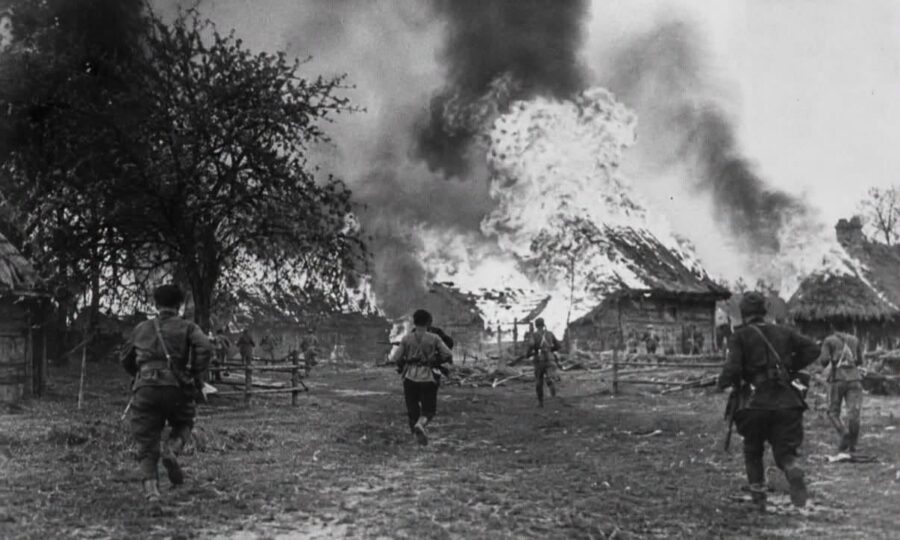
Exhumation works began in Puźniki, in Ukraine’s Ternopil region, at the site of a wartime massacre where Polish civilians were murdered by Ukrainian nationalists in 1945. The initiative marks the first such operation since Ukraine lifted its ban on the search and exhumation of Polish victims of war and conflict on its territory, a restriction that had been in place until November 2024.
The massacre in Puźniki took place during the night of 12 to 13 February 1945, when a unit of the Ukrainian Insurgent Army (UPA), led by Petro Chamchuk, known as „Bystry,” attacked the local Polish population. Estimates of the number of victims vary between 50 and 120 people.
The exhumation is being carried out under the supervision of Poland’s Ministry of Culture and National Heritage, which is responsible for the care of Polish war graves abroad and for the implementation of the 1994 Polish-Ukrainian agreement on the protection of sites of remembrance and burial of victims of war and political repression.
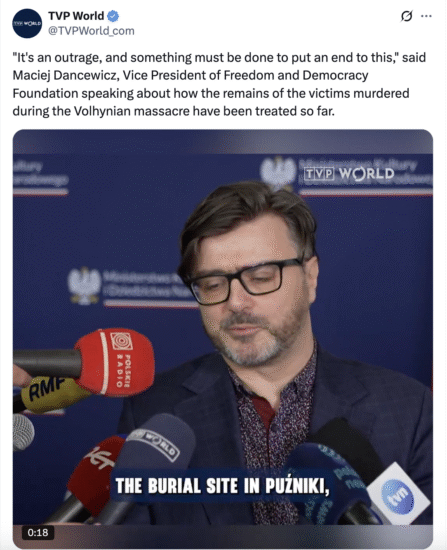
The work is being conducted in partnership with the Freedom and Democracy Foundation, which has been involved in the search and exhumation of Polish victims in Ukraine since 2012. The goal of the project is to ensure a dignified burial for the murdered civilians of Puźniki and, where possible, to restore their identities.
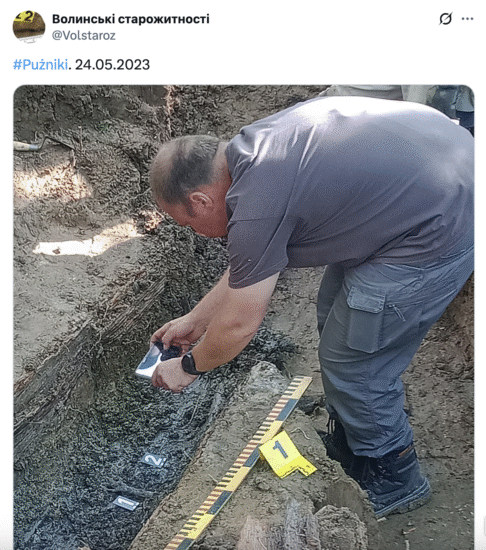
Thursday’s operation follows on from earlier research carried out between May and August 2023, when a mass grave containing the remains of the victims was located. In January 2025, the Ukrainian authorities granted permission for the exhumation to proceed, based on the findings of that initial investigation.
The project involves a team of experts from the Pomeranian Medical University, the Polish Institute of National Remembrance (IPN), and the Ukrainian Volhyn Antiquities Foundation, which received official approval in January 2025 to take part in the search efforts. The work is fully funded by Poland’s Ministry of Culture and National Heritage.
Relatives of the victims are actively involved in the process and have been providing DNA samples to assist with the genetic identification of the remains. According to earlier reports, around 20 specialists are working on site in Puźniki, while up to 50 researchers are expected to take part in the genetic analysis phase of the project.
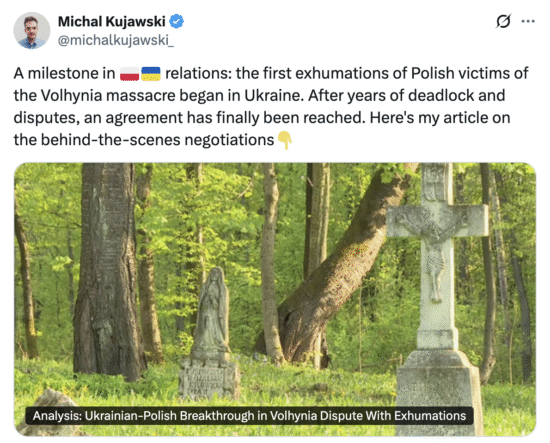
The exhumation is seen as a significant step in addressing one of the most painful chapters of Polish-Ukrainian history.
For many years, the memory of the Volhynia Massacre and the role played by the Organisation of Ukrainian Nationalists (OUN) and the Ukrainian Insurgent Army (UPA) during World War II has remained a major point of tension between Poland and Ukraine.
Between 1943 and 1945, these nationalist groups carried out what historians widely recognise as an ethnic cleansing campaign or genocide, resulting in the murder of nearly 100,000 Polish civilians — women, children, and men.
A particularly sensitive dispute has centred on the issue of exhumations and the search for the remains of Polish victims on Ukrainian soil. Since spring 2017, Ukraine’s Institute of National Remembrance has enforced a ban on such activities.
Source: PAP
Photo: X @LachowskiMateus
Tomasz Modrzejewski