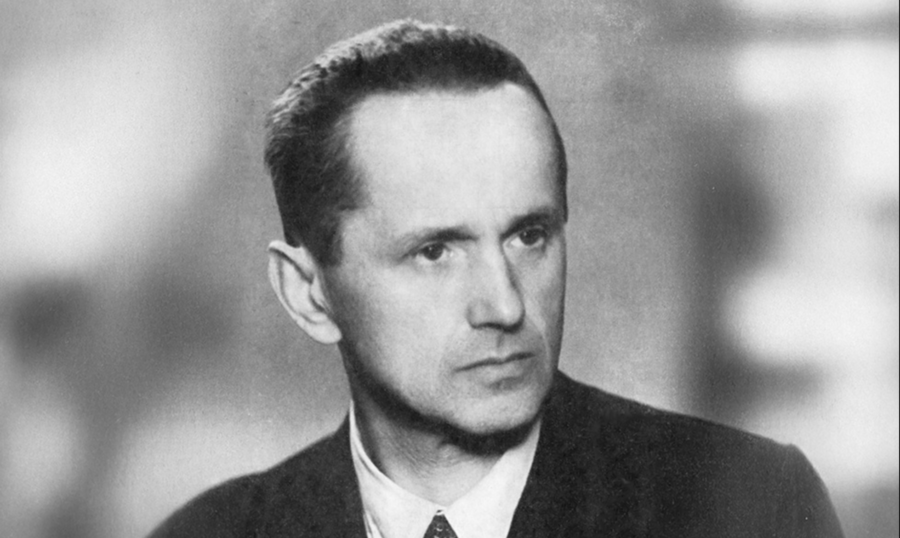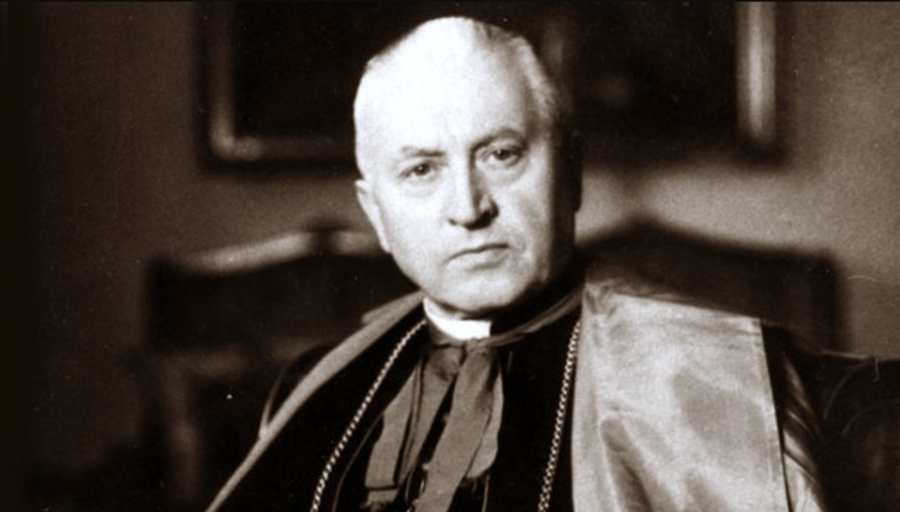
On the 78th anniversary of his death, we look back at the remarkable life of Cardinal August Hlond, a Silesian-born priest who rose to become Primate of Poland and one of the country’s most influential religious figures during the turbulent first half of the twentieth century.
On 22 October 1948, Cardinal August Hlond, the Primate of Poland, died in Warsaw at the age of 67. His passing marked the end of an extraordinary life that had spanned the partitions of Poland, the restoration of Polish independence, the devastation of the Second World War and the establishment of communist rule.
For more than two decades, Hlond had stood at the centre of Polish Catholic life, navigating the difficult relationship between Church, nation and state. His leadership helped shape the modern Polish Church, while his experiences during the war and its aftermath reflected the wider struggles of a country caught between competing totalitarian powers.
Yet his journey began far from the corridors of the Vatican or the archbishop’s residence in Warsaw, in a modest community in Upper Silesia.
August Józef Hlond was born on 5 July 1881 in Brzęczkowice, now part of Mysłowice in southern Poland. At the time, the region belonged to the German Empire, and Polish communities in Upper Silesia lived amid strong political, cultural and linguistic pressures.
After completing his primary education in 1893, Hlond briefly attended secondary school in Mysłowice. That same year, he and his elder brother Ignacy travelled to Turin, Italy, to continue their education at a Salesian institution.
The decision would profoundly influence his future.
An exceptionally capable pupil, Hlond demonstrated both intellectual promise and a talent for music. After further studies in Lombriasco, he entered the Salesian novitiate at Foglizzo in 1896 and made his religious profession the following year.
His academic abilities subsequently took him to the Pontifical Gregorian University in Rome, where he studied philosophy and completed his doctorate in 1900.
The experience introduced the young Silesian to the international structures of the Catholic Church. His time in Rome also allowed him to establish relationships within ecclesiastical circles that would later prove valuable.
Returning to Polish lands, he joined the developing Salesian institution in Oświęcim, where he taught subjects including history, mathematics, Greek and geography. He also conducted musical ensembles, organised performances and contributed to Salesian publications.
On 23 September 1905, he was ordained a priest in Kraków.
Over the following years, he took on increasingly responsible positions within the Salesian congregation, serving in Kraków and Przemyśl before moving to Vienna in 1909.
By 1919, in the aftermath of the collapse of Austria-Hungary, he had been entrusted with leadership of a Salesian province covering territories in Central Europe.
The restoration of Polish independence in 1918 transformed the political map of Central Europe. Upper Silesia, Hlond’s birthplace, became one of the most contested regions, with its future decided through plebiscites, uprisings and international negotiations.
In November 1922, Pope Pius XI appointed Hlond Apostolic Administrator of the Polish part of Upper Silesia.
It was a particularly demanding responsibility. The Catholic Church had to adapt to new borders and political institutions while serving communities divided by language, nationality and competing loyalties.
Hlond proved an effective organiser. He helped establish the administrative foundations of the Church in the region and oversaw the development of institutions that would serve the newly created Diocese of Katowice.
He became its first bishop, receiving episcopal consecration in January 1926.
His advancement was rapid. On 24 June 1926, Pope Pius XI appointed him Archbishop of Gniezno and Poznań, thereby making him Primate of Poland. Less than a year later, on 20 June 1927, he was elevated to the College of Cardinals.
At just 45, he had become one of the most prominent figures in the Polish Catholic hierarchy.
During the interwar years, Cardinal Hlond exercised considerable influence over religious and social life in the Second Polish Republic.
He promoted Catholic Action, a movement encouraging lay Catholics to participate more actively in public affairs and to bring Christian principles into social and cultural life.
He also paid particular attention to education, charitable work and the spiritual needs of Polish communities abroad.
In 1932, he established the Society of Christ for Polish Migrants, a religious congregation dedicated to pastoral care among the Polish diaspora.
This initiative reflected his belief that the Catholic Church had an important role in preserving religious and cultural identity among Poles living outside their homeland.
Hlond was also an energetic international traveller who represented the Polish Church at major religious gatherings, strengthening its connections with the wider Catholic world.
But the relative stability of the interwar period was abruptly shattered in September 1939.
When Germany invaded Poland on 1 September 1939, Cardinal Hlond faced one of the most consequential decisions of his career.
Following consultations with senior political and diplomatic figures, he left Poland, travelling through Romania before reaching the Vatican on 19 September.
Hlond nevertheless sought to use his international position to publicise the suffering of occupied Poland.
Through Vatican Radio, particularly during the final months of 1939, he delivered addresses drawing attention to the situation in his homeland. He also attempted to return to Poland, but the circumstances of the occupation prevented him from doing so.
In June 1940, he moved to France, where he continued documenting the persecution of Polish society and the Catholic Church under German occupation.
While staying in Lourdes, he prepared accounts of the conditions facing the Polish population, including the repression of religious institutions.
In February 1944, German security forces arrested him at Hautecombe Abbey in France. He remained in German custody until his liberation in April 1945.
After the war’s end, he travelled to Paris and then Rome, determined to return to Poland as soon as possible.
The country to which he would return, however, was radically different from the one he had left six years earlier.
When Hlond returned to Poland in the summer of 1945, he encountered a nation devastated by six years of war.
Millions had died, entire communities had disappeared, and much of the country’s religious and cultural heritage lay in ruins.
Poland had also undergone a profound political transformation. Its pre-war eastern territories had been absorbed into the Soviet Union, while former German territories in the west and north were placed under Polish administration.
At the same time, a communist government, backed by Moscow, was consolidating its power.
For Hlond, the immediate challenge was to rebuild the organisational and spiritual foundations of the Catholic Church while preserving its independence from the emerging political system.
His activities quickly attracted the attention of the communist security services, which regarded the Church as a potential obstacle to their efforts to reshape Polish society.
In 1946, the Vatican reorganised the country’s ecclesiastical administration. The historic union between the archdioceses of Gniezno and Poznań was dissolved, while Gniezno was linked to Warsaw.
Hlond consequently became Archbishop of Warsaw as well as Gniezno, combining the leadership of the Polish Church with responsibility for the shattered capital.
Despite mounting political pressures, Hlond devoted considerable energy to restoring religious life.
He supported the reconstruction of churches destroyed during the war, paying particular attention to Warsaw, where German destruction had left numerous historic buildings in ruins.
In June 1947, he established the Primate’s Council for the Reconstruction of Warsaw’s Churches, helping to organise efforts to restore some of the capital’s most important religious landmarks.
He also encouraged large-scale religious observances intended to strengthen a society traumatised by occupation and increasingly confronted with communist ideology.
One of the most significant took place on 8 September 1946, when Poland was consecrated to the Immaculate Heart of Mary during a national ceremony at Jasna Góra, the country’s most important Marian sanctuary.
Hlond also promoted commemorations of the 950th anniversary of the martyrdom of St Adalbert, one of Poland’s principal patron saints.
Such events were not merely religious ceremonies. In the context of post-war Poland, they also became powerful expressions of historical continuity and national identity.
For many Polish Catholics, the Church represented an institution that had survived the destruction of the war and remained independent of the ideology promoted by the new authorities.
Cardinal August Hlond died in Warsaw on 22 October 1948.
His funeral took place four days later, on 26 October, at a time when Poland was moving towards increasingly rigid Stalinist rule.
In accordance with his wishes, his coffin was placed within the ruins of St John’s Cathedral in Warsaw, a church almost destroyed by the Germans during the suppression of the Warsaw Uprising in 1944.
Source: PAP
Photo: X @ipngovpl
Tomasz Modrzejewski