German-Polish relations have rarely been good. Even today, although the two states are formally allied by their membership of NATO and privileged economic partners as members of the European Union, Germans and Poles can hardly be considered “brotherly peoples”. This regrettable situation can be explained by a millennium of sensitive neighbouring.
From its creation at the end of the 10th century, the Polish state was confronted militarily by the Germanic peoples. The following centuries were a succession of prolonged wars between the Kingdom of Poland and the Teutonic Knights.
This series of conflicts ended with, on the one hand, the debacle of the Teutons at the Battle of Grunwald (Tannenberg) in 1410 and, on the other hand, with the Thirteen Years’ War (1454-1466). After another war caused by the Teutonic Order in 1519-1521, the secular Protestant Duchy of Prussia was created in 1525, and the grand master of the order, Albrecht Hohenzollern, became its ruler.
Although the Duchy of Prussia was a vassal of the Polish-Lithuanian Commonwealth, it was ceded in the 17th century to the Brandenburg branch of the Hohenzollerns and in 1657 acquired its sovereignty. In 1701, Brandenburg-Prussia became the Kingdom of Prussia, which pursued a policy of hostility and contempt towards its eastern neighbour. This country was the main initiator of the three partitions of Poland.
In 1871, Prussia completed the work of unifying Germany, which until then had been made up of many small states. Both in the Kingdom of Prussia and in the united German Reich, the fight against Polishness and the Poles continued throughout the 19th century via an often brutal Germanisation policy.
German expansionism was one of the elements that led to the outbreak of the First World War. This resulted in a crushing defeat for the German Reich, the liquidation of the empire, and the creation of the Weimar Republic. It is this context that allowed Poland to regain its independence 123 years after having disappeared from the map.
In the aftermath of the Treaty of Versailles, certain territories which had been forcibly integrated into the German state returned within the Polish borders, namely almost the whole region of Greater Poland, part of Eastern Pomerania and a piece of Upper Silesia.
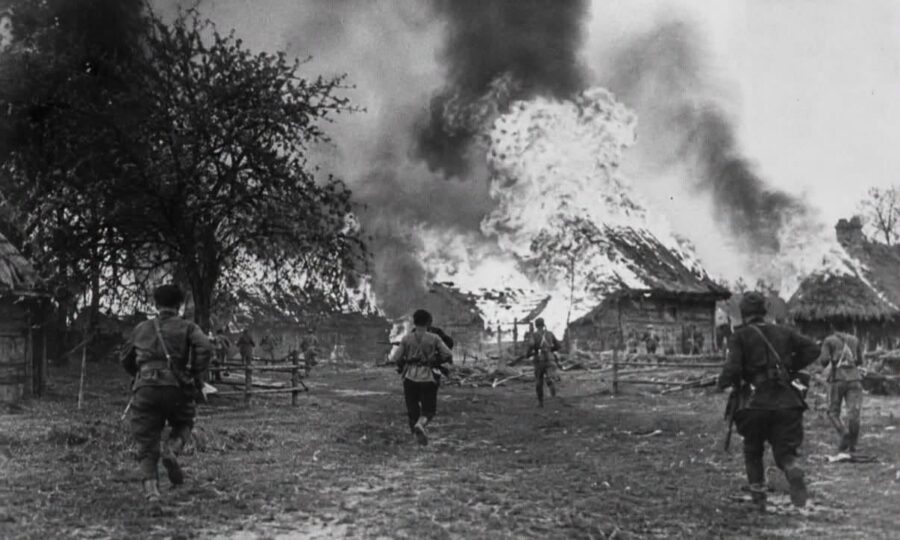
Then came the height of the German policy of violence toward Poland. This is of course, the Second World War. This was not a war like any other. During this conflict, the Germans (the SS, SA, the Gestapo, but also a large part of the soldiers of the Wehrmacht) perpetrated the most horrific crimes, in most cases against a defenceless civilian population.
Only a tiny fraction of the German criminals from 1939 to 1945 faced justice for their misconduct. Not only were heavy sentences an exception, but they were also rarely carried through. Several German citizens with the blood of thousands on their hands were released from prison after just a few years for health reasons. Also, the ratification of the border agreement between Poland and Germany took place only half a century after the end of the war.
Since the early 1990s and Germany’s reunification, the contact between the two countries has dramatically increased, mainly for economic reasons. The free exchange of goods and services from 2004 via membership in the EU and the passing of time softened the animosity to a certain extent. Yet some of the unthinkable wounds inflicted by Germany on its neighbour during the six years of the last world war remain open.
In a few years, there will be no more witnesses of WWII. Today, Poles who have clear memories of their childhood amid the German invasion are hard to find, although there are still a few of them out there. Their testimony is worth being recorded on tape for us, and for future generations. It’s a true goldmine of valuable information which allows us to understand better the deep-rooted mistrust of many Poles towards their western neighbours.
Image: I Stock
Author: Sébastien Meuwissen