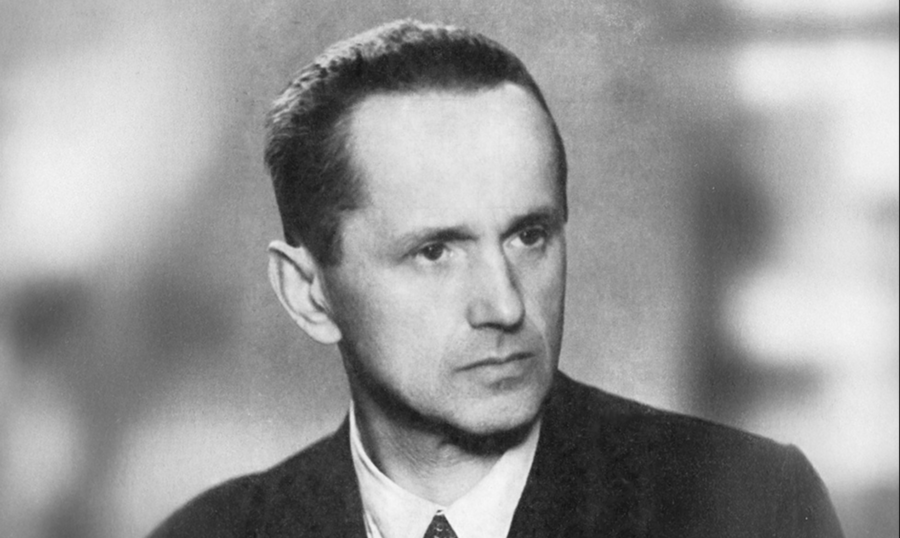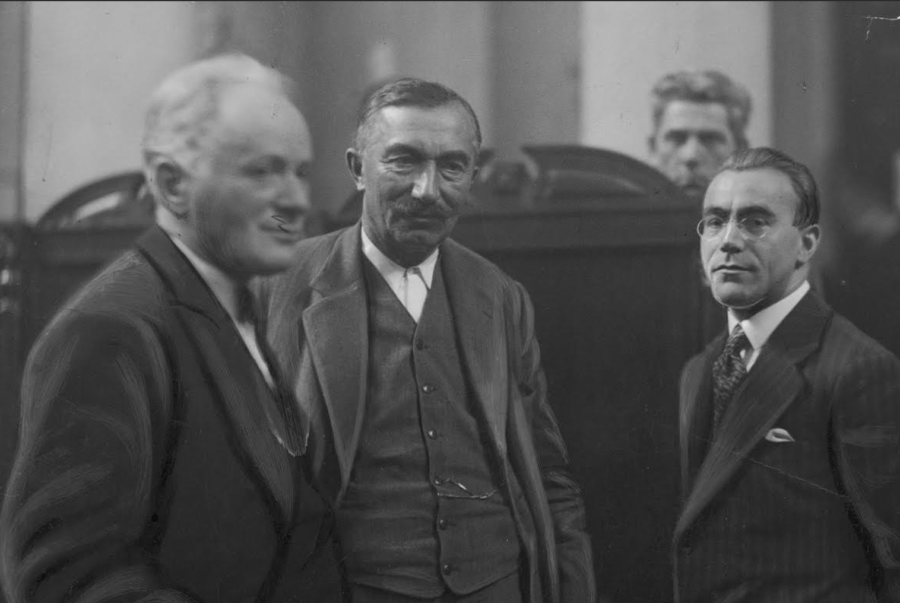
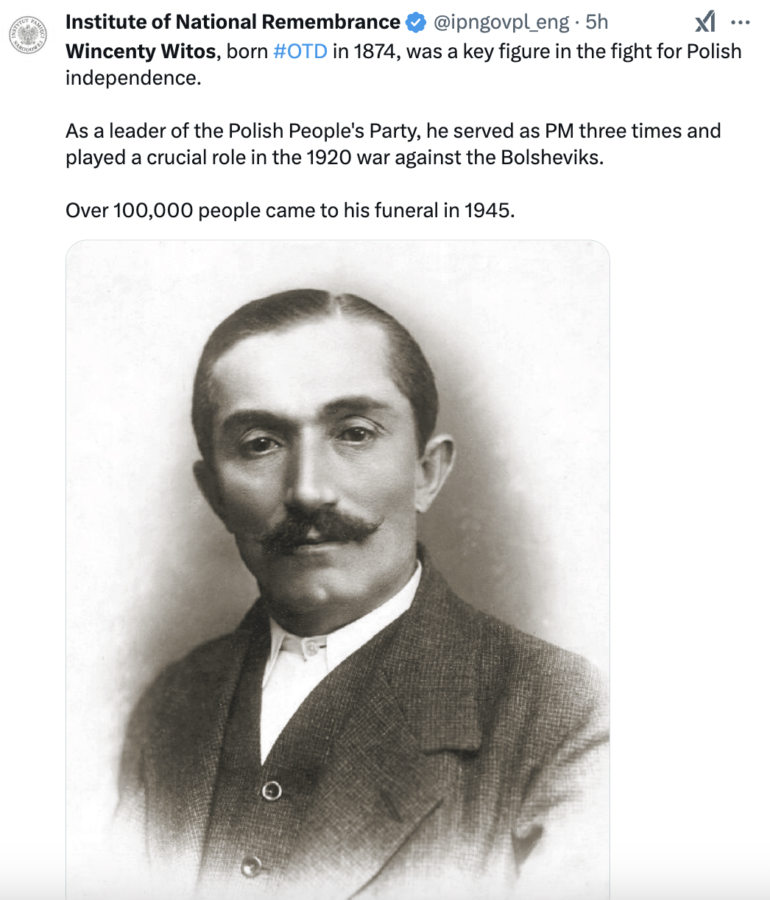
Wincenty Witos was born on 21 January 1874 in Wierzchosławice near Tarnów. He was an activist in the peasant movement, one of the Fathers of Polish Independence and a three-time Prime Minister of the Second Republic of Poland.
Witos lived a rather ordinary life as a farmer but became an influential social activist and local government leader, devoted to the peasant movement since its beginning. Born in the village of Wierzchosławice near Tarnów on 27 January 1874, he was involved in the social and economic organisations of the Polish peasantry.
Witos joined the People’s Party (from 1903 the Polish People’s Party or PSL) in 1895, and the Polish People’s Party ‘Piast’ in 1913.
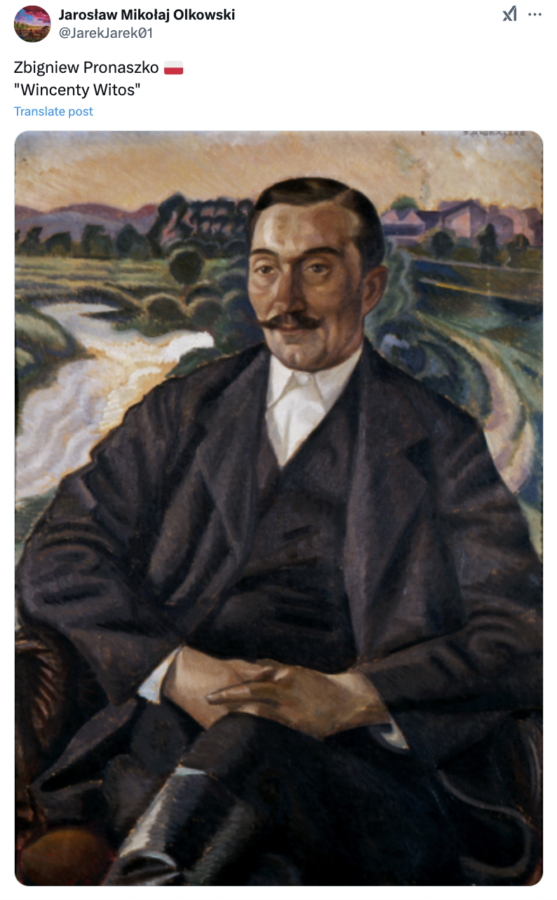
After Poland regained its independence in 1918, Witos headed the Polish Liquidation Commission, which substituted for the first Polish government in the area of the former Austro-Hungarian partition.
Witos refused to enter the first Polish government formed in Lublin because of its radical agenda represented by the socialist Prime Minister Ignacy Daszyński.
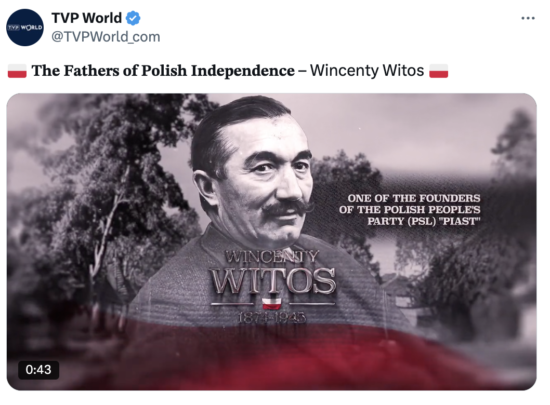
In the elections to the first Constituent Assembly, Witos was elected as MP and Chairman of the PSL ‘Piast’. From that day he became one of the central figures of the Second Polish Republic.
Witos became Prime Minister on 24 July 1920, at a difficult time during the Polish-Soviet War in the so-called War Cabinet, in which Ignacy Daszyński served as deputy Prime Minister.
During Witos’s rule, the Constitution, known as the March Constitution, was adopted on 17 March 1921. This event ended the process of forming the legal and political frames for the new Polish state.
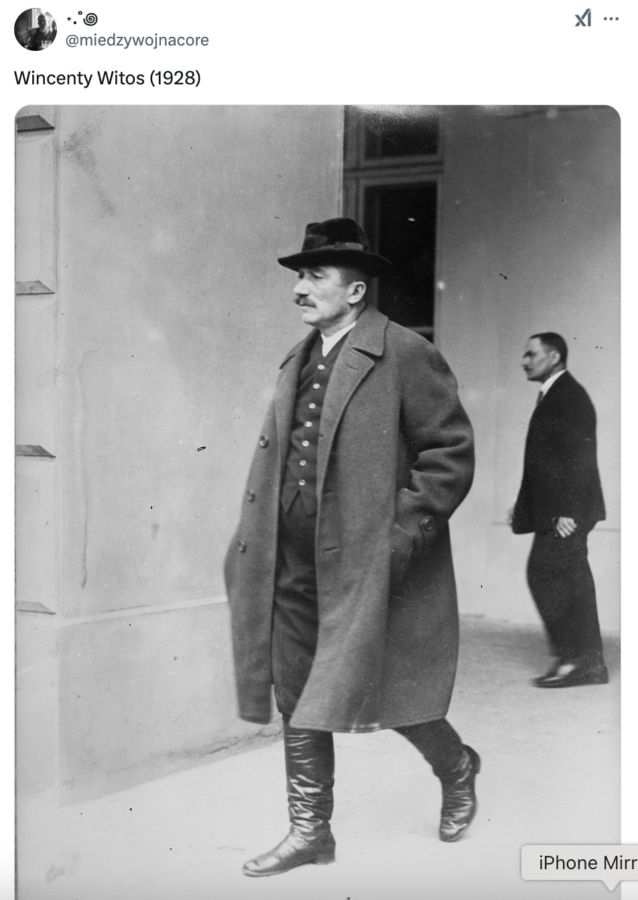
On 28 May 1923, Witos was again elected Prime Minister, leading a parliamentary coalition with the National Democratic Party.
Since the first contact of Witos and right-wing parties, his conflict with Józef Piłsudski started to escalate. Witos became Prime Minister once again on 10th May 1926, just two days before the successful coup d’etat headed by Piłsudski.
As a result of the so-called May Coup President Wojciechowski and Prime Minister Witos resigned.
In 1929, Witos became one of the leaders of the ‘Centrolew’ which was an opposition coalition of centre and left-wing parties, aimed at fighting the new authoritarian order proposed by Piłsudski’s Sanacja.
Leaders of those groupings were arrested by the orders of Józefł Piłsudski. As a result, Witos was imprisoned for 74 days in a military prison in Brześć.
He was one of the main defendants in the so-called Brest Trial.
On the night of 9-10 September 1930, military police and police forces arrested more than a dozen opposition politicians.
Those accused in the trial were six members of the PPS: Herman Lieberman, Norbert Barlicki, Adam Pragier, Stanisław Dubois, Adam Ciołkosz and Mieczysław Mastek, and five representatives of the PSL: Wincenty Witos, Władysław Kiernik, Kazimierz Bagiński, Józef Putek and Adolf Sawicki.
Witos was sentenced to 1.5 years in prison for his political activities in opposition to the ruling regime. Later Witos went into political exile in Czechoslovakia on 28 September 1933.
Wincenty Witos returned to Poland in March 1939. He was arrested by the German occupation authorities in September, after the start of the 2 World War. He refused to cooperate with attempts to establish a collaborationist government.
In 1945, he was appointed Vice-Chairman of the National People’s Council, but due to his illness was unable to take the post.
After the World War, 2 together with Stanisław Mikołajczyk, he re-established the Polish People’s Party, in which he served as Chairman from August 1945.
Wincenty Witos died on 31 October 1945. He is buried in the cemetery in Wierzchosławice, which to this day remains an important place for the members of the Polish Peoples Party.
In 2023 the Supreme Court acquitted Wincenty Witos and nine other former PSL and PPS (Polish Socialist Party) leaders and officially cleared their names. The decision came as a result of a motion proposed by the Polish ombudsman in 2020.
Source: PAP, Polskie Radio, Dzieje
Photo:@DziejeSejmu
Tomasz Modrzejewski