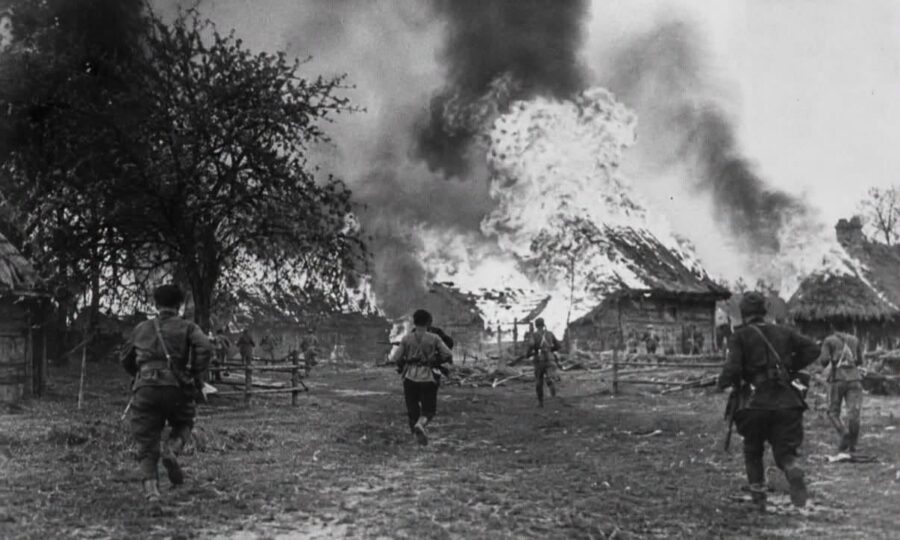
In the heart of German-occupied Europe, amid the smouldering ruins of Warsaw, a unique chapter of international solidarity unfolded in the summer of 1944. While the world watched the Polish capital fight for its life, a multinational force of Allied airmen embarked on what would become one of the most dangerous and heroic aerial missions of World War II — the Warsaw Airlift.
On 3 August 1944, with the Warsaw Uprising just days old, the Allied command made a bold decision: to launch supply drops over the city to aid the Polish Home Army (Armia Krajowa), fighting one of the deadliest urban battles in European history. The airmen—mainly from the RAF, South African Air Force (SAAF), and the Polish 1586 Special Duty Squadron—took off from Brindisi, Italy. Their missions required flying more than 2,600 km round-trip, through heavily defended Nazi airspace, under the cover of night.
Some crews returned on fumes, landing in Brindisi with empty tanks. Others never made it back.
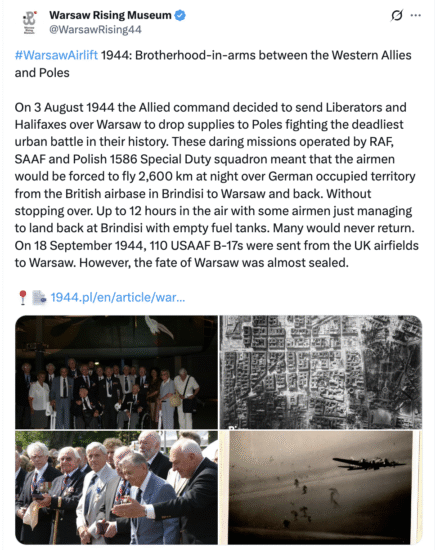
The missions began with Polish crews alone. Soon, British and South African squadrons joined, including No. 148 RAF, No. 178 RAF, and SAAF’s 31st and later 34th Squadrons. These flights were perilous — low-level, under heavy fire, over a burning city.
One man who never forgot was Bombardier Bryan Desmond Jones. Recalling the pre-flight briefing, he remembered a Polish officer rising to address the assembled Allied airmen:
“He was very emotional. He said, ‘My country, Poland, is in serious trouble. And I plead with you – South African and British gentlemen – to help Poland tonight.”
That officer, Captain Zbigniew Szostak, would die in action the very next day.
The airmen flew over Warsaw at altitudes as low as 300 feet. Flak, searchlights, and night fighters haunted every mission. George Robert Adams of No. 178 RAF Squadron described the surreal nightmare of flying into such concentrated fire:
“We came in about three hundred feet… we flew over the city. We were being fired at… Our guns shot at the searchlights. Without that, we’d have crashed.”
Air Marshal Sir John Slessor later captured the sheer audacity of these missions:
“It was quite another thing to bring a big aircraft down to a thousand feet… over a great city, itself the scene of fires and flashes from guns and bursting shell.”
While the British and Commonwealth crews continued the airlift at great cost, political roadblocks hampered American efforts. Franklin D. Roosevelt tried in vain to persuade Stalin to allow U.S. planes to refuel at Soviet-controlled airfields, a denial that cost precious time.
Only in September did the Soviets relent. On 18 September 1944, 107 B-17 bombers from the USAAF flew in from England. Flying high at 5,000 feet, they dropped 1,284 containers—tragically, only about 20% reached insurgent-held zones.
Still, for Warsaw’s embattled residents, the sight of Allied aircraft overhead brought hope: a signal that they were not forgotten.
The cost of this solidarity was staggering. Dozens of planes were shot down; hundreds of airmen perished. In a telegram to South African Field Marshal Jan Smuts, Polish President Władysław Raczkiewicz wrote:
“The epic flights will not be forgotten by the Polish people for many years to come.”
Smuts replied with equal gravity:
“We are proud to have stood by Warsaw in her hour of ordeal.”
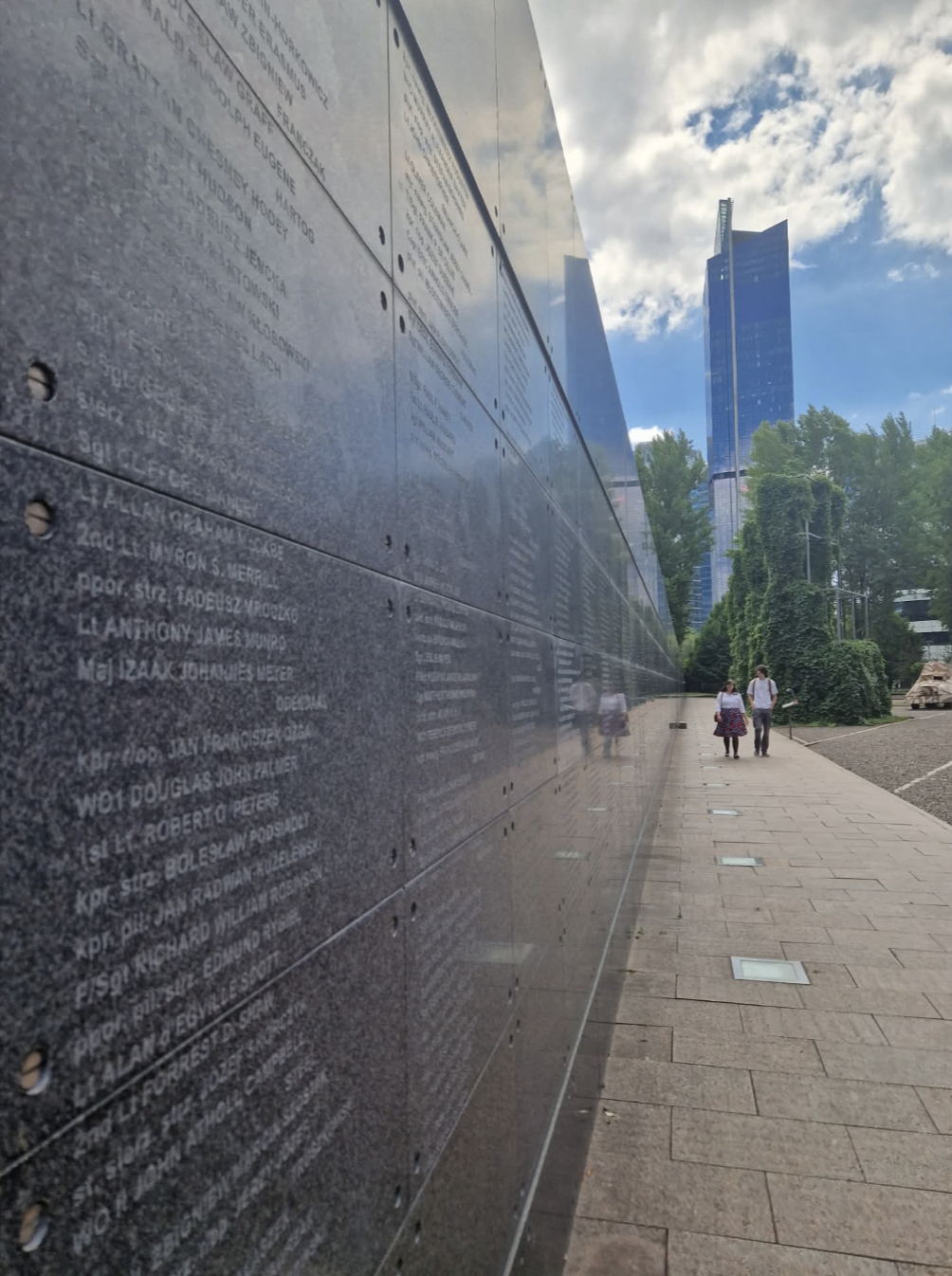
According to the Warsaw Rising Museum, 112 Polish, 90 British, 43 South African, and 12 American airmen died supporting the Warsaw Uprising. Their names are now etched on the Memorial Wall at Freedom Park in Warsaw — a roll call of international sacrifice:
- First Lieutenant Francis E. Akins
- Captain Leonard Charles Allen
- Lieutenant Peter Herbert Andrews
- Second Lieutenant Clyde Alison Arrants
- Corporal (Navigator) Włodzimierz Augustyn
- Warrant Officer Wilhelm Andrzej J. Balcarek
- Sergeant Fernard Joseph Barrett
- Warrant Officer Murray Alexander Baxter
- Flying Officer Ely Berenson
- Warrant Officer (Pilot) Józef Bielicki
- Warrant Officer (Radio Operator/Gunner) Stefan Bohanes
- Flying Officer Albert Milvron Bonney
- Warrant Officer Edward Bradshaw
- Lieutenant John Christopher Branch-Clark
- Warrant Officer 1 Douw B. Brandsma
- Warrant Officer II Herbert James Brown
- Lieutenant Oliver Coleman
- Lieutenant Cedrick Arthur Cooke
- Lieutenant Percy Gordon Coutts
- Major (Navigator) Stanisław Jerzy Daniel
- Flight Sergeant Robert Samuel Darling
- Sergeant Sydney John Davis
- Technical Sergeant Frank P. De Cillis
- Flying Officer Ronald George Devine
- Warrant Officer (Bombardier) Tadeusz Dubowski
- Corporal (Radio Operator) Józef Dudziak
- Second Lieutenant (Bombardier) Konstanty Dunin-Horkowicz
- Corporal (Gunner) Franciszek Dziaduła
- Captain Eric Arnold Endler
- Warrant Officer 1 Jacobus Burger Erasmus
- Lieutenant Keith Fairweather
- Warrant Officer (Pilot) Włodzimierz Sergiusz Fedziński
- Warrant Officer (Gunner) Jan Florkowski
- Second Lieutenant (Pilot) Mieczysław Witold Foczpaniak
- Sergeant Cecil Edward Foreman
- Second Lieutenant (Pilot) Stanisław Zbigniew Franczak
- Sergeant Edward George Fretwell
- Sergeant William George Clement Garner
- Warrant Officer (Pilot) Bolesław Graff
- Second Lieutenant Robert George Hamilton
- Staff Sergeant Paul F. Haney
- Sergeant Ronald Rudolph Eugene Hartog
- Lieutenant Arthur James Hastings
- First Lieutenant Paul R. Hibbard
- Lieutenant Grattan Chesney Hooey
- Sergeant Sidney Frank Horne
- Sergeant William Huddart
- Sergeant Herbert Hudson
- Lieutenant Eric Ben Horton Impey
- Lieutenant (Navigator) Bolesław Antoni S. Jasiński
- Lieutenant Tadeusz Jencka
- Corporal (Gunner) Edward Jodis
- Sergeant Gordon Wallace Joslyn
- Corporal (Bombardier) Jan Kantowski
- Second Lieutenant (Navigator) Stefan Gabriel Kleniewski
- Lieutenant Walter Klokow
- Corporal (Gunner) Bronisław Kłosowski
- Second Lieutenant Władysław Kozioł
- Second Lieutenant Zbigniew Jerzy Kozłowski
- Second Lieutenant (Navigator) Tadeusz Lach
- Lieutenant Ray Arras Lavery
- Sergeant Thomas Law
- Captain Gordon Lawrie
- Lieutenant Ralph Laurence Lawson
- Warrant Officer Jasper Victor Lee
- Sergeant Peter Henry George Lees
- Lieutenant Herbert Henry Lewis
- Lieutenant Bernard Thomas Loxton
- Staff Sergeant George A. MacPhee
- Flying Officer George Dougald MacRae
- Warrant Officer (Gunner) Rudolf Majewski
- Sergeant (Gunner) Stanisław Malczyk
- Lieutenant Harry Allpress Ruston Male
- Sergeant (Pilot) Brunon Malejka
- Sergeant Clifford Manley
- Warrant Officer (Flight Engineer) Jan Zdzisław Marecki
- Sergeant Leslie Mayes
- Lieutenant Allan Graham McCabe
- Lieutenant Allan John McInnes
- Flight Sergeant Hugh Valance McLanachan
- Second Lieutenant Myron S. Merrill
- Warrant Officer II Joseph Arnold Meyer
- Sergeant Matthew Thomas Mountain
- Second Lieutenant (Gunner) Tadeusz Mroczko
- Warrant Officer (Flight Engineer) Stanisław Józef Mucha
- Second Lieutenant (Gunner) Adam Mühl
- Lieutenant Anthony James Munro
- Sergeant John Richard William Nickerson
- Major Izaak Johannes Meyer Odendaal
- Corporal (Gunner) Tadeusz Ogrodnik
- Warrant Officer 1 Terence Desmond O’Keefe
- Captain (Navigator) Franciszek Kazimierz Omylak
- Corporal (Radio Operator) Jan Franciszek Ożga
- Warrant Officer Ernest Henry John Page
- Flight Sergeant Roland Charles Pain
- Warrant Officer 1 Douglas John Palmer
- Corporal (Gunner) Jan Paszkiewicz
- Warrant Officer (Radio Operator) Witold Paździor
- First Lieutenant Robert O. Peters
- Lieutenant Gordon Bruce Pitt
- Captain (Pilot) Zygmunt Pluta
- Corporal (Gunner) Bolesław Podsiadły
- Sergeant John Edward Porter
- Sergeant William Pratt
- Corporal (Pilot) Jan Radwan-Kużelewski
- Captain Nicolaas van Rensburg
- Sergeant Gerard Thomas Robinson
- Flight Sergeant Richard William Robinson
- Sergeant Peter Henry Roots
- Warrant Officer Wincenty Tadeusz Rutkowski
- Second Lieutenant (Pilot/Gunner) Edmund Rygiel
- Sergeant Richard Herbert Charles Scott
- Sergeant Arthur Sharpe
- Second Lieutenant Forrest D. Shaw
- Staff Sergeant Walter P. Shimshock
- Sergeant (Gunner) Roman Jakub Sikorski
- Senior Sergeant (Gunner) Józef Skorczyk
- Lieutenant (Bombardier) Kazimierz Sorówka
- Warrant Officer 1 Reginald Walter Stafford
- Warrant Officer II John Atholl Campbell Steel
- Lieutenant Timothy A. Stewart
- Sergeant Rupert Vincent Stonier
- Lieutenant Alan d’Egville Scott
- Sergeant George Swift
- Corporal (Flight Engineer) Alfred Jan Szmigielski
- Captain (Pilot) Zbigniew Marcin Szostak
- Warrant Officer (Flight Engineer) Antoni Jan Szyller
- Flight Lieutenant Edwin Charles Thyer
- Senior Sergeant Jerzy Józef Truszkowski
- Sergeant Edward Hall Turner
- First Lieutenant Joseph J. Vigna
- Corporal (Radio Operator) Karol Wałaszek
- Corporal (Radio Operator) Ludwik Wantulok
- Lieutenant Thomas Tennant Watson
- Sergeant (Gunner) Bolesław Wawrzak
- Warrant Officer (Pilot) Bernard Weber
- Sergeant (Radio Operator) Edward Weinz
- Warrant Officer (Bombardier) Bernard Wichrowski
- Second Lieutenant (Pilot) Kazimierz Widacki
- Sergeant John Winter
- Sergeant (Radio Operator/Gunner) Józef Witek
- Sergeant (Flight Engineer) Leon Zygmunt Witkowski
- Warrant Officer II Ben Nevis Woods
- Warrant Officer (Pilot) Józef Henryk Woroch
- Lieutenant (Navigator) Lucjan Piotr Woytanowicz
- Flight Sergeant Ronald Zambra
- Warrant Officer (Flight Engineer) Edmund Zieliński
For those who survived, the bonds forged in those deadly nights remained unbroken. In the 1980s, former airmen reunited to form the “Warsaw ’44 Club” and later the “Air Bridge Association.” They published newsletters, held reunions, and honoured their fallen comrades across continents. In 2006, a group of veterans visited the Warsaw Rising Museum. Some returned to Poland to unveil memorials. Others remained in touch until the very end.
Among those who risked their lives to aid the Warsaw Uprising were also the English – steadfast friends of Poland. One of them is Jim Auton, who served as an RAF airman and flew over the burning city in August 1944 to drop supplies for the fighting Home Army. On the night of 13–14 August, his crew spent a full 50 minutes over the capital, braving enemy fire and great danger until Jim was certain the cargo had reached the resistance.
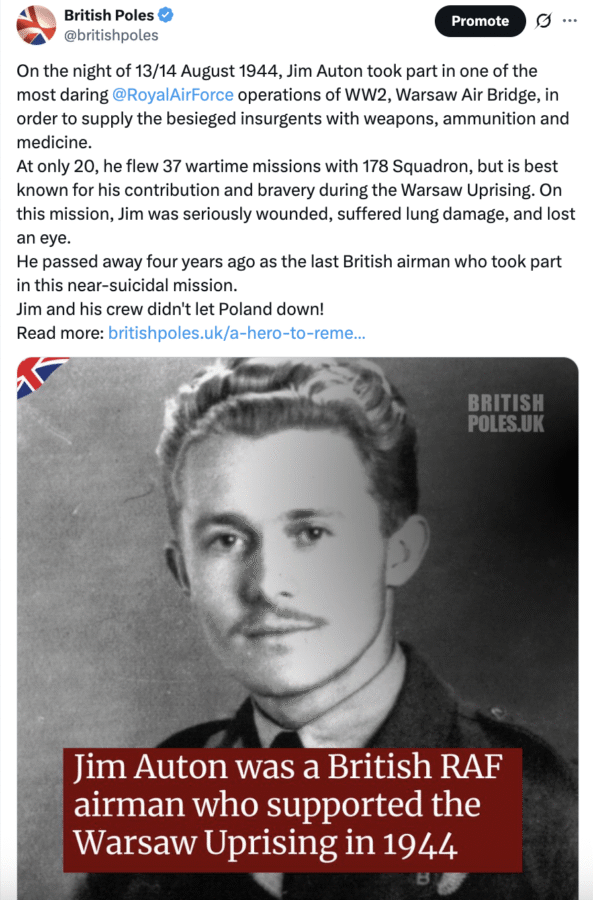
After the war, Jim Auton never turned his back on Poland. It was thanks to his initiative that a memorial was erected at Newark-on-Trent Cemetery – the largest Polish military airmen’s burial site in the world.
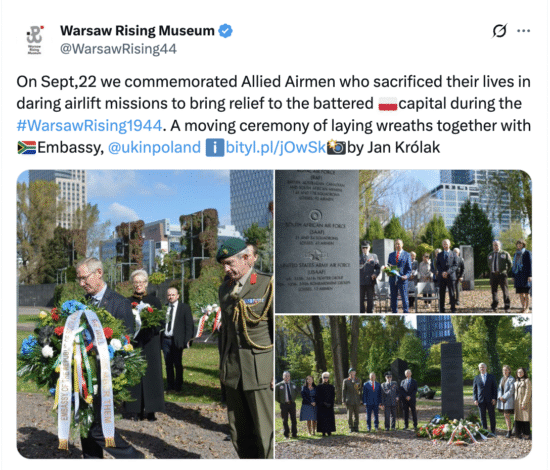
The monument honours both the Allied aircrews who lost their lives flying missions over Warsaw and the unwavering courage of the Home Army and the people of the capital who stood up in a desperate struggle for freedom. For Poles in exile, it is more than a gesture of gratitude – it is a solemn pledge never to forget people like Jim.
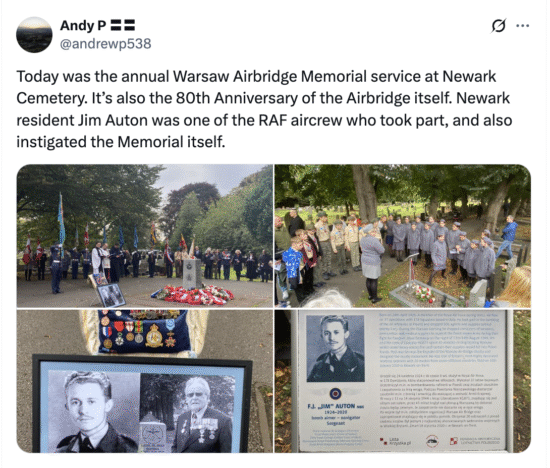
Jim Auton died in January 2020. The British Poles editorial team had the honour of attending the funeral Mass at St. Mary Magdalene Church in Newark and the burial of Jim Auton on 6 February 2020 at Newark-on-Trent Cemetery.
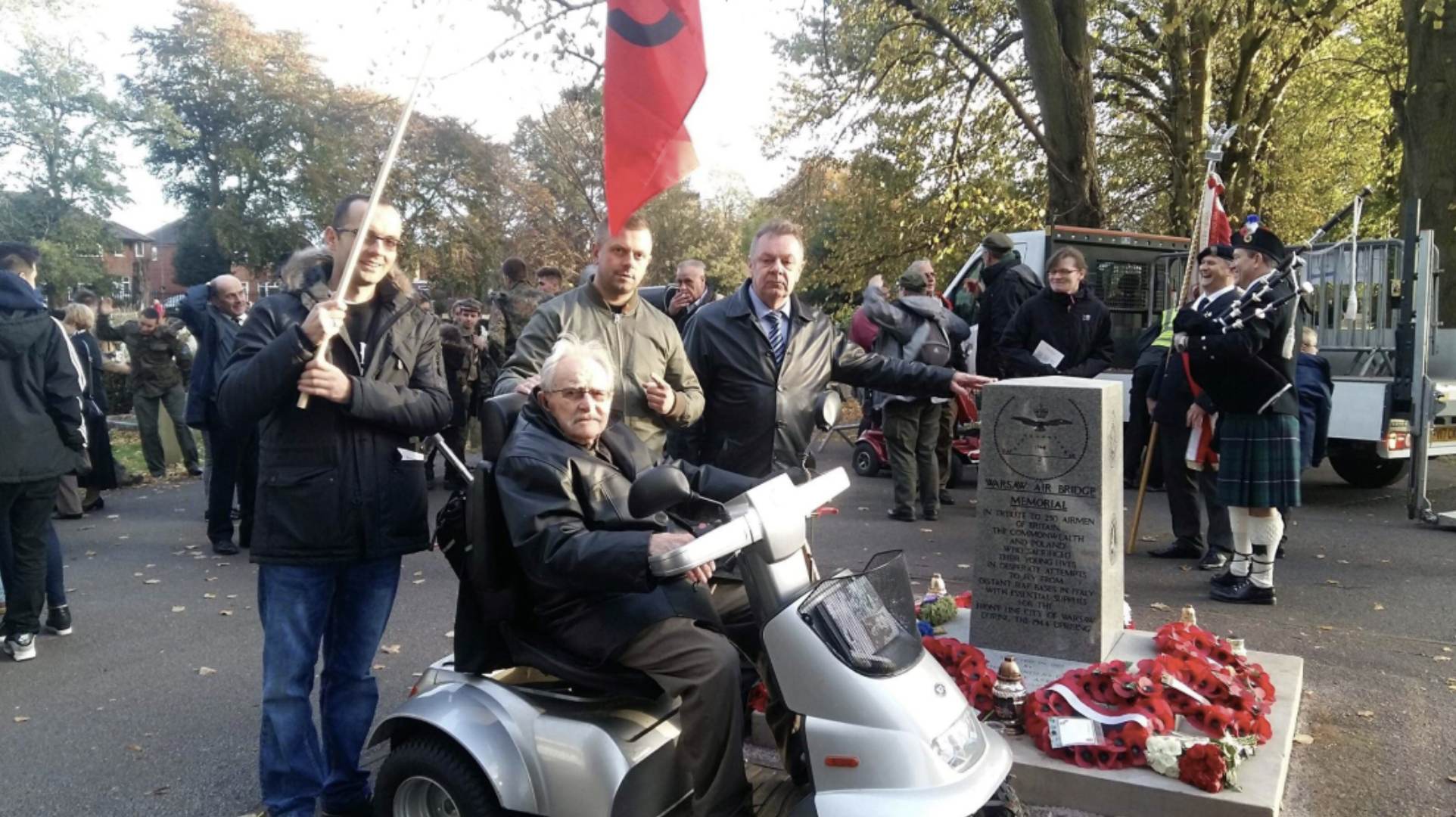
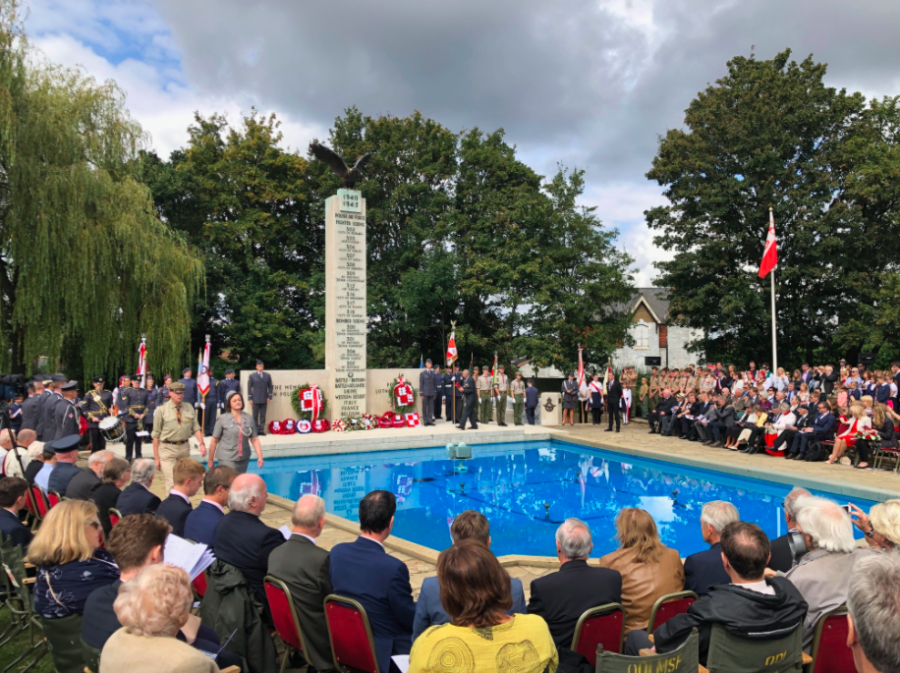
Jim was laid to rest just steps from the Warsaw Air Bridge Memorial, which, as few Poles living here today know, he built in 1989.
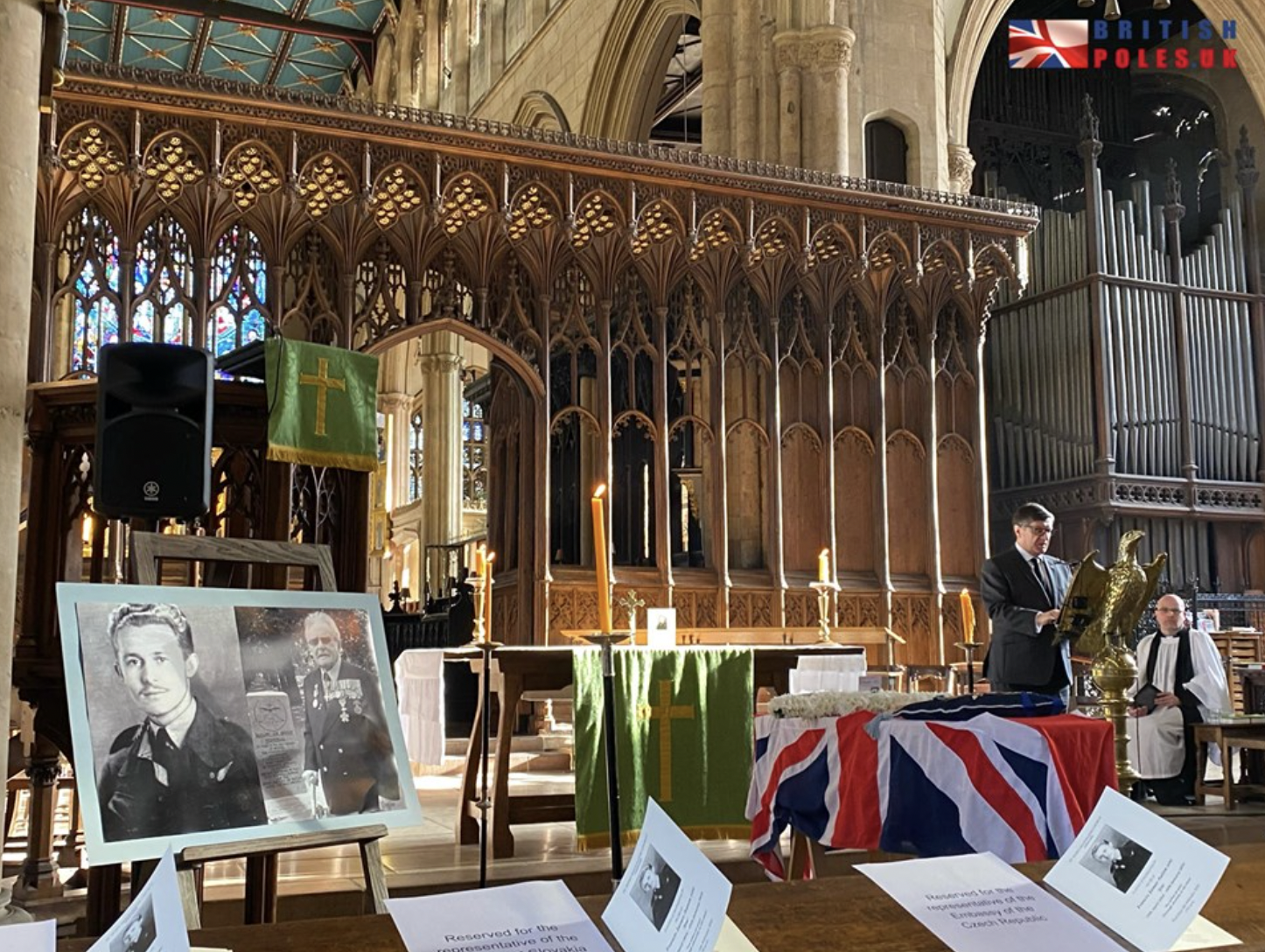
You can read more about Jim Auton in our article Jim Auton, RAF hero of the Warsaw Uprising, was laid to rest with hundreds of strangers paying their respects.
All that happened as from the Vistula’s eastern bank, the Soviet Red Army watched as Warsaw was reduced to rubble. They intervened only in January 1945, long after the city’s fall. By then, over 180,000 Poles had died. Some 650,000 residents were expelled; the city, home to nearly a million before the war, ceased to exist in any meaningful form.
Communism would cast its long shadow over Poland for the next 44 years.
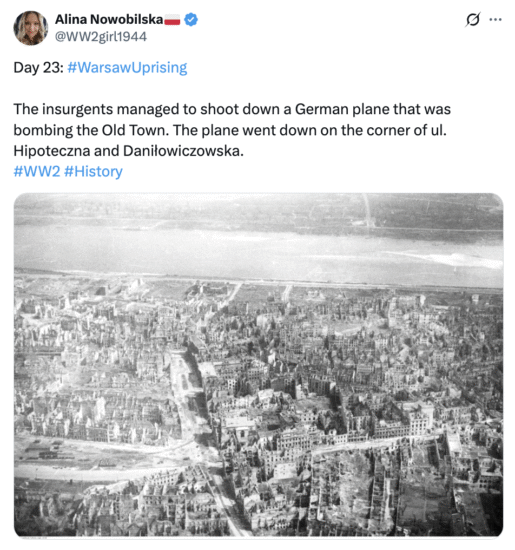
Today, memorials and commemorations across Poland honour these silent heroes of the sky. Official ceremonies mark their sacrifice, and new monuments continue to appear. Their legacy lives on not only in bronze and stone, but in the collective memory of a nation that remembers who flew through the fire — and who did not turn away from Poles in desperate need.
Source: Warsaw Rising Museum, British Poles
Photo: IPN, British Poles, Warsaw Rising Museum
Tomasz Modrzejewski