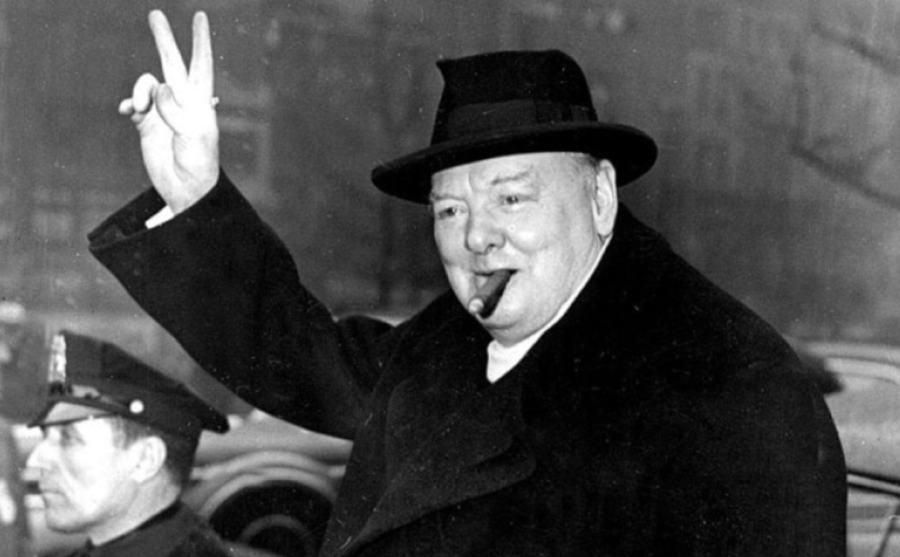
On 22 February 1944, British Prime Minister Winston Churchill gave a speech in the House of Commons in which he de facto accepted the Soviet Union’s annexation of almost half of Polish territory. The decision was a tragic blow to the Polish government in London and millions of Poles who fought for their independence for six long years of the conflict.
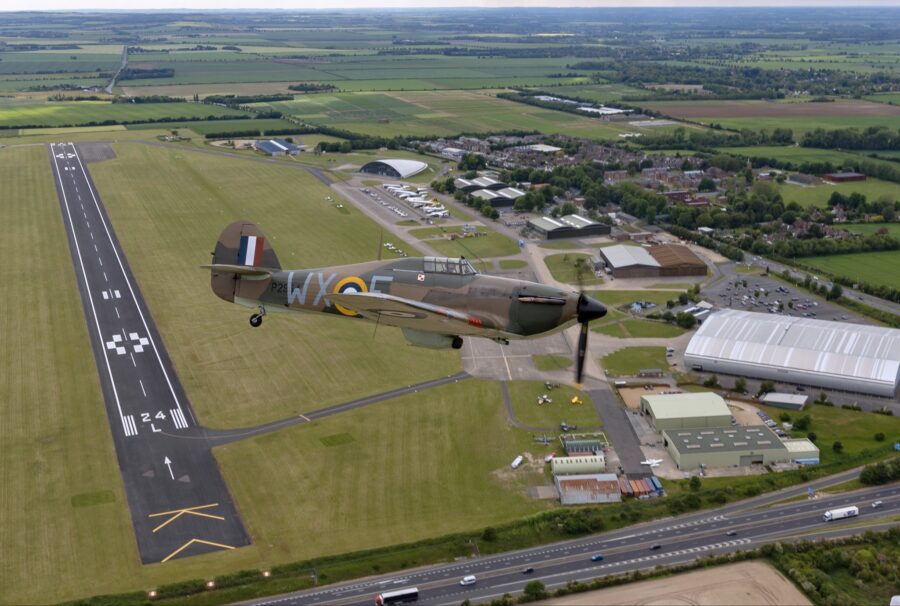
When Poland was invaded by Russia and the Soviet Union in 1939 the Polish Army continued to fight the Germans on fronts across the world and became the first Ally of Britain in the Ant-Hitler Coalition in Europe.
When the war started in 1939 Poland never considered giving away any of its territory to either of its enemies, and most importantly its elite could not imagine such a decision to be supported by its closest ally – the United Kingdom.
On 14 August 1941, British Prime Minister Winston Churchill and US President Franklin D. Roosevelt signed the Atlantic Charter which clearly stated that any future territorial changes must be put to the people’s decision.
Churchill’s statements presented to the parliament in 1944 constituted a clear violation of the provisions of the second clause of the Atlantic Charter, whose signatories stated that they ‘do not wish to implement any territorial changes that do not accord with the freely expressed wishes of the peoples concerned’.
Nevertheless, in 1944, Winston Churchill proposed Poland’s new western border on the Oder and Lusatian Neisse (or Klodzka Neisse) rivers in the West and completely stripped of its territories in the East.
The idea was to reward the Soviets for their casualties and also encourage Stalin for even more aggressive military tactics against the Germans showing that he could shape the future of Europe with blind force.
Stalin welcomed the idea to extend his Western borders at the expense of Poland.
“We had never weakened in our resolve, even in the period when we were all alone, and that the fate of the Polish nation holds a prime place in the thoughts and policies of His Majesty’s Government and of the British Parliament.”
Other parts of his speech were not as optimistic for Polish territorial unity. Churchill said that a quarter of a century earlier, Poland had acted with force to enlarge its territories in the East making it a case to determine the new border without asking anybody but Stalin.
The most disturbing part of the speech was one in which Churchill stressed that Britain had never guaranteed Poland’s pre-war borders. According to the British Prime Minister the borders of “New Poland” were to be decided only at a planned peace conference.
“Here I may remind the House that we ourselves have never in the past guaranteed, on behalf of His Majesty’s Government, any particular frontier line to Poland,” Churchill said.
“However, the advance of the Russian Armies into Polish regions in which the Polish underground army is active makes it indispensable that some kind of friendly working agreement should be arrived at to govern the war-time conditions and to enable all anti-Hitlerite forces to work together with the greatest advantage against the common foe,” Churchill added aiming to address the problem of Polish underground Army fighting the Germans on Polish lands that the USSR wanted to incorporate.
The words of the British Prime Minister were criticised by many Polish politicians and members of the intelligentsia.
“Well, in the conditions placed before us on 22 February, we see only what we are to relinquish, what we are to give up, while what we are left with is defined vaguely,” wrote Stanisław Cat-Mackiewicz, a well-known political commentator of the time.
In the following months, British diplomats still considered negotiating slightly more favourable borders for Poland and wanted to secure Lwów in its borders.
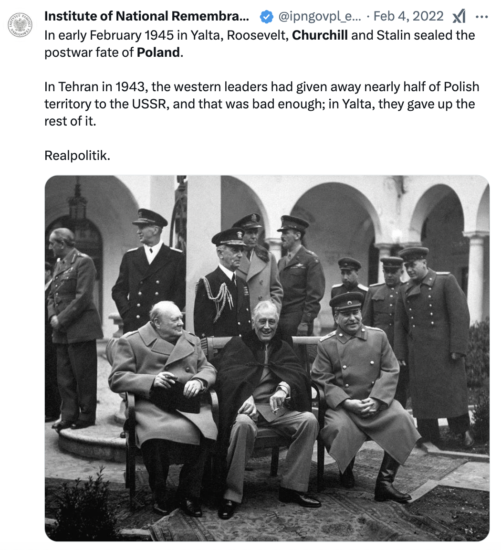
Eventually, in February 1945 Churchill, Roosevelt and Stalin agreed at the Yalta conference that the future Polish-Soviet border would be situated on the Curzon Line with minor changes for the benefit of Poland.
Source: IPN, Dzieje.pl, api.parliament.uk
Photo: @OnthisdayRN
Tomasz Modrzejewski