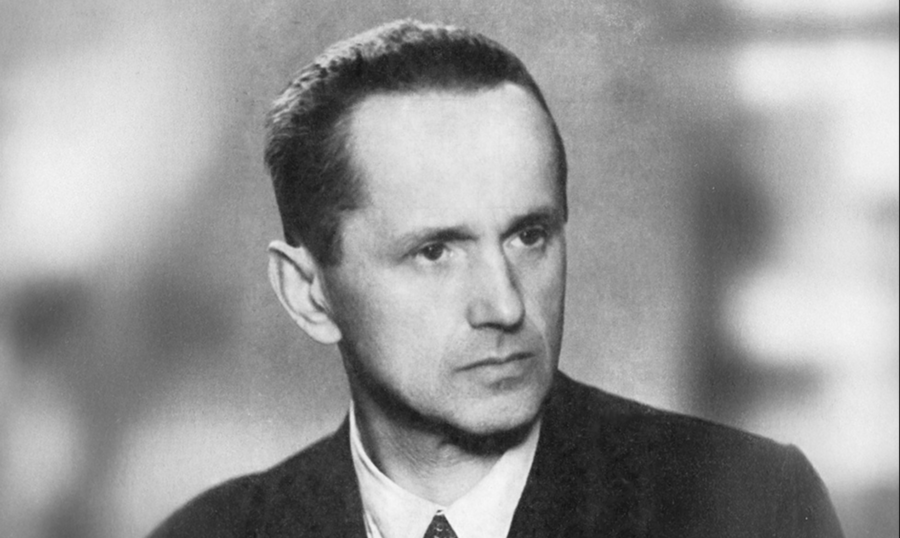
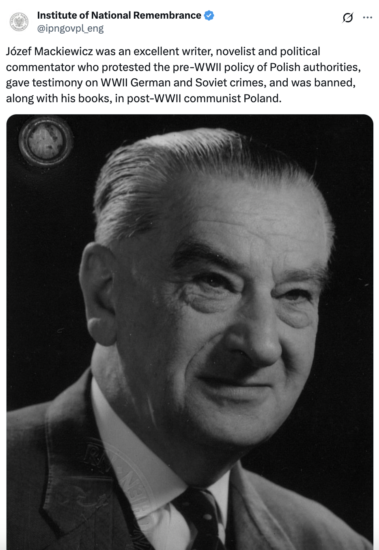
Józef Mackiewicz was born in Saint Petersburg on 1 April 1902. He was raised in a patriotic Polish home, his older brother was Stanisław Cat Mackiewicz, a journalist and writer, prime minister of the Polish government in exile in 1945-1955. Mackiewicz is considered one of the most important Polish writers of the 20th century for his great depictions of communities torn by totalitarianism.
In 1920, Mackiewicz took part in the Polish-Soviet War as a student of secondary school in Vilnius.
Mackiewicz was a student of natural sciences at Vilnius University, particularly interested in ornithology, and went down in his friends’ memory as a bird lover, expert and breeder. He wrote reports from his travels in the Polish Eastern Borderlands, which he published in the Vilnius “Słowo” – a newspaper run by his brother Stanisław Cat-Mackiewicz.
During the German occupation in Vilnius between July and October 1941, Mackiewicz published in the ‘Goniec Codzienny’, a newspaper published in Polish by the German occupation authorities.
He was an eyewitness of the terrible Ponary Massacre on Poles and Jews perpetrated by the Germans and Lithuanians collaborating with the Nazis.
In total, he published four articles there about the Soviet occupation of Lithuania, but the very fact of writing to the ‘gadzinówka’ (a journal run by the occupation authorities) became the basis for Mackiewicz’s later accusations of collaboration with the Germans.
According to later interpretations, this was the reason why the Home Army Special Military Court passed a death sentence on the writer in 1943.
The sentence on Mackiewcz was to be carried out by another writer and Home Army soldier – Sergiusz Piasecki. However, the writer-soldier refused to carry out the sentence for the first and only time in the history of his collaboration with the Home Army because he had doubts about the motives of the death sentence and Mackiewicz’s true guilt.
In May 1943, after the discovery in Katyn of the graves of Polish officers murdered by the Soviets, at the invitation of the Germans and with the consent of the Polish underground authorities, Mackiewicz went to Katyn in the company of several other Polish writers as an observer of the exhumation of the bodies.
On his return, an interview with Mackiewicz entitled “I saw with my own eyes” was published in the daily “Goniec Codzienny”. Then he wrote a book entitled “Katyn: a crime without trial or punishment”, being one of the first works to point to the Soviets as responsible for the Katyn massacre.
In 1945, Mackiewicz emigrated from Poland. After he had stayed for some time in Rome and London, he finally settled in Munich. He collaborated with Jerzy Giedroyc’s famous “Kultura” and many other émigré periodicals, including Russian, Byelorussian and Ukrainian.
Among his most important works was an epic novel, “Kontra”, describing the fate of Cossacks during the 2nd World War.
Throughout his life, Mackiewicz published eight novels, a volume of novellas, three journalistic books, several pamphlets and two volumes of memoirs.
In 1989, the Polish Nobel Prize winner for literature Czesław Miłosz wrote in ‘Kultura’ that Mackiewicz writes “against the whole world, which calls black white, and there is no one to set up a veto”.
The writer died in Munich on 31 January 1985. The urn containing his ashes was laid to rest on 1 March 1985 in the crypt of St. Andrew Bobola Church in London.
In his last will, he expressed his wish to be buried in Vilnius when the city was liberated from Soviet occupation.
Source: Dzieje.pl
Photo: IPN
Tomasz Modrzejewski