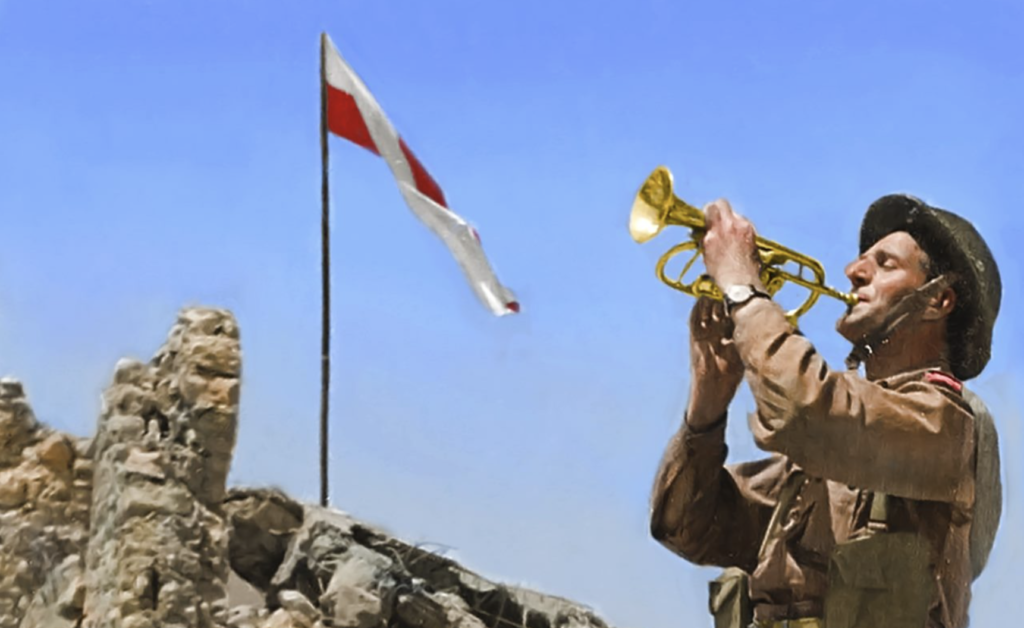
It took about two hours for platoon sergeant Emil Czech to move several kilometres under German fire to get to Monte Cassino and play the St. Mary’s Bugle call, the symbol of Polish culture. The famous soldier, who announced the Polish victory over the Germans, was born in Bobowa near Nowy Sącz 116 years ago, on 8 August 1908.
The picture of the Polish soldier playing a trumpet at the ruins of Monte Cassino became the symbol of the Polish fight on the Western front.
After the long bloody battle on the morning of 18 May 1944, the 3rd Carpathian Rifle Division captured Hill 593 with the ruins of a Benedictine monastery. Soon a patrol of the 12th Podolski Lancers Regiment, commanded by Second Lieutenant Kazimierz Gurbiel, raised the Polish flag at the site.
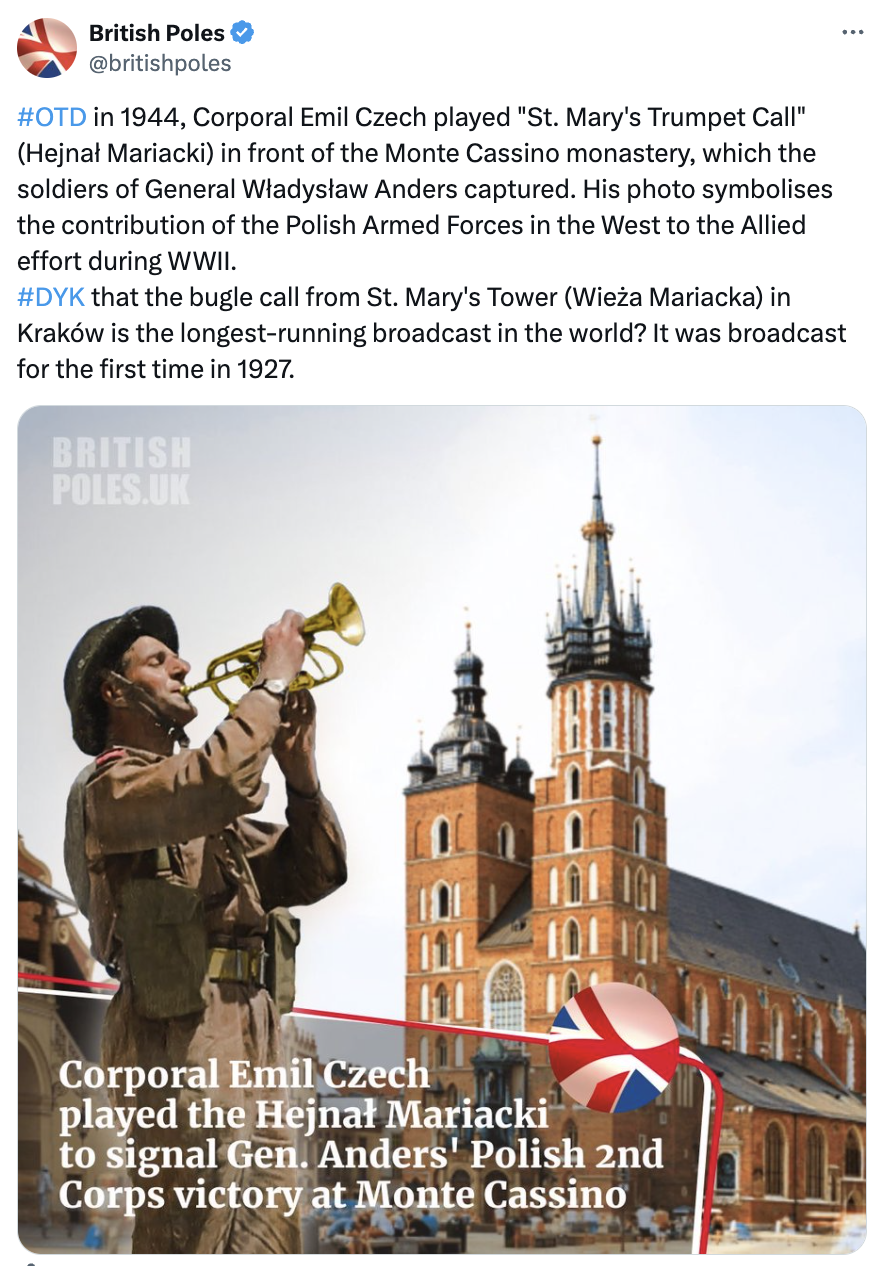
Exactly at noon, a familiar melody sounded from the hill. Platoon Leader Emil Czech, a soldier of the 3rd Battalion of Sappers, played the sound of the St. Mary’s bugle call. His extraordinary mission was not only demanding due to great emotion but also because of the German activities in the area.
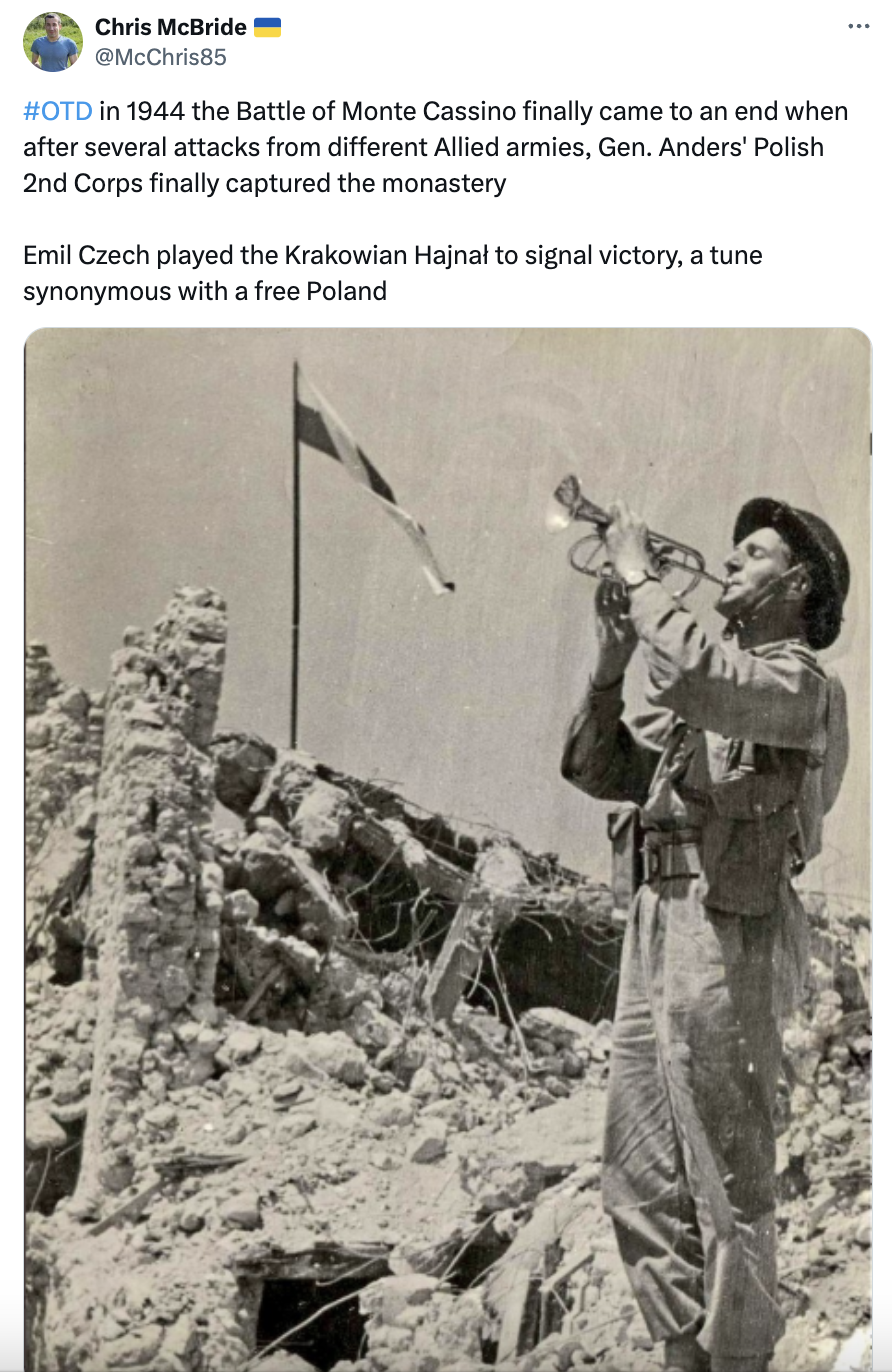
Emil Czech later recalled:
“Colonel Rakowski turned to me with the words: >> Sergeant, you have a combat task to perform. You will drive up to the monastery and play the St. Mary’s bugle call under the Polish flag. I received a trumpet, a so-called cornet, and together with the driver we set off in the car. Halfway there, the vehicle stopped. The driver turned to me and asked: >>Mr Platoon Sergeant, do you want to live? Because I do. I’m not going any further,” the soldier wrote in his memoirs, published in the 1970s.
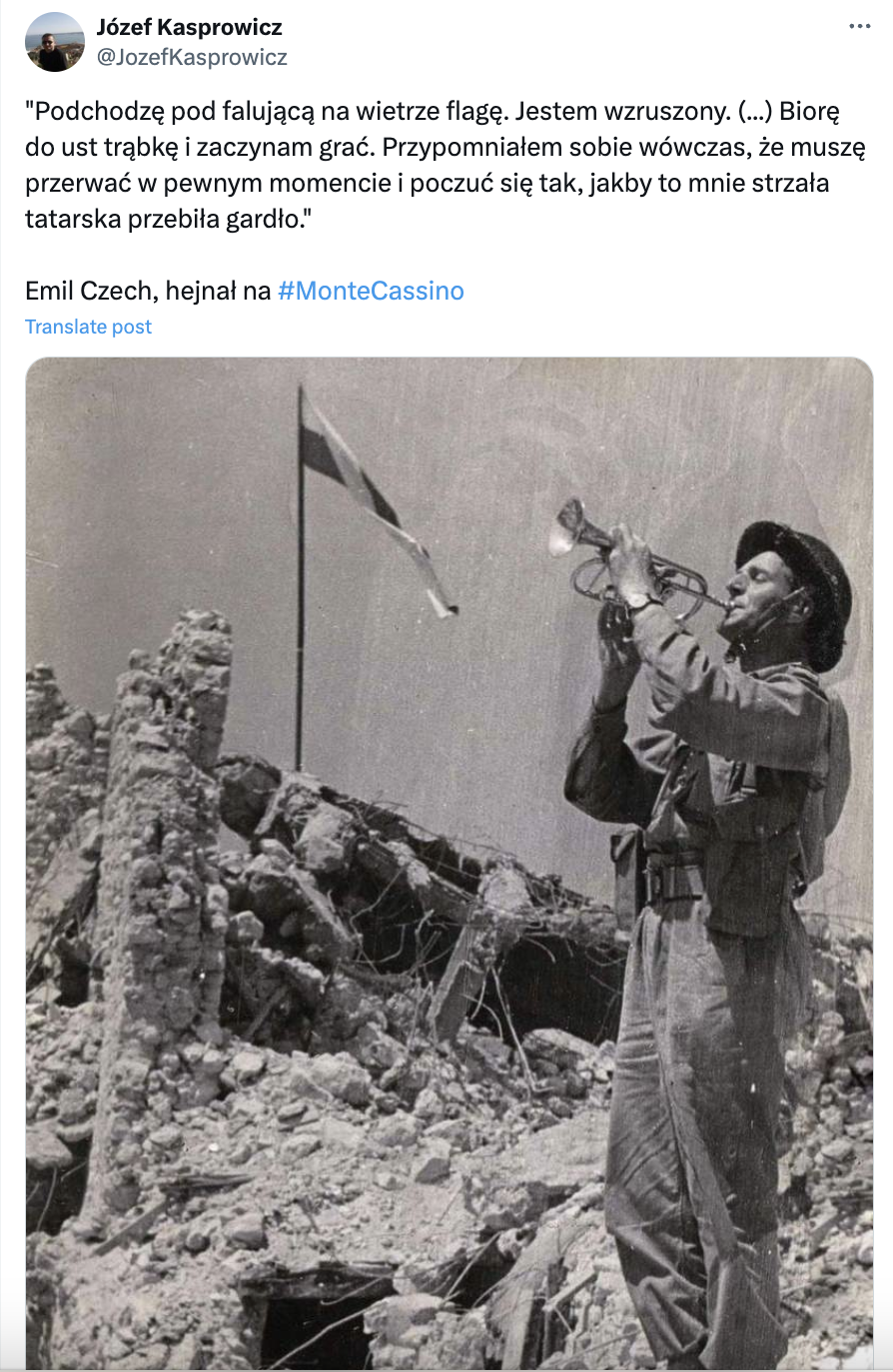
“I got out of the care. A doctor I knew, Lieutenant Stanisław Szczeponek, was also driving in that direction. He drove me to the church so that I reached my destination fifteen minutes before the appointed time. I walk up to the flag waving in the wind. I was deeply moved. I didn’t know if I could play the bugle properly. I took the trumpet to my lips and began to play. Then I remembered that I had to stop at a certain point and pretend as if a Tartar arrow had pierced my throat. It was then that some reporters, American and Polish, appeared from somewhere. (…) After playing the bugle call, I reported to my commander. He was very touched. As I was leaving, he stopped me for a moment and said: 'Remember, platoon sergeant Czech, your trumpet and your bugle call will go down in history one day’.
And so it happened. Sergeant Czech later took part in the famous battles of Ankona and Bologna. He was heavily wounded during the bombing of Loreto.
After the World War 2 ended, Czech decided to come back to the country – now dominated by the communist regime – where he suffered persecution in everyday life as an ex-soldier of the Anders Army that fought alongside British and American troops. He was finally able to start his work in the Polish railways in the 1950s and remained a respected member of the local community until his death. He was also an active member of local music groups.
Although the persecution was not as hard as during the Stalinist period he was not allowed to participate in the Monte Cassino 30th Battle Anniversary in 1974. The authorities would not allow a legend to be visible once again.
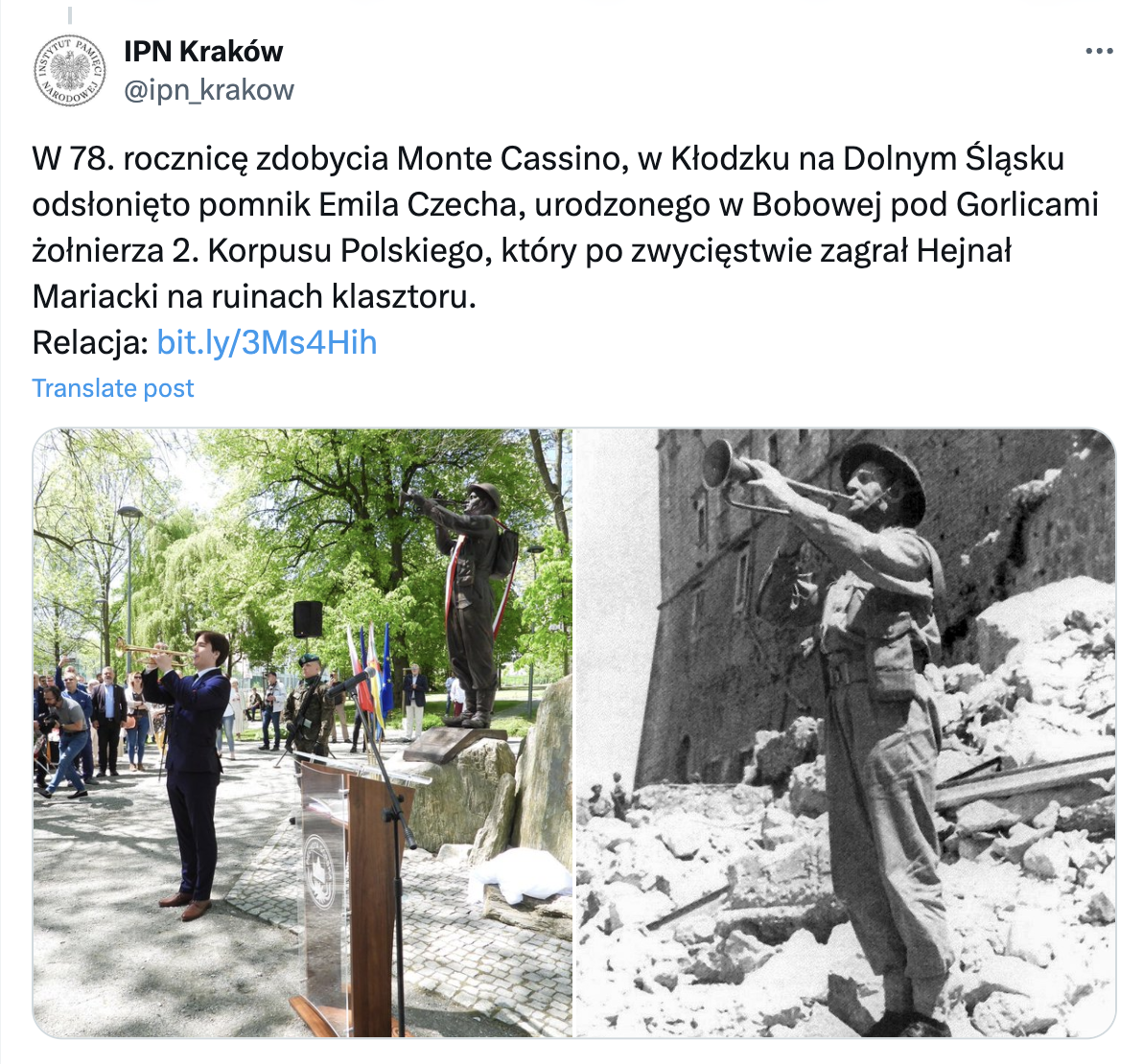
Four years later, on 26 March 1978, Emil Czech died. His beloved wife died just 9 days before. He received many state and military decorations for his fight for independence, including the Order of Polonia Restituta. In 2022, a monument of the Polish soldier was erected in Kłodzko.
Tomasz Modrzejewski
Source: Polskifr.fr, IPN
Photo: IPN
Colourisation: Mikołaj Kaczmarek – Kolor Historii