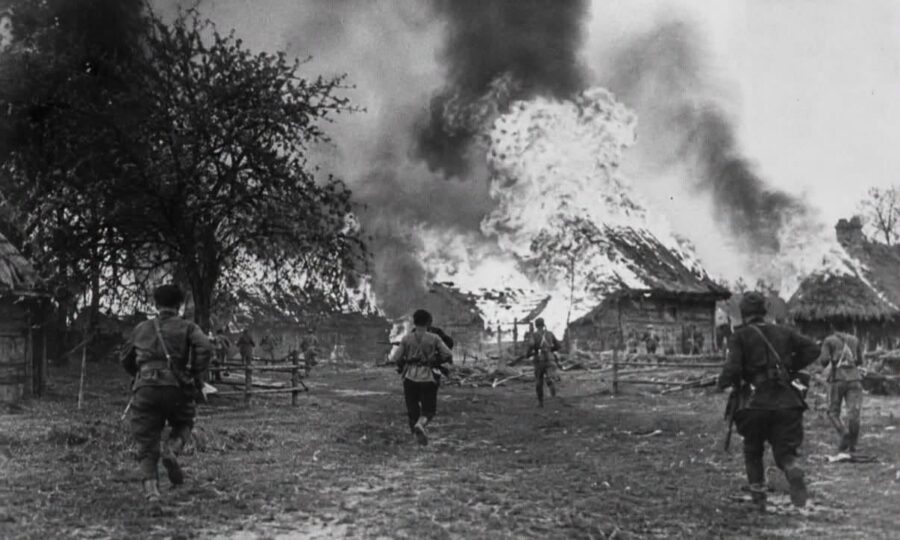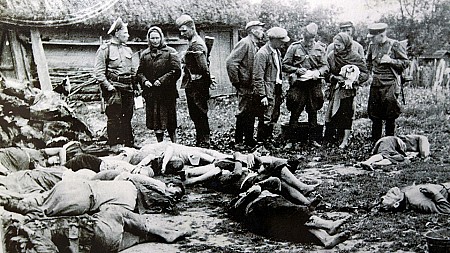
Lithuania’s public broadcaster, LRT, has come under fire after publishing an article that has been widely criticised in Poland for distorting the historical record of the Volhynia Massacre. The article, featured on LRT’s website, adopts terminology and interpretations aligned with Ukrainian narratives, equating victims and perpetrators in what it calls the „Volhynian tragedy”.
Rather than referring to the events of 1943–1945 as a genocide perpetrated by the Ukrainian Insurgent Army (UPA) against Polish civilians – a term increasingly recognised in Poland’s historical and legal discourse – the article frames the violence as a mutual tragedy, echoing language promoted by Ukrainian historians and officials.
Among those cited in the piece is Olena Babakova, a journalist known for advocating greater political representation for Ukrainian migrants in Poland. Babakova claims that Poland’s ruling coalition, facing domestic challenges on the economic and social fronts, is using the Volhynia issue as a populist tool.
“Construction, healthcare, defence – these are costly and difficult. Instead, one can reap political dividends from stirred-up emotions, posing for photos by monuments,” she writes.
The article further alleges that Poland seeks to monopolise the narrative of suffering, omitting references to Ukrainian or Jewish victims of wartime violence. In an especially contentious move, LRT quotes Volodymyr Viatrovych, a prominent Ukrainian historian and former head of the Ukrainian Institute of National Remembrance, known for his denialist stance on Volhynia and self-described affiliation with Bandera’s legacy. Viatrovych rejects the notion that the UPA coordinated attacks on over 100 Polish villages on 11 July 1943, claiming a lack of documentary evidence.
LRT concludes its article by accusing Poland of exhibiting “historical egoism”, arguing that the new remembrance legislation passed by the Sejm selectively highlights Polish suffering while overlooking alleged retaliatory actions and systemic discrimination carried out by Polish authorities during the interwar period and the underground Home Army (AK) during the war.
“Poland remains silent on its role in escalating the conflict: from discriminatory interwar policies to pacifications and AK-led reprisals,” the article asserts.
“This not only distorts history but also endangers current regional relations, especially at a time when Ukraine and Poland are allies in the face of Russian aggression. Instead of pursuing reconciliation through dialogue, Poland is opting for populism at a historically fragile moment – risking trust and stability across the region.”
The article’s publication has triggered strong reactions in Warsaw, where many view it as an attempt to relativise a genocide and undermine efforts at historical justice. With Polish-Ukrainian relations already under strain following the Polish parliament’s decision to establish 11 July as a national day of remembrance, this latest intervention from a third party adds further complexity to an already delicate bilateral dynamic.
Source: Kresy.pl
Photo: IPN
Tomasz Modrzejewski