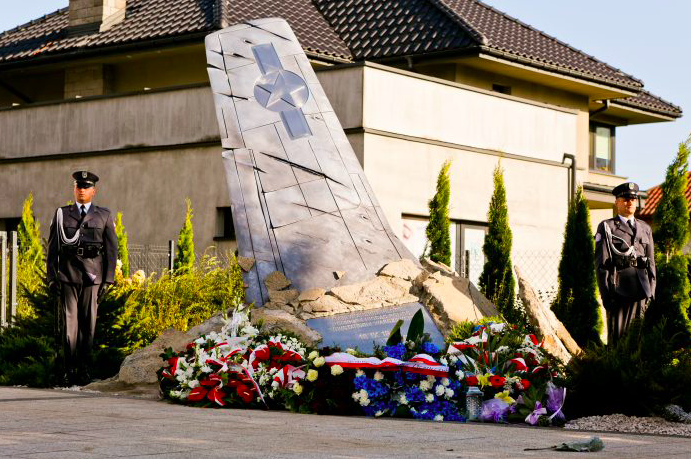
In a small town of Nasielsk, in the Masovian Voivodeship, a monument dedicated to the memory of two American pilots, Lieutenant Joseph Vigna and Lieutenant Robert Peterson, was recently unveiled. The pilots’ plane was shot down and they both died during support mission to help the Warsaw Uprising. The monument was financed by money raised by Tomasz Krason, who originally comes from Nasielsk but who has been living in Boston, USA, for 30 yrs.
Although the idea commenced as a grass-roots community initiative, it evolved in time into a big international event, and the ceremony was attended by American Ambassador Georgette Mosbacher, as well as the Deputy Commander of the Polish Armed Forces, General Major Jan Sliwka. Colonel Eugeniusz Tyralski, pseudonym ‘Sek’, 96 years old participant of the Warsaw Uprising and Major Antoni Zienkiewicz, pseudonym ‘Cichy’, the Home Army soldier, were also in attendance.
Representatives of the Polish Air Forces, the Ministry of National Defence and the National Security Bureau, the World Union of Home Army Soldiers, the Warsaw Uprising Remembrance Association, the Warsaw Insurgent Association, the Polish Underground State Foundation, the Polish Aviators Association, the Polish Military Aviation Seniors Association, Institute of Aviation and School Board in Warsaw, were also present during ceremony.
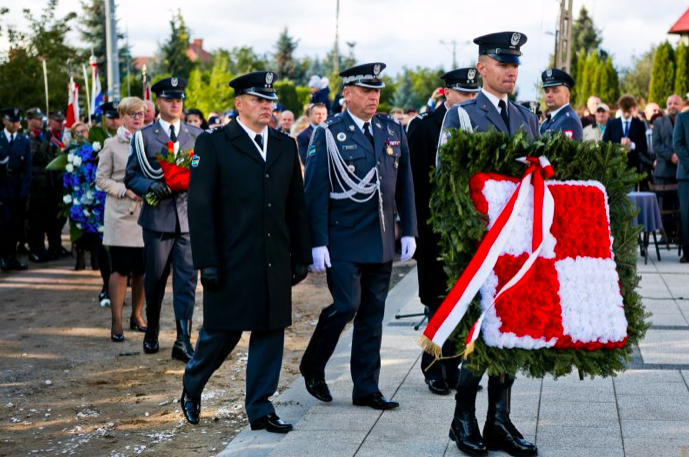
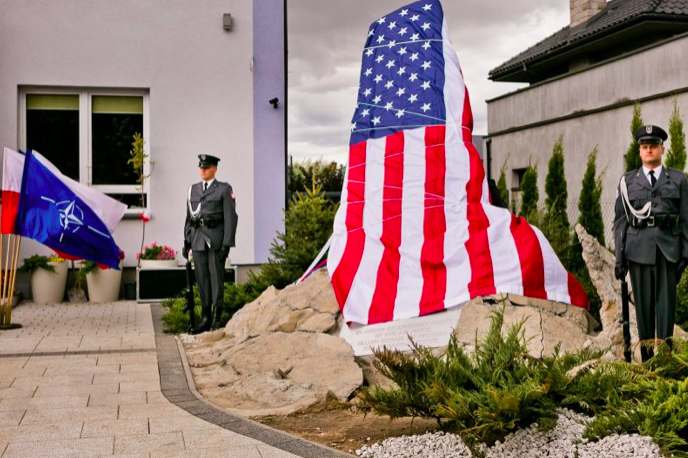
The unveiling of the monument was also celebrated by the Polish National Air Force Representatives and the Military Orchestra, both from Dęblin. The monument was erected on the grounds of a local Primary School ‘Blue Violets’ and the students prepared a special artistic performance for the occasion. Families of both American pilots came from the United States to participate in the ceremony and their journey was funded by money raised by Tomasz Krason.
The unveiling ceremony of the monument took place on September 18, exactly 75 years after their death. This date also commemorates the birthday of the US Air Force, as President Truman signed the National Security Act establishing the U.S. Airforce on this day in 1947.
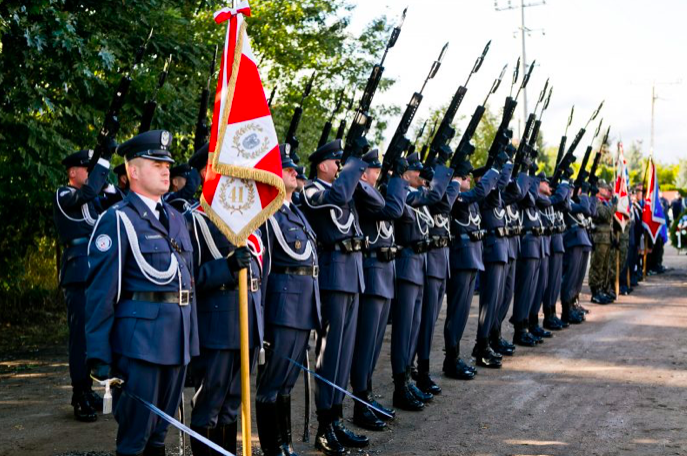
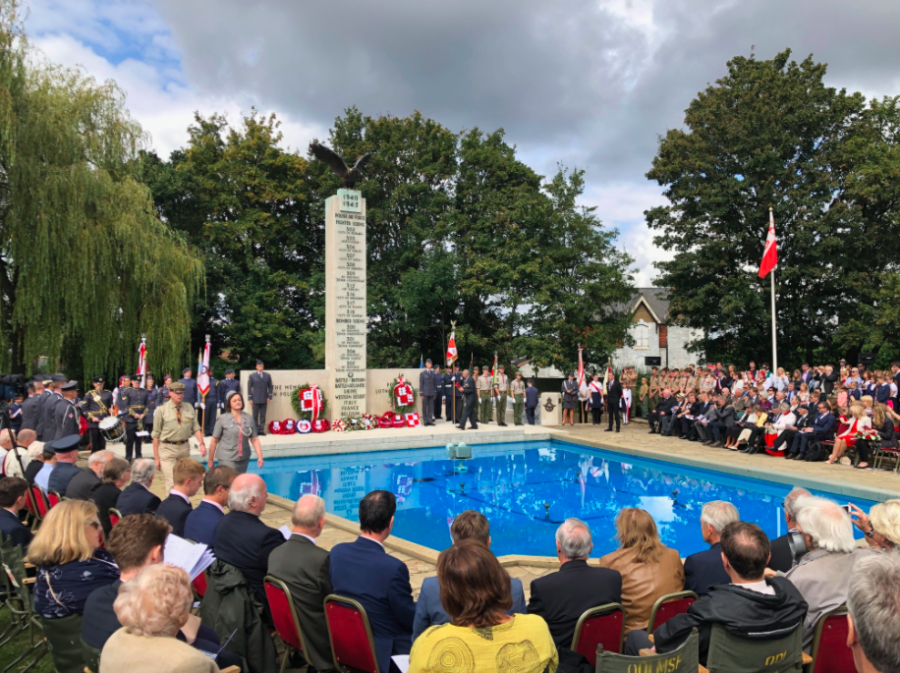
The unveiling of the monument
„When I look at this monument I see a witness for the hope that comes from shared experiences and grows out of common sacrifice, it is a testimony of values that unite our two nations. These two pilots paid the highest price for our freedom and we will never forget about it” – said American Ambassador Georgette Mosbacher during the Nasielsk ceremony. She, together with family members of two American pilots – Lynne Alexander and Mellisa Misi – and accompanied by General Jan Śliwka and Tomasz Krason, unveiled a monument commemorating Lieutenant Joseph Vigna and Lieutenant Robert Peters.
During the ceremony, the military orchestra played Polish and American national anthems followed by a salvo of honour. A letter written by President of Poland Andrzej Duda and the Appeal of Remembrance were read. With the consent of the Ministry of National Defence, it was slightly modified to include the names of American pilots and the names of several local war heroes.
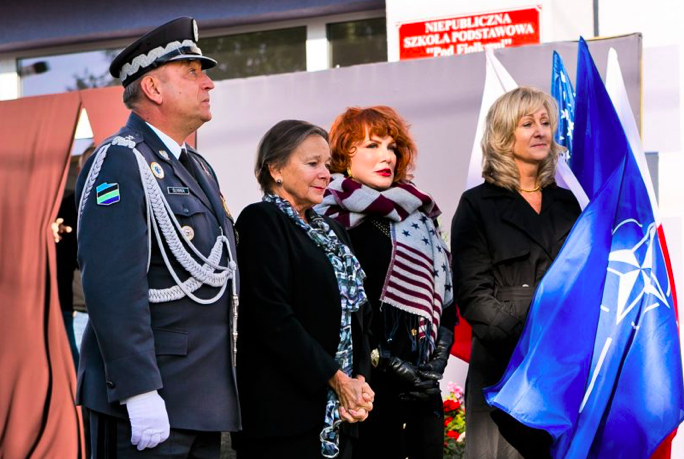
The ceremony was concluded by an exhibition at the school of various mementoes of the shot down planes found, collected and carefully stored by locals, including oxygen container, aluminium pieces of wings and cabins, rifle shells. A theatrical play – ‘Pilot’s Death’- written by one of the teachers was stage-performed by students. Tomasz Krasoń in his interview with 'Nowy Dziennik’ said the Americans were extremely touched and even tears flowed at some moments during the ceremony. He also mentioned the ceremony was designed by Elżbieta Fijalska, the headmistress of the Primary School „Blue Violets”, who volunteered for after-hours supervision of all the preparations.
HERO-PILOTS
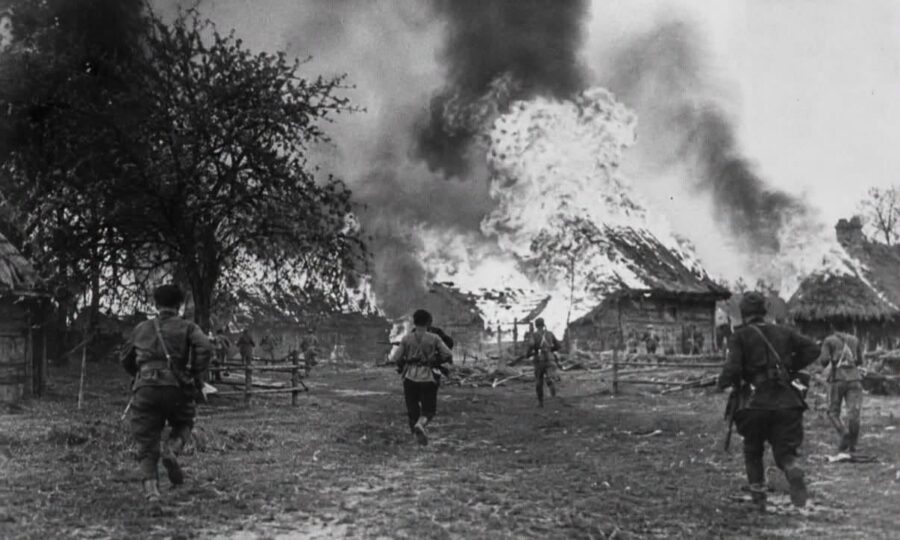
American pilots, Lieutenant Joseph Vigna and Lieutenant Robert Peters, were shot down on September 18, 1944, during a mission to help the Warsaw Uprising. The mission was headed by a Flying Fortress B-17 flanked by 56 P-51 Mustang fighters. They aimed was to drop 1248 containers full of weapons, ammunition, food and medicine. Two fighter planes piloted by Lt Vigna and Lt Peters were downed near the village of Kątne and Stara Wrona in the Nasielsk vicinity.
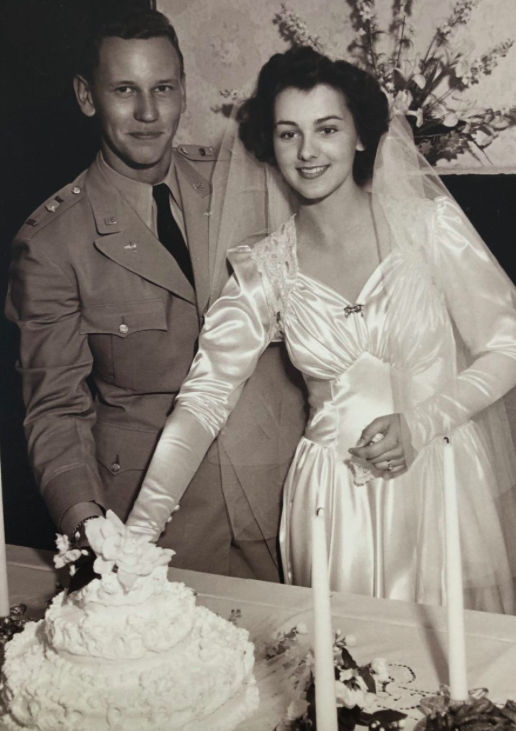
Lieutenant Rober Peters, born in Ohio, was 21 years old at the time of his death. He left a wife and two-month-old daughter he had never met. He was buried near the place of his plane fall. After his plane was down, the Germans surrounded it to prevent locals from getting the pilot out of the machine. He burned alive.
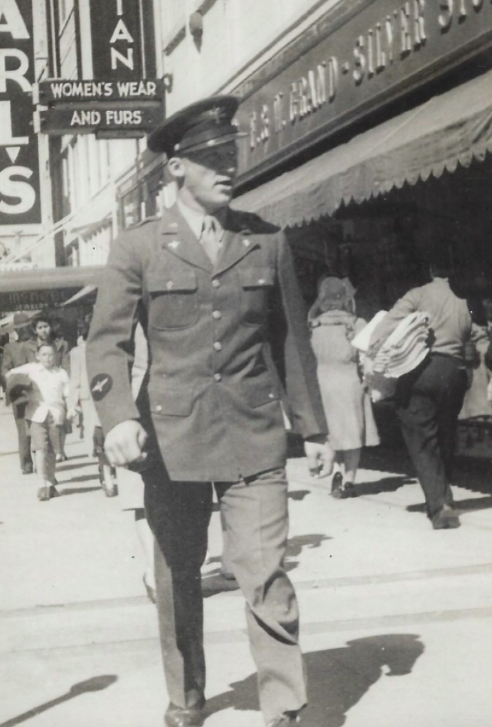
24-years old Lieutenant Joseph Vigna from California, on the order of the German pilot who shot him down, was buried with military honours. After the war, the bodies of both pilots were exhumed and transferred to the military cemetery in Neuville, France. In 1948 they were transferred for burial in their native towns in America.
Tomasz Krason who is a history enthusiast and vintage military paraphernalia collector, explains: “The air-drops were supposed to be made much earlier, but all was delayed because of a planes maintenance problem. They were flying from Great Britain or Italy on one fuel-tank, so they had to fly beyond the front-line for landing on the American bases located in the Soviet Union to re-fuel, repair, renovation, and ammunition replenishment, as part of the operation ‘Frantic’.”
“ ‘Frantic’ completed seven bombing missions between June and September 1944, and Stalin was to give personal permission for each landing of Americans on Russian territory, provided he would be informed in detail about every action. However, when he learned the flights were planned and organized to help Warsaw insurgents, he immediately withdrew his consent. He only changed his decision under pressure in mid-September, when the uprising was almost at the end and the area occupied by the insurgents was very small. Due to this delay, only about 20 percent of American aid met the target” – emphasizes Mr Krason, a member of the Polish Military Fan-Club.
COMMEMORATION IDEA
Tomasz Krason has learned about the fate of two American pilots who died during support mission for Warsaw Uprising, several years ago. Being a history enthusiast he decided to do more research and to collect more information on what happened in this fateful day in September 1944. “I went to meet an elderly lady, Leokadia Lacka, who is now 90 years old and has witnessed the tragedy” – he recalls. It turned out, Mrs Lacka knew Krason’s mother, Irena, very well and said to him: “Your mother helped my family to survive the war“. Mr Krason’s mother worked in a German bakery at that time and because of severe food rationing, she usually took in secret some of the baked bread and distributed it to the poorest families. Tomasz was very touched by the story – „When I found out about it, I concluded that our meeting could not be accidental. I came there from the United States to learn the history of downed pilots from a person who witnessed the event and by coincidence, I learned a lot about my mother as well. So I decided to start the action to commemorate the sacrifice of these American soldiers ” – says Tomasz, adding that he was also determined to find relatives of both pilots. After long efforts, he managed to find their families last year.
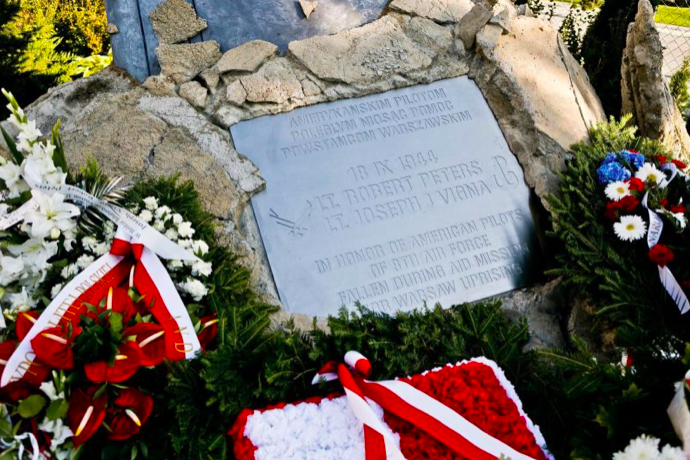
With the help of the internet, numerous family-connection websites, social media, phone books and by sending letters to families of as many downed pilots as he managed to trace, Mr Krason eventually found pilots’ relatives. He recalls: „First I found Lynne Alexander, who is now 75 years old, and at the time of her father death, she was only two months old. Lt Peters was 21 and an air ace, who had shot down five German aircrafts. On September 18, it was his 50th combat flight, which ended so tragically for him”. The relatives were very surprised and touched by his plans to commemorate sacrifice of their loved ones.
„As for the family of Lt. Joseph Vigna, I managed to find his niece in California. I wrote a letter to her, which she obtained on June 6, the anniversary day of the landing of the Allied forces in Normandy. Mellisa Misi had only a vague idea about her uncle, she knew that he was a pilot and that he died in Poland. It wasn’t until I sent her various materials, including prints from the book 'Frantic 7′ by Jerzy Szcześniak, she became very interested in his fate, ” recalls Tomasz Krasoń. The parcel Melissa received was one of the many he kept sending to the people he thought could be relatives of Lt. Joseph Vigna.
„The parcel was addressed to her and her mother, the airman’s sister who is still alive. Because Melissa sold the house a year ago, she thought the letter was about the transaction and set the envelope aside. It wasn’t until the evening that day when she and her family sat at the dinner table she had remembered the shipment and opened it. As she read the letter, tears began to flow down her face, so everyone immediately began to ask what was going on. It was an amazing experience for them, „says Mr Krason, adding that everyone decided to fly from California to Nasielsk for the unveiling ceremony.
They spent a week in Poland and even visited Leokadia Łącka, who witnessed the destruction of Lt. Joseph Vigna plane.
LIKE PHOENIX FROM THE ASHES
The originator of the idea honouring American pilots who died in the Nasielsk area did not want their commemoration to look banal. He believed they deserved something lasting and touching all hearts for they paid the highest price to help the Warsaw Uprising.
„Initially, I was thinking about some plaque commemorating this event, but I thought there are already a lot of them all over Poland, so I decided to do something more than that. Hence the idea of the monument appeared to me”- recalls Tomasz Krasoń. He decided to ask Tadeusz Adamowski and his wife Katarzyna Waszewska who were both artists and friends to come up with some ideas.
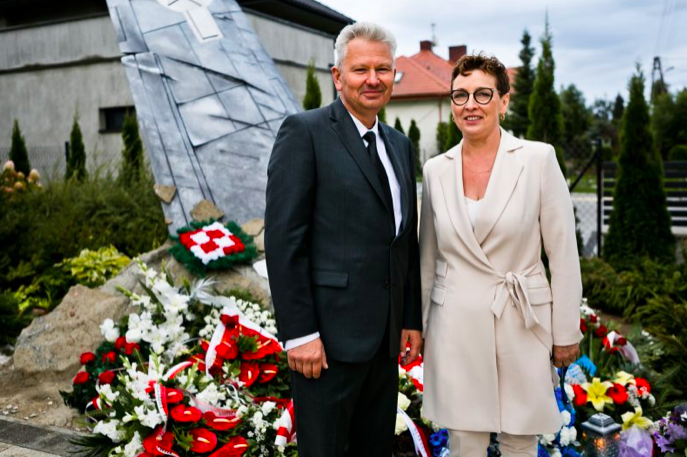
„They decided to make a monument in the shape of a wing of the Mustang B-51 fighter plane, which both pilots flew at the time. The wing is frayed by bullets, but it does not look like hammered into the ground by the falling, instead, it protrudes from the ground as if the wing was emerging from the ruins of destroyed Warsaw. In this way the jagged wing makes an impression of being reborn, like a phoenix from the ashes. The idea was to show that these soldiers have not been defeated by death but willing to continue fighting” – explains Mr Krasoń.
The monument, which was unveiled on 18 September at the premises of the Primary School „Blue Violets” in Nasielsk, was financed from private money, including donations given by Tomasz Krason, his family and friends, as well as Wojciech and Roman Zasadziński – sons of the Warsaw insurgent lieutenant Jerzy Zasadziński. No public funds were earmarked for this purpose, and local and municipal authorities did not join the collection.
Wojtek Maślanka, dziennik.com/MB
Pictures: Adam Kownacki
Translation: Jolanta Pitera
Portal British Poles would like to thank Mr. Tomasz Krason for agreeing to publish the materials from his private archive.