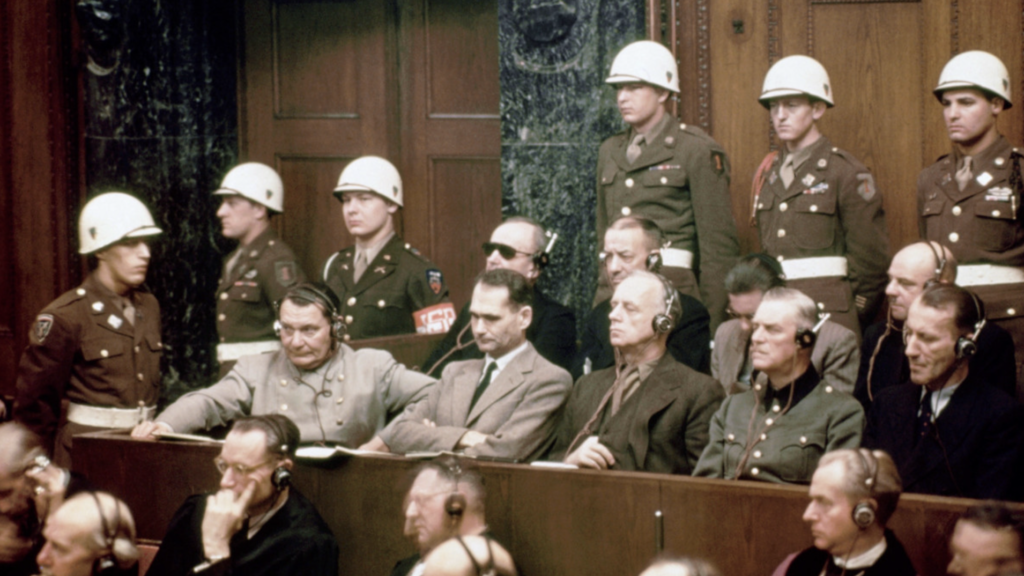
The Nuremberg Trial began on 20 November 1945 and ended on 1 October 1946. During nearly 220 days of work, the testimony of 240 witnesses was heard and more than 5,000 documents were submitted to the court. Unfortunately, the Tribunal was unable to provide justice for the victims of Soviet crimes, as the USSR also controlled the indictment.
The hearings took place in the Palace of Justice in Nuremberg. The indictment was drafted while the war was still in progress. It contained accusations of numerous crimes committed by the Nazis during the war but also consisted serious of errors and deficiencies. One such example was the issue of the German occupation of Poland, Jewish ghettos the population resettlement and the Germanisation process. During the trial, the indictment was frequently modified with more and more evidence coming into the hands of the Allied prosecutors.
The International Military Tribunal tried 22 war criminals of the Third Reich. None of them pledged guilty.
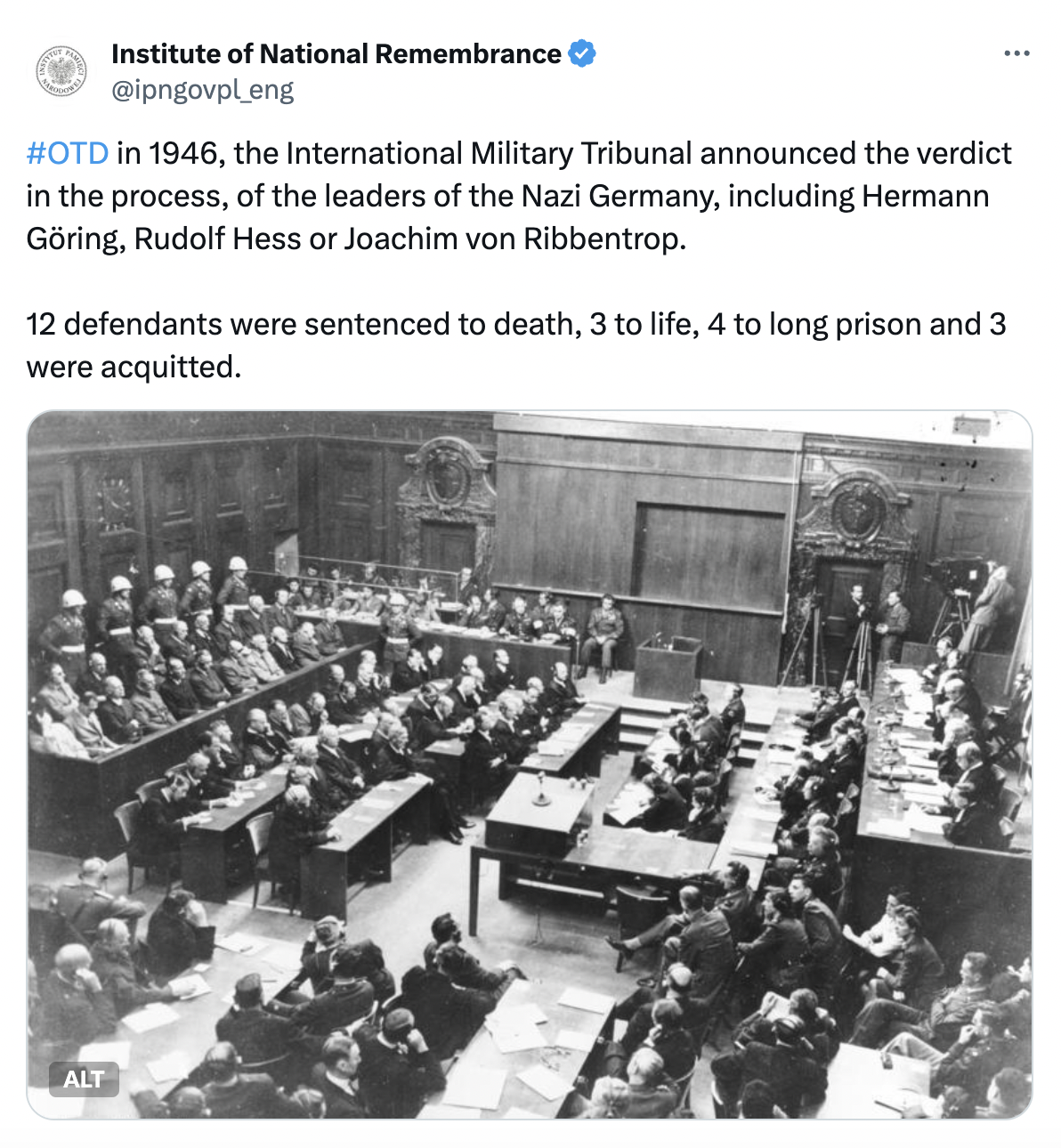
This was an unprecedented trial, as it was the first time that the principle of criminal responsibility of state leaders for international crimes was applied. The German political leaders and military command were charged with four types of crimes: participation in a conspiracy to commit an international crime, crimes against peace, war crimes and crimes against humanity.
The tribunal consisted of representatives of the four victorious powers. Nuremberg was chosen as the venue for the trial. It was there that Hitler’s rise to power in 1933 was celebrated, and where the so-called Nuremberg Laws were passed in 1935, which deprived Jews of Reich citizenship, legal protection and property.
The Soviet representatives tried to include the Katyn Massacre in the indictment to put the blame on the Germans and deny its responsibility. However, the Soviets successfully forced the Tribunal to abandon the secret clause to the Molotov-Ribbentrop Pact presented by the German defence lawyers, which was the basis for the partition of Poland in 1939 and would redefine the USSR’s role in the one as an aggressor state, allied with Hitler’s Germany.
The Tribunal issued a death sentence to:
- Martin Bormann – head of Hitler’s office, later Hitler’s deputy and head of the NSDAP (tried in absentia);
- Hans Frank – Governor General in occupied Poland;
- Wilhelm Frick – SS and SA General, Protector of Bohemia and Moravia;
- Hermann Goering – Reich Marshal, Commander in Chief of the Air Force, founder of the Gestapo;
- Alfred Jodl – Chief of Staff of the Wehrmacht High Command;
- Ernst Kaltenbrunner – Chief of the Reich Security Main Office;
- Wilhelm Keitel – Field Marshal of the Reich, Chief of the Wehrmacht High Command; Joachim von Ribbentrop – Minister of Foreign Affairs; Alfred Rosenberg – NSDAP party ideologue, Reich Minister for the Eastern Territories;
- Fritz von Ribbentrop – Minister of the Interior.
- Fritz Sauckel – SS and SA general, organiser of forced labour;
- Arthur Seyss-Inquart – Reich Commissioner in the Netherlands;
- Julius Streicher – publisher of ‘Der Stuermer’, co-organiser of the extermination of Jews.
- All criminals, except Martin Bormann, were hanged on 16 October 1946 by professional executioner Sgt John C. Wood.
“The Nuremberg Trial was intended to ensure that the leaders of the Third Reich would never become national heroes, that the German banners would never bend over the memorial of historical criminals. So that future generations of Germans would acknowledge their bloody guilt and could – and would – repay a terrible debt to the whole world.” – wrote the Polish correspondent in Nuremberg, Edmund Osmanczyk, who later became a politician in the communist Poland, and a Senator after the 1989.
Source: Polskie Radio
Tomasz Modrzejewski
Photo: Wikipedia, public domain