The idea of establishing an air link with occupied Poland was conceived as early as 1939. The Polish government-in-exile, reconstituted in France, fully recognised the strategic importance of such a connection. On 28 November, General Władysław Sikorski ordered the air force command to create an aviation unit capable of maintaining contact with key centres of the occupied homeland: Warsaw, Kraków and Lwów.
The rapidly expanding resistance movement in Poland required both material and personnel support. The intelligence data gathered and processed within Poland also needed to be delivered to the Allies. While supplies for the underground could be dropped by parachute, not all information—and especially not people—could be transmitted this way or through radio communication.
Aircraft from the pre-war LOT Polish Airlines fleet, which had been successfully evacuated, were initially considered for the task, as were light sport aircraft such as the RWD-13, renowned for its ability to land in makeshift terrain.
However, the fall of France in 1940 abruptly derailed these plans. In the new geopolitical context, the Polish Air Force could no longer fly into Poland. Hopes shifted to the British Special Operations Executive (SOE), which had already begun conducting clandestine landings in occupied France by October 1940.
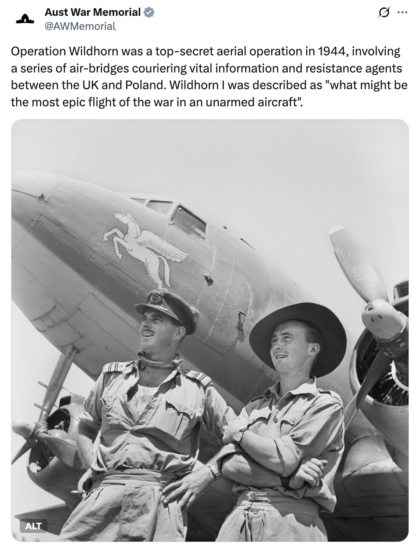
Flying into Poland presented a significant logistical challenge. Aircraft based in Britain would need to follow a long and circuitous route over the North Sea, Sweden and the Baltic to reach Polish airspace safely. One aircraft capable of undertaking the journey was the Armstrong Whitworth Whitley bomber—though only with great difficulty. Critically, it lacked sufficient fuel reserves to return after landing, and it required hardened runways for take-off and landing.
Seaplanes were also considered, but they proved too slow to complete a round trip to occupied Poland and back within a single night, making them unfit for the mission.
The concept of landing Allied aircraft in occupied Poland was revived in 1943, following the capitulation of Italy and the Allied occupation of much of the Apennine Peninsula. From the southern Italian airbase at Brindisi, the aerial distance to Warsaw was only around 1,300 kilometres—a feasible range for the Douglas Dakota, the Allies’ most widely used transport aircraft.
Polish military authorities quickly acted on the opportunity. Section VI of the Commander-in-Chief’s Staff and the Aviation Department of the Home Army’s High Command began work to identify suitable landing sites. In July 1943, four codenamed locations—Mucha (Fly), Mrówka (Ant), Ważka (Dragonfly), and Biedronka (Ladybird)—were assessed for their potential.
Each site was evaluated based on runway length, ground firmness, available approaches for aircraft, the ability of underground units to secure the landing, and the proximity of German patrols. After thorough analysis, the most promising site turned out to be—ironically enough—Biedronka, the “Ladybird.”
However, in October 1943, the British informed their Polish counterparts that such a landing operation could not go ahead at that time.
The plan to fly into Poland from Italy was finally realised six months later, during the operation season known as Riposta. On 28 February 1944, official approval was granted, and No. 267 Squadron of the Royal Air Force was authorised to prepare an aircraft for the extended flight.
A Dakota aircraft was modified with eight additional fuel tanks, extending its range for an 18-hour round trip. All that remained was a window of favourable weather conditions.
On 15 April 1944, a total of twelve aircraft departed for Poland. Among them was a Dakota from No. 267 Squadron, stationed at Campo Casale airfield. This particular aircraft had a unique mission: to become the first Allied transport plane to land on Polish soil.
At the controls was Flight Lieutenant Edward “Ted” Harrod, accompanied by Captain Bolesław Koprowski of the Polish 1586 Special Duties Flight. Their successful mission marked a historic moment in the cooperation between the Polish resistance and Allied air forces, bringing not only supplies and personnel but also renewed hope.
Source: IPN
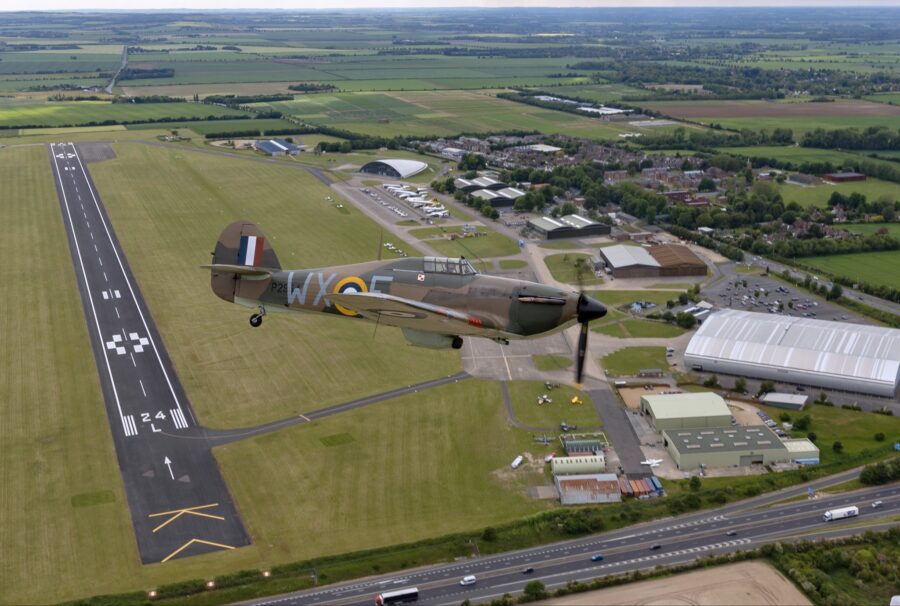
Photo: @FennellJW
Tomasz Modrzejewski