On the 16th of December 1981, the Communist authorities of the Polish People’s Republic brutally crushed a strike in the “Wujek” mine in the Silesian mining city of Katowice.
The outbreak of mass protests initiated by the famous Solidarity movement was perceived as a genuine threat to the Communist regime. This is why one of the first actions undertaken by the authorities was the arrest of leaders of the striking movement.
https://twitter.com/enrs_eu/status/1471493985675841545?s=20
Martial law was established in Poland on the 13th of December 1981. In the following days, about 200 workplaces went on strike during the first days of martial law. One of them was the “Wujek” mine of Katowice. On the 14th of December, the first shift started a strike, demanding the release of Jan Ludwiczak, the chairman of the „Solidarity” Works Committee in „Wujek” as well as other Solidarity activists from all over the country.
Later on, more and more miners joined the strike and formulated new postulates. They demanded among others the lifting of the Martial law and the restoration of the activity of „Solidarity”. Unfortunately, negotiations between the protesters and the authorities did not lead to an agreement.
On the 16th of December, several thousand people went on strike in „Wujek”. Some of them were carrying sharpened bars, bricks or shovels. The mine was surrounded by the police and even the army. A crowd of women, youth and children also gathered around. Representatives tried to convince the protesters to surrender – unsuccessfully. The armed forces started to use water cannons despite the (very) cold weather. Some eyewitnesses remember that the police also used tear gas among others.

Before noon, tanks broke through the mine wall, allowing armed ZOMO units to enter the plant. The miners were then doused with water and shelled with different kinds of chemicals. During the clash, three policemen were captured, which forced the rest of the pacifiers to withdraw.
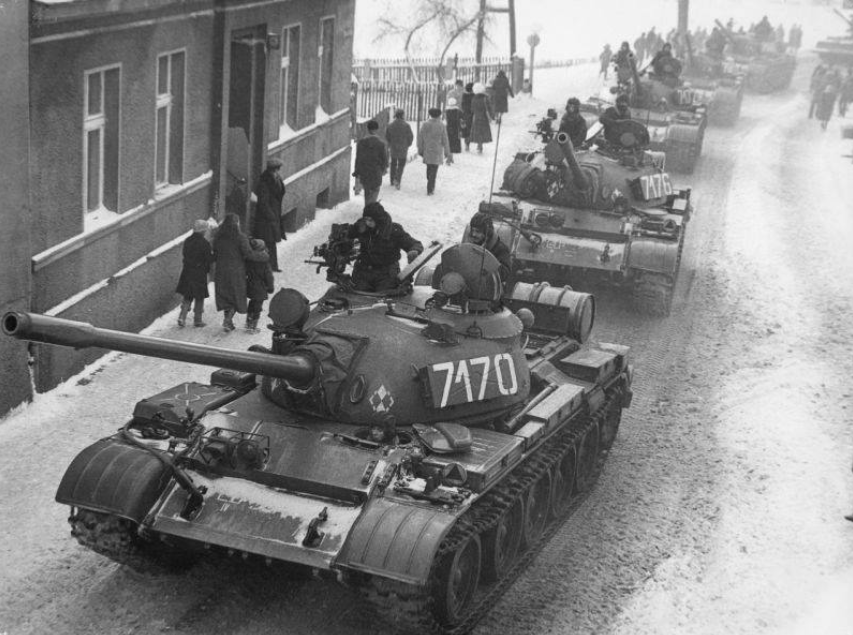
Later on, the authorities of Communist General Wojciech Jaruzelski got much more aggressive. The ZOMO officers started to shoot in the crowd with real bullets. Six miners died on the spot and three more died soon after as a result of their severe injuries. Their names are Józef Czekalski, Krzysztof Giza, Ryszard Gzik, Bogusław Kopczak, Zenon Zając, Zbigniew Wilk, Andrzej Pełka, Jan Stawisiński and Joachim Gnida. Over forty ZOMO officers also suffered from injuries even though none of them died.
Once the pacification was completed, talks were held between representatives of both sides. The miners released the captured three policemen, gave up their weapons and ended the strike. Shortly after, the Security Service arrested eight people who were accused of having organised. In February 1982, four of them received sentences ranging from three to four years in prison while four others were acquitted.

The events in „Wujek” were monitored not only in Poland but also across the world, causing public outrage across the Western world. For example, American President Ronald Reagan vividly criticised General Jaruzelski and his allies and imposed sanctions against the authorities of the People’s Republic of Poland.

The 40th anniversary of this tragic event was commemorated in the Polish parliament by a temporary exposition. In the meantime, another exposition could be seen in the main hall of the Central Station in Warsaw where a dozen miners in working clothes were handing out information leaflets about the “Wujek” events.
Author and photos: Sébastien Meuwissen, IPN
Picture: Marian Siwek