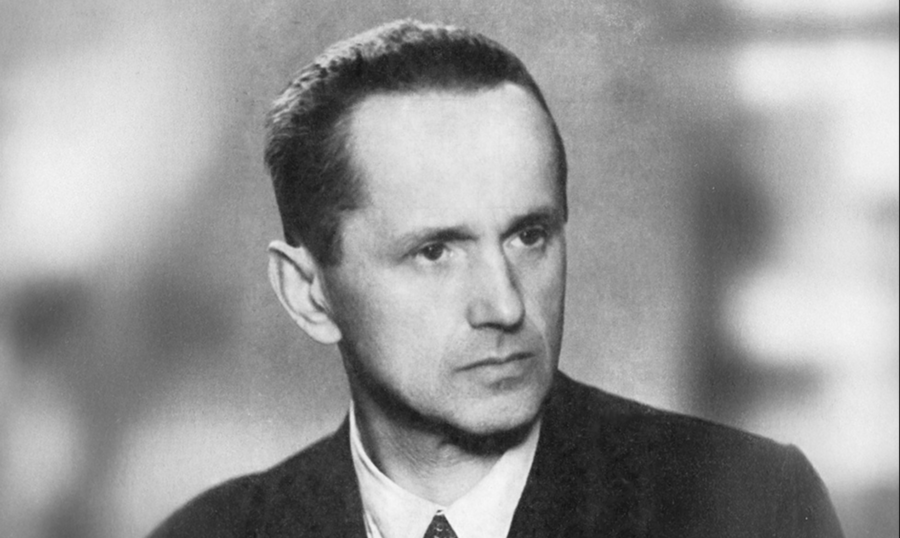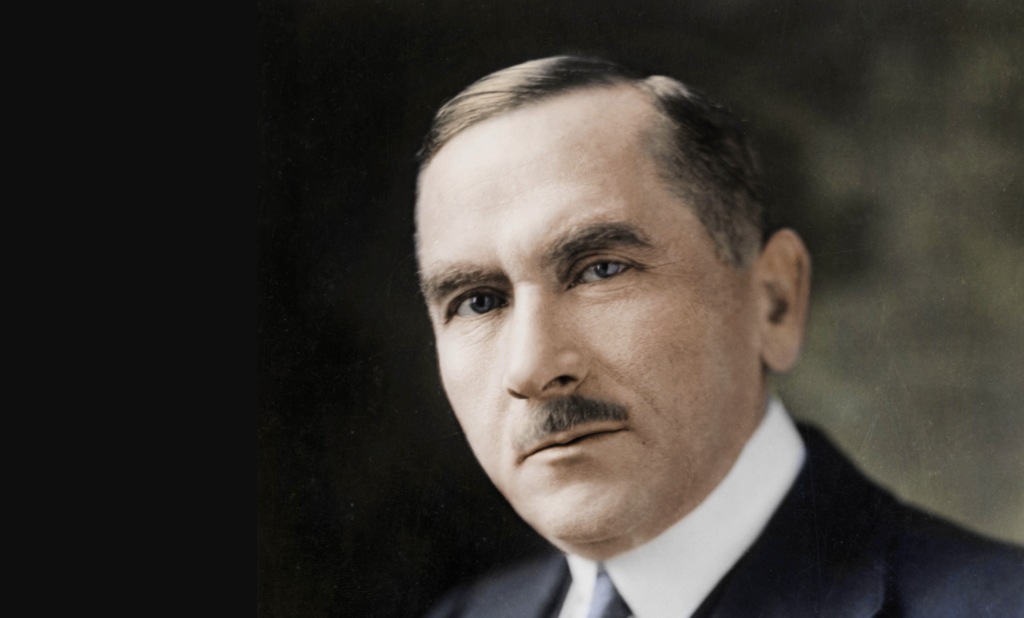
Dmowski was a thinker and politician who defined the modern Polish identity in opposition to its neighbours and national minorities. Despite that view, the broader sense of his political Imaginarium was filled with symbols from Sienkiewicz’s literature and ideas of a strong Polish state.
Roman Dmowski was born in 1864 in the village of Kamionek, near Warsaw (today’s Praga-Południe district of Warsaw), to a poor petty noble family.
While attending school he established a secret student organisation called „Strażnica”, whose main task was to resist Russification, expressed in secret lectures. He later graduated from biology at the University of Warsaw.
Later until 1901, he was a member of various Polish underground political groups.
In 1902, a series of his articles entitled “Myśli nowoczesnego Polaka” [Thoughts of a modern Pole] was published in the All-Polish Review. A year later he published a book with the same title. Dmowski later described this work as his „credo of national faith”. In 1905, he moved to Warsaw.
Dmowski was a critic of the 1905 revolution that included the Polish socialist movement. He said that the case for Polish independence should not be connected with the ideas of socialism, and especially should not include the demands of the Russian political opposition.
He later served as a member of the Polish circle in the II Russian Duma (parliament), where he supported the idea of a Russo-French alliance aimed at weakening Germany as a way to Polish independence.
During the Great War Dmowski was a firm supporter of political concessions for Poles under the Russian Imperial rule.
On 11 August 1916, for a series of lectures, he received an honorary doctorate from Cambridge University.
In July 1917, he circulated a memorandum entitled Problems of Central and Eastern Europe, in which he formulated a territorial programme for a future independent Poland, to the leading representatives of the political world of Western countries.
His greatest role was the representation of Poland at the Paris Peace Conference ending the World War 1. As a fluent speaker of several European languages, Dmowski was able to deliver arguments for the creation of an independent Polish state in French and English.

After he came back to the country he became a symbol of the opposition and resistance to all supporters of Marshall Józef Piłsudski. He shortly served as Foreign Minister in 1923 and then remained the chief authority of the National Democratic Party and the right-wing opposition structures.
At that time he described the Polish geopolitical position:
“I believe that our policy [foreign] must be as strictly peaceful as possible. This is because we have recognised borders; we therefore have the opportunity to pursue a policy of peace. To heal our treasury, we must strive for peace.”
After leaving government Dmowski remained the head of the nationalist movement in Poland, creating several political parties but with no personal participation in the political life.
On 28 December 1938, he suffered from pneumonia and died on 2 January 1939 in Drozdowo. Dmowski was buried in the family grave in the Bródno cemetery in Warsaw.
“He sacrificed everything for Poland and Poland gave him nothing. But he did not expect it either,” Prof Jan Żaryn, a Polish historian said.
A Polish pre-war time journalist Stanisław Cat-Mackiewicz said it was tragic for Poland to have such two outstanding leaders, Dmowski and Piłsudski, at the same time in the nation’s history. They both were great men of their time but could not cooperate due to their different backgrounds and political choices. He also wrote that Piłsudski was a symbol of Polish expansion, a cavalry squadron attacking at far positions. Dmowski remained a stronghold in the country, as a defender of Poland’s treasures.
Tomasz Modrzejewski
Photo: IPN