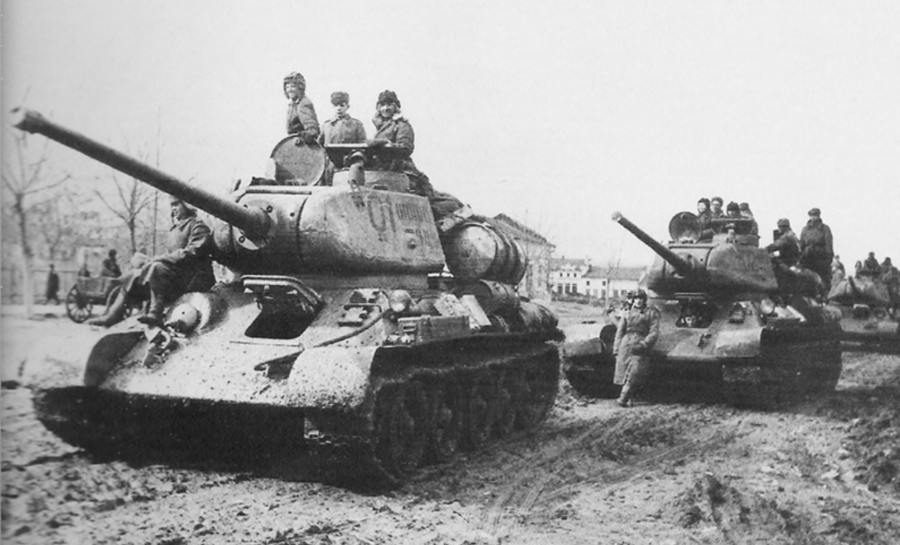
On the night of 3 to 4 January 1944, in the village of Sarny in Volhynia, Soviet troops crossed the pre-war border of Poland. The Government of the Republic of Poland in Exile declared its readiness to cooperate with the “Ally of our Allies” in the fight against the Germans and expressed the hope that the Soviet Union would respect the rights and interests of Polish citizens in the occupied territories.
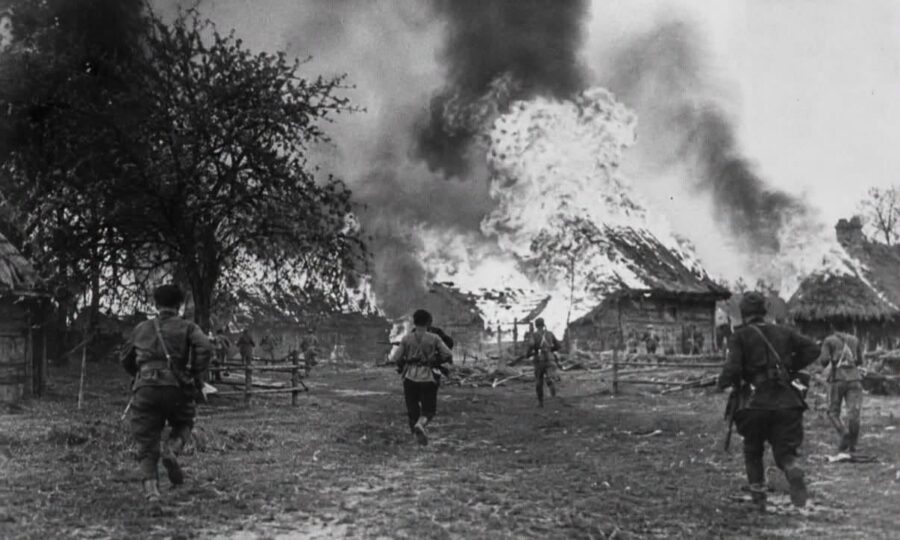
Unfortunately, the Soviets treated Polish civilians as any other on their way to Germany – their arrival meant robbery, rape and murder of the local population.
The Soviet army started to rule the “New Poland” with local communists with weak support. Therefore the new structures cooperating with the Soviet NKVD began the fight with the Polish underground.
The NKVD organised a network of prisons in which thousands of Poles died, including in Lublin and Rzeszów and many other places, such as Nowiny and Majdanek. NKVD operational groups used terror, murders and torture. The killings sometimes took on a mass scale, including at the NKVD camp in Krzesimów and in the Głogowskie Forests (Turza near Rzeszów).
Repressions against the Home Army in the summer of 1944 stopped many units from joining the Warsaw Uprising.
The NKVD forces were called to fight in the Bialystok region, from where, in November 1944, almost 3,000 people were deported to labour camps. The situation was no different in the rest of Poland. In the report of the communist District Public Safety Office in Sandomierz (for the period from 7 to 27 June 1945), one could read:
“On 10 June, at midnight, the information was received that a group of 130-150 people was breaking through from the area of the Lublin voivodship towards the Sandomierz district, attacked a cattle transport and drove it into the forest. After receiving a report, which was confirmed by aeroplane reconnaissance, a plan was drawn up together with Guard Colonel Comrade Ja[k]owlevy to capture this group. As a result of the fight with the band, which was broken up on the road to Sandomierz, there were 80 bandits killed, 2 wounded and 5 taken prisoner.”
Almost every region of Poland was marked by violent war crimes perpetrated by the Red Army. The attitude of the local population towards the Red Army, initially quite favourable or at least neutral, changed from day to day, to more reluctant or even hostile.
Red Army soldiers were also responsible for the massive theft of private and public property, and widespread, devastation of property and the mass rape of women. The Soviet Command did nothing to react to those crimes.
In Greater Poland alone, around 40 per cent of murders were perpetrated by Soviet soldiers, as were around 70 percent of robberies and as many as 80 percent of rapes on women and children. The rural population was particularly vulnerable to violence.
Although the victory of the Red Army over Nazi Germany in 1945 ended the German occupation of Poland, it brought no liberation for Poles.
The “liberation” brought to Poland by the Red Army meant prisons and labour camps, where thousands of Poles died, often subjected to brutal torture.
The number of victims of repression in Poland between 1944 and 1945 is estimated at tens of thousands.
Source: IPN
Photo: IPN/X
Tomasz Modrzejewski