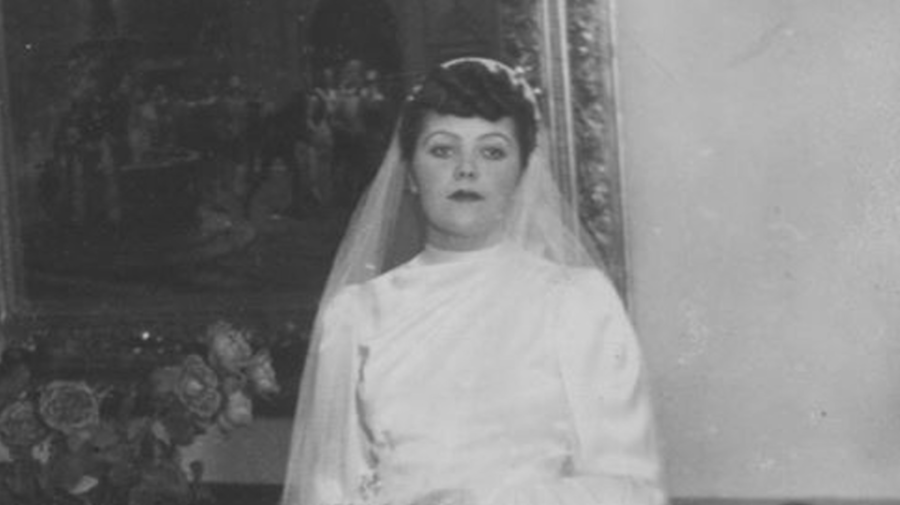
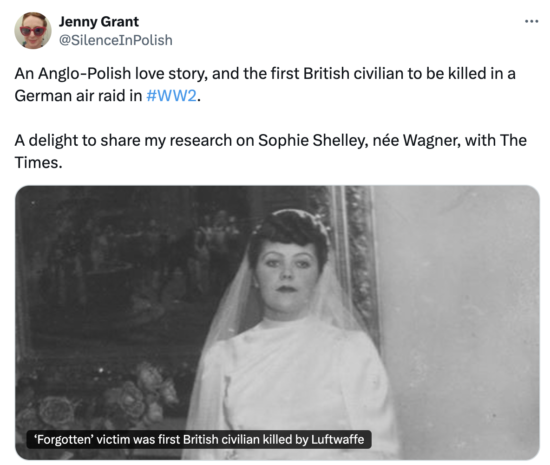
In her piece for The Times, Jenny Grant tells the story of a forgotten first civilian victim of the German aggression in 1939, who killed the wife of a British intelligence officer and a volunteer nurse Sophie Shelly.
Most of the British consider James William Isbister, killed during a German raid on Orkney in March 1940 the first civilian victim of the Luftwaffe, but now Jenny Grant tells the story that predates that death.
“New research has revealed that the first British civilian killed by a German bombing raid had died in Poland the previous autumn, and the victim was part of what might have been the first tragic love story of the war,” writes Jenny Grant.
The wife of British intelligence officer Sophie Shelly, who was a British citizen after her marriage, born Sophie Wagner, found herself in Poland along with her husband in the very first days of the 2 World War.
Sophie and her husband married in February of 1939 in Vilnius, and that is how she became a British citizen just months after the start of the war.
As her husband worked in the Embassy during the outbreak of the war, Sophie volunteered to help the wounded in Warsaw when the air raids began.
The family then relocated with the British diplomatic mission to the south Masovian city of Łuków, which was also targeted by the German Luftwaffe, probably after intelligence leaks.
There, after returning for a cat she left behind, Sophie Shelly was hit by a German bomb and died.
“Colonel Shelley’s wife was buried under the wreckage of a direct hit, and most people were helping to get her out, though she is almost certainly dead,” another member of the British mission reported.
As the war and air raids on civilian infrastructure started she volunteered to help the tormented population as a nurse.
Her death in 1939 was indeed noted, even by The Times, but over the years that shaped the history narratives she was forgotten as the first British civilian killed by the German airforce.
A PhD candidate at Queen Mary University of London, Jennifer Grant, decided to restore the memory of the very first British civilian killed in the war.
“The whole of the September campaign doesn’t play much of a role in most British overviews of the war — they sort of skip to May 1940, effectively,” Grant wrote.
“We’re quite Anglocentric — it’s not until the War arrived on British shores that we see the potential for civilians to be in the line of fire,” the researcher adds.
You can read the full story of Sophie Shelly here.
Source: The Times
Tomasz Modrzejewski