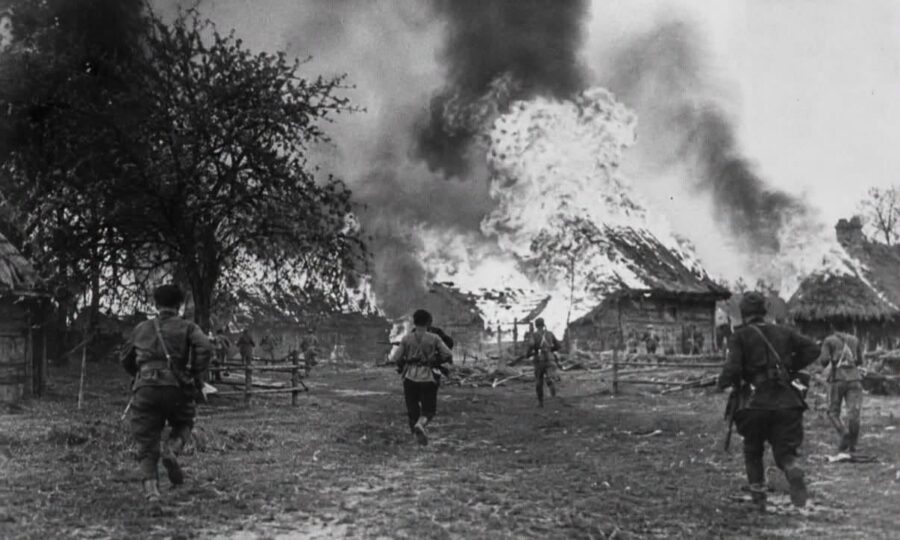
On 19 April 1943, an uprising began in the Warsaw Ghetto, which went down in history as the greatest act of armed resistance against the Holocaust. The Polish Jews fought against Nazi German troops. According to various estimates, some 13,000 Jews were killed in an unequal fight. The Jewish struggle was supported by attacks on German troops from the Polish Home Army.
From the earliest moments of the German occupation in 1939, Polish Jews were subjected to escalating terror and persecution. As the Luftwaffe bombarded Warsaw in September of that year, the city’s northern districts — home to approximately 360,000 Jewish residents — were among the primary targets.
By November 1939, the campaign of violence had intensified. The first mass execution of Jews in the capital took place that month, when 53 residents of a tenement on Nalewki Street were shot dead. The official pretext: the killing of a Blue Police officer.
Later that same month, the German authorities imposed a new decree requiring Jews to wear armbands bearing the Star of David. This marked the beginning of a series of discriminatory policies that pushed Jews out of public life. They were systematically dismissed from municipal offices and other institutions, including the legal profession. Some Polish lawyers who protested these measures were themselves arrested.
These events were only the beginning of what would become a relentless campaign of segregation, dispossession, and violence.
By the autumn of 1939, mere weeks after the German invasion of Poland, Nazi authorities imposed mandatory labour on Jewish citizens — a prelude to the full-scale forced labour system that, by the summer of 1940, would engulf over 100,000 people.
Simultaneously, the occupiers moved to establish Jewish administrative bodies such as the Warsaw Judenrat. These councils were tasked with implementing German decrees, often serving as intermediaries for increasingly repressive policies. One of the Judenrat’s earliest and most ominous assignments was to oversee preparations for building a wall that would seal off the area designated by the Germans as the Jewish district.
In March 1940, Adam Czerniaków, head of the Warsaw Judenrat, was officially informed of the plan to enclose the Jewish quarter. Seven months later, in October 1940, the Governor of the Warsaw District, Ludwig Fischer, issued orders to divide the city physically. As a result, 138,000 Jews were forced to relocate to the designated ghetto area, while 113,000 Polish residents were evicted from it.
The ghetto was officially sealed on the night of 15–16 November 1940. From that moment on, it became a closed district, increasingly cut off from the outside world and transformed over time into a zone of death. Its inhabitants, reliant on starvation-level food rations, began to perish in growing numbers.
In the following months, the ghetto boundaries were repeatedly redrawn, compressing its population into ever-smaller quarters. After the so-called Grossaktion — the mass deportation operation in the summer of 1942 — the ghetto’s size was drastically reduced, cementing its role as a site of systematic destruction.
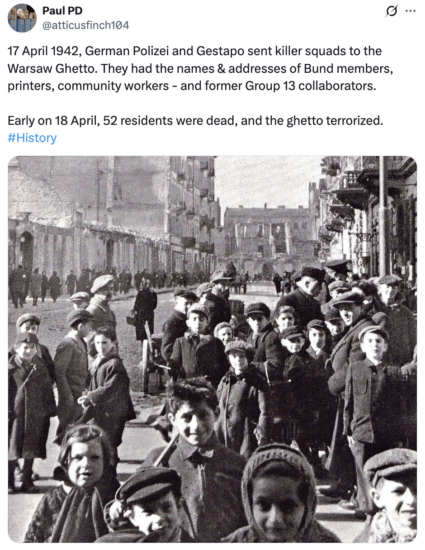
On 22 July 1942, Nazi authorities launched what became known as the “Grossaktion” — the Great Deportation — a key phase of Operation Reinhardt, the meticulously planned campaign by the Reich Main Security Office to annihilate Europe’s Jewish population.
Over just two months, approximately 300,000 Jews were forcibly removed from the Warsaw Ghetto and transported to the Treblinka extermination camp, where they were systematically murdered. An additional 10,000 people were executed within the ghetto itself.
By the end of the operation, the ghetto’s population had been slashed by nearly three-quarters. Only around 60,000 individuals remained within a drastically reduced area — most of them spared, temporarily, because they were employed in workshops and factories producing goods for the Nazi war effort. These survivors now lived under even harsher conditions, in a ghetto transformed into a prison-labour complex under the shadow of imminent death.
By the autumn of 1942, as the scale of Nazi atrocities became unmistakably clear, the remnants of the Warsaw Ghetto began preparing for a final stand. Political groups and emerging underground militias went into hiding, laying the groundwork for armed resistance.
Secret bunkers and shelters were hastily constructed beneath the ghetto’s war-ravaged streets — not only as places of refuge, but as future strongholds for defence against the anticipated German onslaught.
Two main resistance groups, the Jewish Military Union (Żydowski Związek Wojskowy) and the Jewish Combat Organisation (Żydowska Organizacja Bojowa), took the lead in these efforts. As part of their preparations, they also began eliminating individuals accused of collaborating with the Nazi occupiers, determined to root out betrayal from within before the decisive battle began.
On 18 April 1943, German military activity was observed near the borders of the Warsaw Ghetto. The underground resistance was quickly alerted — both by its surveillance and by intelligence from the Polish Home Army (Armia Krajowa). In response, resistance units began to mobilise.
At dawn on 19 April, German troops launched their assault. A force of 850 Waffen-SS soldiers, equipped with machine guns, flamethrowers, artillery, armoured vehicles, and tanks, entered the ghetto through the gate on Nalewki Street. But instead of finding a submissive population, they were met with fierce resistance.
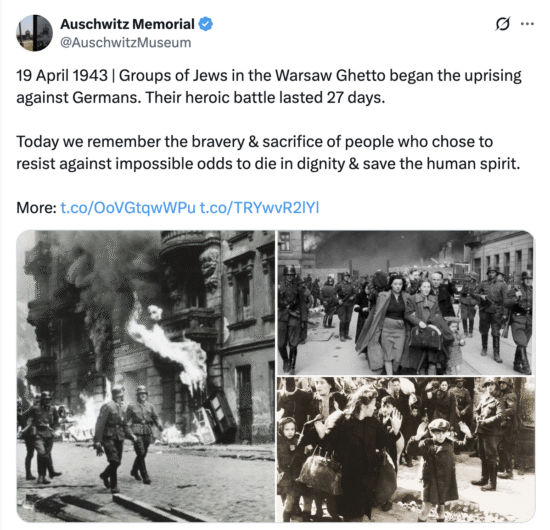
Jewish fighters — vastly outnumbered and outgunned — struck first, catching the attackers off guard and winning the opening clash. Their bold stand marked the beginning of the Warsaw Ghetto Uprising.
Later that same day, reinforced German units, under the command of senior SS officer Jürgen Stroop, returned to the ghetto in greater numbers and with heavier weaponry, determined to crush the revolt.
On the first day of the Warsaw Ghetto Uprising, the Polish underground sought to come to the aid of the Jewish fighters. Responding to the sounds of gunfire and explosions echoing from behind the ghetto walls on Monday, 19 April 1943, the Home Army (Armia Krajowa) ordered a 25-man unit to spring into action.
By around 6 p.m., sections of the group had reached the vicinity of Bonifraterska Street, near the ghetto wall. Approaching the area unnoticed proved surprisingly easy — large crowds of Warsaw residents had gathered along the perimeter to watch the inferno consuming the ghetto, inadvertently masking the movement of the resistance fighters.
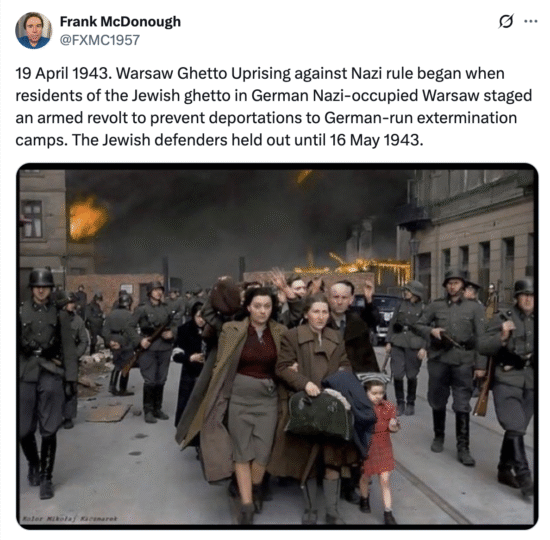
However, the illusion of opportunity quickly shattered. The entire zone was heavily fortified by German troops and the so-called Blue Police. As the Home Army unit attempted to move closer to the wall, they came under immediate fire. A fierce exchange of gunfire ensued, revealing just how tightly the Nazis had sealed off the besieged district. As a result of the action, two Polish soldiers died.
Evidence of Polish support during the Warsaw Ghetto Uprising can also be found in the official report of SS commander Jürgen Stroop, who oversaw the brutal liquidation operation. In his account, Stroop complained that efforts to crush the uprising were repeatedly hampered by the actions of what he called „Polish bandits” — a clear reference to underground resistance efforts outside the ghetto walls.
He further noted that Polish fighters had joined the battle at Muranowski Square, one of the uprising’s key flashpoints. It was there, according to Stroop, that a powerful symbol of solidarity appeared: two flags flying side by side above the ghetto — one bearing the Star of David, the other the Polish national colours.
As the uprising wore on, German forces gradually captured key bunkers that had served as centres of Jewish resistance. One of the last major confrontations took place near Franciszkańska Street and ended on 3 May, marking the close of large-scale fighting within the ghetto.
Just five days later, on 8 May, German troops discovered and surrounded a massive underground shelter at 18 Miła Street. Inside were several hundred people, including the leadership of the Jewish Combat Organisation (ŻOB) and over a hundred armed fighters. When ordered to surrender, the civilians emerged — but most of the resistance fighters, led by Commander Mordechai Anielewicz, chose suicide over capture.
Despite the collapse of central resistance, small isolated groups continued to fight well into May and June. For the Germans, the symbolic conclusion of what they saw as their “final mission to eliminate the Jews of Warsaw” came on 16 May, when they demolished the Great Synagogue on Tłomackie Street — a calculated act of destruction intended to mark the end of Jewish life in the city.
According to SS commander Jürgen Stroop’s reports, between 20 April and 16 May 1943, German forces uncovered more than 56,000 Jews hiding in bunkers throughout the Warsaw Ghetto. Around 7,000 were killed in combat during the raids, while a further 6,000 perished in fires or from smoke inhalation as bunkers were set ablaze or gassed.
Of the Jewish Combat Organisation (ŻOB) fighters, only a few dozen survived the uprising. Even fewer lived to see the end of the war. Among the handful of surviving leaders were Yitzhak Zuckerman and Marek Edelman, two of the last remaining members of the ŻOB command, who would go on to bear witness to one of the most powerful acts of resistance in Jewish history.
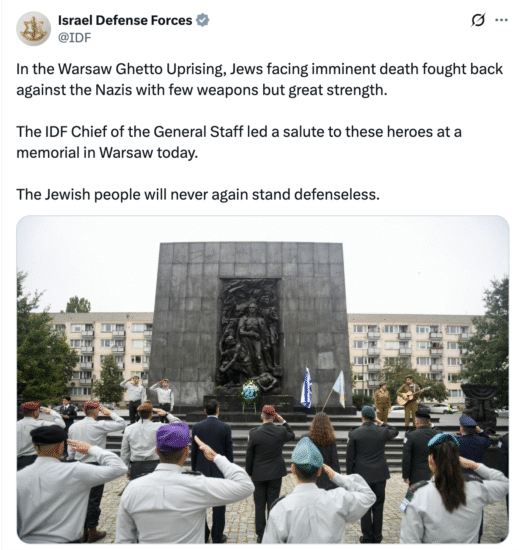
The fight in the Warsaw Ghetto remains one of the most important narratives shaping the ethos of modern Israeli armed forces, the IDF.
Source: Dzieje.pl
Photo: X @AuschwitzMuseum
Tomasz Modrzejewski