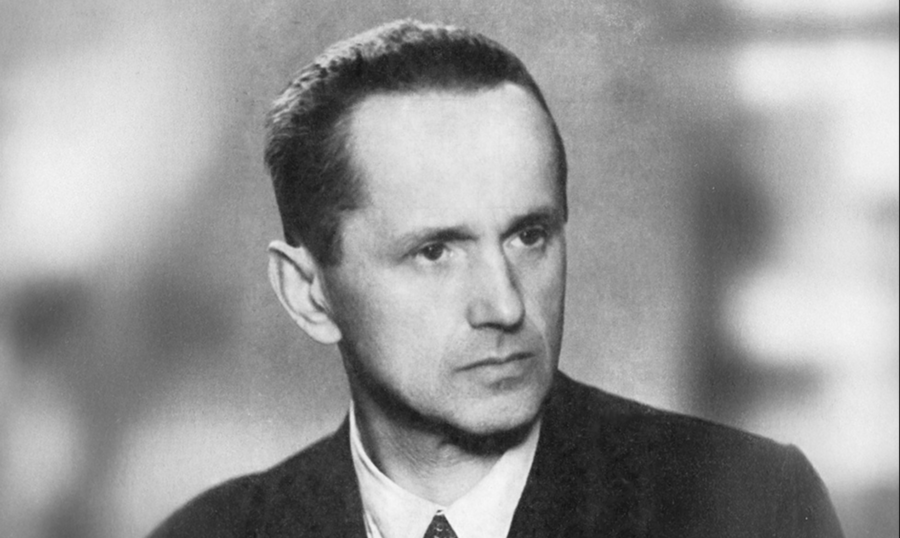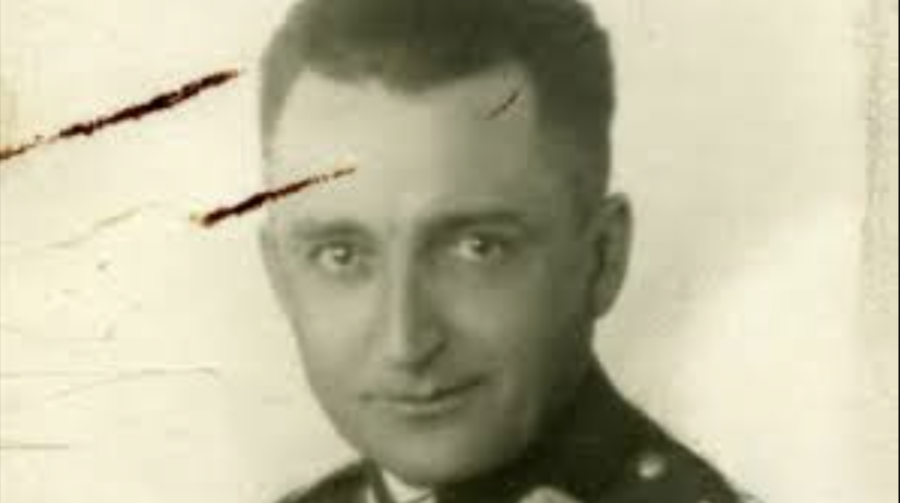
General August Fieldorf, widely known by his nom de guerre, “Nil,” remains one of Poland’s most venerated military figures. He symbolises unwavering patriotism, strategic brilliance, and the tragic cost of freedom. His life, marked by courageous leadership and profound sacrifice, encapsulates the turbulent history of Poland during the World War 2 and the first years of Stalinism.
Born on 20 March 1895, Fieldorf’s formative years were steeped in the struggle for Polish sovereignty. From an early age, he was exposed to the ideals of national independence and the harsh realities of a country under foreign dominion.
His decision to pursue a military career was driven not merely by personal ambition but by an earnest commitment to restoring Poland’s dignity on the global stage. After the outbreak of the First World War, on 6 August 1914 at the Oleandry in Kraków, he volunteered for the Polish Legions and went to the Russian front.
He saw the end of the Great War while serving with the Second Brigade of the Imperial Rifles until September 1918. After he moved on a leave he never returned to the Austro-Hungarian Army and joined the Polish Military Organisation in Kraków
Fieldorf worked on his skills in the interwar period. In the 1920s and 1930s, he remained in active service, serving in the 1st Infantry Regiment of the Legions in Vilnius.
Fieldorf’s military acumen and resolute character quickly propelled him through the ranks of the Polish armed forces. He demonstrated a keen understanding of conventional warfare and guerrilla tactics, a duality that later became a hallmark of his command style.
From 1938, he served as commander of the 51st Border Rifle Regiment in Brzeżany, at the head of which he fought in the Polish campaign of 1939.
As Germany invaded Poland in September 1939, Fieldorf emerged as a key leader in the resistance movement. Operating under the pseudonym “Nil,” his role in organising and directing underground military operations became central to the Polish struggle against occupation.
After the end of hostilities, he made his way through Hungary to France, where he completed staff courses and was promoted to colonel. Faced with the defeat of France, he evacuated to Great Britain.
The choice of “Nil” as his nom de guerre was symbolic as it showed his amazing journey of returning to Poland from England via South Africa and Egypt in 1940.
He arrived in occupied Poland at the beginning of September 1940. In the Union for Armed Struggle (ZWZ), he was initially an officer to the orders of the Commander-in-Chief, and later an inspector of the Kraków-Silesia area of the ZWZ. From February to August 1942, he was commander of Area II Bialystok of the Home Army.
Fieldorf was a key figure in shaping the strategies of the Home Army (Armia Krajowa), Poland’s (and Europe’s) largest resistance force. Under his leadership, small groups of fighters executed daring sabotage missions and coordinated intelligence efforts—moves that not only disrupted enemy operations but also sustained Polish morale during the bleakest moments of the war.
In April 1944. ‘Nil’ was given the task of creating, outside the structures of the Home Army, a secret organisation called “Niepodległość”, codenamed “NIE”. It was to be prepared for action in the event of the occupation of Polish lands by the Soviets.
Appointed to his new post, Fieldorf remained in deep conspiracy, taking no part in the Warsaw Uprising of 1944.
On 28 September 1944, he was promoted to the rank of brigadier general and awarded the Golden Cross of the Order of Virtuti Militari.
In October 1944, while commander of the ‘NIE’, he did not accept the post of Chief of Staff of the Home Army HQ.
After the Warsaw Uprising, acting Home Army Commander-in-Chief General Leopold Okulicki ‘Niedźwiadek’ appointed him as his deputy.
The end of World War II did not signal a peaceful resolution for Fieldorf. With Poland falling under the sway of a new, oppressive communist regime, the general found himself on the wrong side of political power.
On 7 March 1945, General Fieldorf was accidentally arrested by the NKVD in Milanówek under the occupation name Walenty Gdanicki. Unrecognised by the Soviet authorities, he was sent to a labour camp in the Urals.
After serving his sentence, he returned to Poland in October 1947 and settled under a false name in Biała Podlaska. He then stayed in Warsaw and Kraków and finally settled in Łódź.
In response to the amnesty announced in 1947, he disclosed himself as an ex-Home Army senior officer in February 1948.
Seen as a potential threat to the new order due to his prominent role in the underground resistance, Fieldorf was arrested by the communist authorities.
On 9 November 1950, General Fieldorf was detained by officers of the Ministry of Public Security in Łódź at Piotrkowska Street as he was leaving the Military District Headquarters building. He was then transported to Warsaw and imprisoned in the MBP detention centre on Koszykowa Street.
On 16 April 1952, in the building of the Provincial Court for the capital city of Warsaw, the ‘main hearing’ began. The court, composed of the presiding judge Maria Gurowska, jurors Michał Szymański and Bolesław Malinowski, found General Fieldorf guilty of the charges and sentenced him to death by hanging.
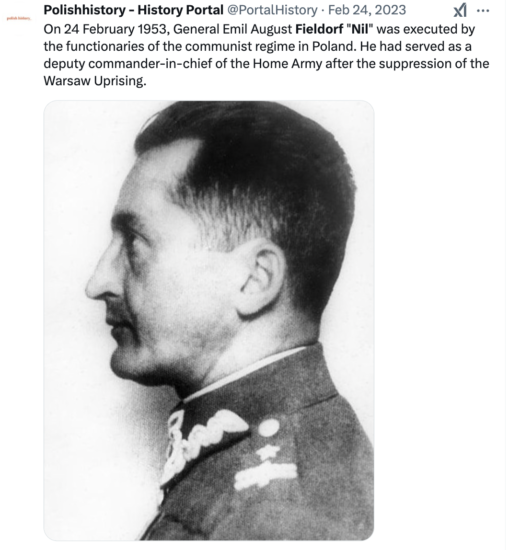
On 24 February 1953, General August Emil Fieldorf was hanged in the Mokotów prison in Warsaw. His body was buried in an unknown location.
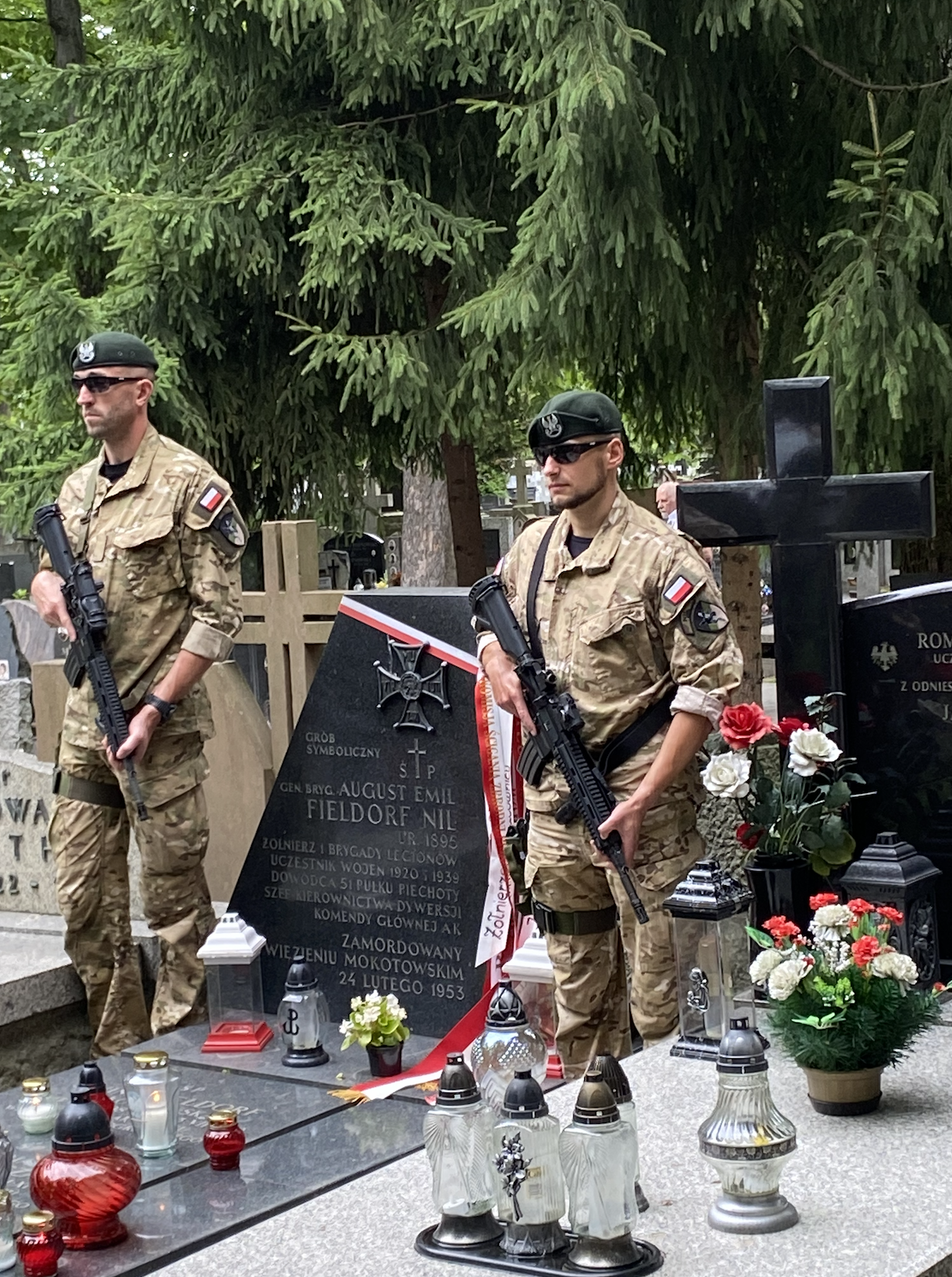
There are many indications that the immediate reason for the general’s death sentence was his refusal to cooperate with the communist authorities. Those responsible for the crime committed against General Fieldorf have not been punished.
In the years that followed, as Poland gradually emerged from the shadow of communism, public sentiment began to revere Fieldorf not as a dissident to be forgotten, but as a martyr whose sacrifice exemplified the highest ideals of patriotism and honour. His posthumous rehabilitation was not merely a legal correction but a profound reawakening of national pride. Statues, memorials, and scholarly works now celebrate Fieldorf’s life, ensuring that his story continues to inspire new generations.
Source: Dzieje.pl
Photo: IPN
Tomasz Modrzejewski