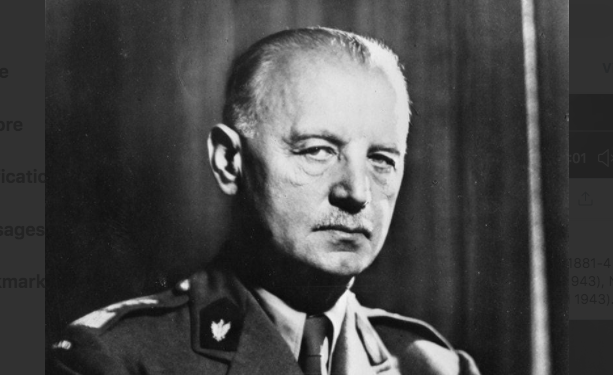
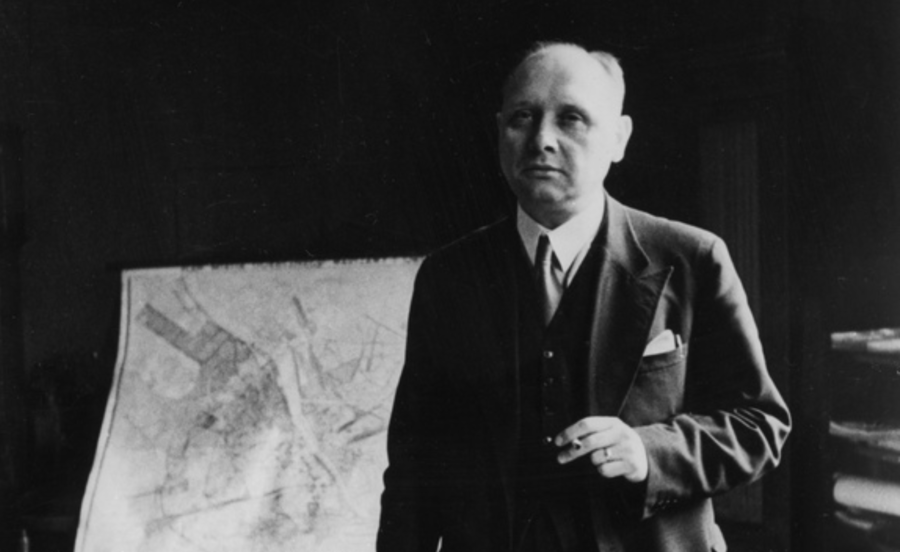
| Władysław Sikorski was born in Tuszów Narodowy in the Mielec poviat on 20 May 1881. He was a son of Tomasz Sikorski, a teacher in a folk school and Emilia née Albertowicz. In 1898 Władysław Sikorski began to attend the Teachers’ College in Rzeszów. At that time he lived at the College Headmaster Julian Zubczewski’s home. In 1902 Sikorski passed his final exam and enrolled on the Faculty of Civil Engineering at the Lviv Technical University. He graduated after five years. In 1904 he interrupted his studies and was called up into the Austrian Army for a one-year military service. In 1906 he has commissioned a second lieutenant.
He gave clandestine lectures on regular army tactics for the activists of the Polish Socialist Party. In 1908 he was a co-founder of the illegal Union for Armed Struggle (ZWC) and in 1910 a co-founder of its overt structure – the Rifle Association. In 1912, after the outburst of the Balkan War and the establishment of the Provisional Commission of Confederated Independence Parties, Sikorski became the Head of its Military Department. In 1914, in the face of imminent great war, he was called up into the Austrian army. Thanks to politicians’ mediation he was released from the service. On 9 August 1914 Sikorski joined the rifle units in Miechów. After the collapse of the idea of the anti-Russian uprising in the Congress Kingdom, he became involved in the creation of the Supreme National Committee (NKN), in which he took the office of the Head of its Military Department. He promoted the idea of the expansion of the Legions, in opposition to Józef Piłsudski, who was reluctant to see Polish regiments under Austrian command. After the dissolution of the Legions, Sikorski continued recruitment to the Polish Armed Forces (Polnische Wehrmacht), however, he opposed the appointment of German officers in such units.
In 1917, after the “oath crisis”, the 2nd Brigade of the Legions fought its way to the Russian side of the front in Rarańcza, but Sikorski was arrested. He was sent to the Huszt (Khust) detention camp, where he was put under trial. Thanks to the intervention of the Polish MPs in Vienna he was released from internment. In autumn 1918 he was staying in Lviv. He organised the relief of the city which was under the Ukrainian siege at that time. He took command of an operation group, which has taken Tarnopol and Brzeżany, reached as far as the Zbruch river.
At the beginning of 1920, Sikorski was appointed brigade general and commander of an operation group. Initially, his troops took the railway node in Mozyrz-Kalenkowicze, later covered the retreat of Polish forces from Kyiv and defended Brest (Brześć). On 6 August 1920, Sikorski was given command of the 5th Army which was then created ad hoc. Under his command, the army counter-attacked on the flank of the Soviet forces marching on Warsaw. In April 1921, Sikorski was promoted to the rank of Division General and appointed Commander of the General Staff of the Polish Army. After President Gabriel Narutowicz was assassinated in December 1922, Sikorski was appointed Prime Minister, taking control of the situation, as the country was under a threat of civil war. In the years 1924-1925 Sikorski was the Minister of Military Affairs. He restructured the army and provided it with modern equipment to make it one of the strongest in Europe at that time.
After a clash with Józef Piłsudski concerning the organisational system of the highest military authorities in 1925, Sikorski resigned from the post of the minister. He became the District Commander of the 6th Crops in Lviv. During the May Coup of 1926, he remained passive – he did not believe that the units faithful to the government would win but did not want to support his opponent. In 1928 he was removed from command and remained at the Minister of Military Affairs’ disposal, with no specific commission. At that time Sikorski published a number of works of interest for the development of military science. In 1936 he became involved in the formation of the Morges Front, created with the aim to restore a fully democratic system in Poland.
Neither in September 1939 was he appointed to any specific post. His efforts to persuade the Commander-in-Chief to get him involved failed. When the government authorities crossed the Romanian border, Sikorski decided to escape to Paris.
On 28 September 1939, Sikorski was asked to take command of newly formed Polish divisions. After Władysław Raczkiewicz took the post of the President of Poland, a meeting of Polish political leaders in Paris on 30 September decided to form the government in which Sikorski was appointed Prime Minister and the Minister for Military Affairs, then, in November 1939 also Commander-in-Chief. He started to organise the army. Soon he signed agreements on the establishment of Polish aircraft units in France and Great Britain and on the Polish Navy operations from British bases. As a result of his endeavours, four infantry divisions were formed in France and the Independent Carpathian Rifle Brigade was established in the Middle East. However, the French blocked the establishment of a larger mechanised unit.
At the same time, Sikorski started a diplomatic campaign to encourage Polish-American citizens in both Americas to join the army. He also talked with the President of Czechoslovakia Eduard Beneš about the future federation of the countries.
After the outbreak of the Finnish-Soviet war and France’s political involvement in the conflict, an idea to create expedition forces that would fight with Bolsheviks was launched. The Independent Podhale Rife Brigade was planned to be part of such forces. However, when the expedition corps was ready for battle, the war in Finland came to an end. Instead, the Brigade took part in the intervention in Norway which was then invaded by the 3rd Reich.
Despite the victory in the battle of Narvik, Norway was defeated and the Brigade was evacuated to France which was about to capitulate. At that time Sikorski tried to persuade one French general after another to undertake a counteroffensive in the south of the country, however with no effect. Finally, on 18 June 1940 he gave the order to the Union of Armed Struggle to continue fighting in the country, while all Polish army units were ordered to march towards the ports from which they would be evacuated to the British Islands. Sikorski also decided to fly to London.
Remembering the negative feelings of Poles when Marshal Edward Rydz-Śmigły left the army which was still fighting, he left an option to return to France by the same plane within 48 hrs open. In the talks with the new British Prime Minister Winston Churchill, Sikorski was ensured that the British would continue war actions. He returned to Libourne, organised the retreat of the last dispersed Polish units. British troopships were expected to wait for them in the ports of the British Channel and in the south of France. Then he flew back to London.
Great Britain renewed his efforts to recreate larger units of the Polish Army. The aircraft and navy personnel, which had been evacuated almost in their entirety, was soon reorganised and used in military actions. The remaining land forces patrolled the shoreline and prepared anti-landing defence in Scotland. With time the 1st Armoured Division and the Independent Parachute Brigade were formed on the basis of those units.
aaaaAfter the German invasion of the USSR, Sikorski gave a speech
on the radio. He addressed the existing Polish-Soviet conflict but proposed an anti-Nazi alliance. After the lengthy and difficult negotiations, on 30 July 1941 Sikorski and the Soviet ambassador Ivan Maisky signed an agreement restoring the relations between the new allies. The agreement did not contain a guarantee for the Polish eastern frontier, however, a protocol was annexed to it ensuring that all Poles detained in the USSR would be released and a Polish army under General Władysław Anders’s command would be allowed to form.
Autumn 1941, Sikorski visited the USSR. First, he went to Cairo by plane and from there, on board of a destroyer, to Tobruk which was under siege at that time. Sikorski was the only leader of the allied forces of such a high rank to visit the soldiers who fought there –“the Tobruk Rats”, as they liked to be called – in their very nest. Then he flew to Kuibyshev and Moscow. At that time the Germans were so close to Moscow that commanders of their armoured units could watch the city through their field glasses. Talking with Stalin face to face, Sikorski managed to obtain his consent for adding two more divisions to the existing army and for the withdrawal of a contingent of military experts to Palestine and the United Kingdom. They also agreed on the rule that war criminals would be punished after the victory.
Unfortunately, Sikorski’s political plans soon fell in ruin. General Anders’s army actually never fought on the Eastern Front, being withdrawn to Iraq instead. Sikorski’s efforts to mobilise American Poles did not bring the results expected. His talks with the President of the USA about the shape of a post-war Europe ended in a fiasco. Franklin Delano Roosevelt did not agree to take Eastern Prussia from the Germans and give it to Poland. The Czechs withdrew from negotiations about the confederation in post-war Europe. When the Germans announced the discovery of mass graves of Polish officers in Katyń in Spring 1943, Polish-Soviet diplomatic relations were broken, and what followed the issue of the Polish Eastern Borderland was suspended in a political void.
Having heard the news about unrest in the army in the Middle East (mainly around the issue of the Polish-Soviet relations and the Eastern Borderland), Sikorski decided to make an inspection of the Polish Army in the East. In the last week of May 1943, he set off for Egypt and Palestine. Throughout a month he was visiting units which exercised on the desert and schools in which young people evacuated from the USSR were trained. In the course of his inspection, Sikorski managed to calm down the spirits, so the political disputes among the officers receded into the background. On his way back to London, Sikorski met with the Polish officers and soldiers, who, on their way from France to Great Britain via Spain, had been set in a detention camp of Miranda del Ebro, then managed to escape and get to Gibraltar.
On 4 July 1943, just before midnight, a Liberator AL 523 from a special transport division for VIPs, with a Czech pilot Captain Eduard Prchal, set off from the runway at the foot of the legendary rock. Sixteen seconds later, the plane fell into the sea from the height of 300 hundred feet. A rescue action was undertaken immediately but with no success. Only the pilot was saved while all the passengers, including Prime Minister Sikorski and his daughter Zofia Leśniowska, were killed.
A British court of inquiry was set up to examine the circumstances which led to the plane crash. The investigators ruled out sabotage, adopting the version of an accident in which jammed elevator controls were to be blamed (incidentally such a system was not used in Liberators). Since the documents of the court still remain secret, speculations about the true reasons of the crash continue to reappear. The British, German and Soviet intelligence as well as some Polish political circles hostile to Sikorski have been accused of the assassination of the Polish Prime Minister, however, the true reasons of the tragedy are still wrapped in a shroud of mystery. |